Is Wireless Auscultation Reliable? What Clinical Studies and Doctors Say

Introduction
Healthcare is evolving, and clinicians are embracing tools that make their work more accurate and efficient. Wireless auscultation is one such advancement, allowing doctors to capture and listen to heart and lung sounds clearly and confidently.
While traditional acoustic stethoscopes remain essential in clinical practice, they have limitations, especially in busy environments like outpatient departments (OPDs), rural health centers, and health camps, where high ambient noise, patient movement, and infection control requirements can interfere with effective auscultation.
This growing interest in wireless stethoscopes among senior clinicians raises an important question: how reliable is wireless auscultation compared to traditional methods? In this blog, we explore the clinical evidence, physician experiences, and technological features that inform the reliability and utility of wireless auscultation in modern healthcare.
Understanding Wireless Auscultation in Clinical Practice
What Is Wireless Auscultation?
Wireless auscultation is essentially a modern electronic stethoscope powered by microphones and digital technology for clearer listening. In some advanced systems, digital processing can further enhance captured sounds and generate visual representations such as phonocardiograms.
Body sounds are captured using high-quality microphones and converted into digital signals. These signals can then be amplified, analyzed, and viewed on connected devices like tablets, smartphones, or computers for review and professional interpretation.
Typically, Bluetooth is used to transfer sounds from the device to a nearby phone or tablet in real time, while internet connectivity is used when sharing recordings with doctors in different locations.
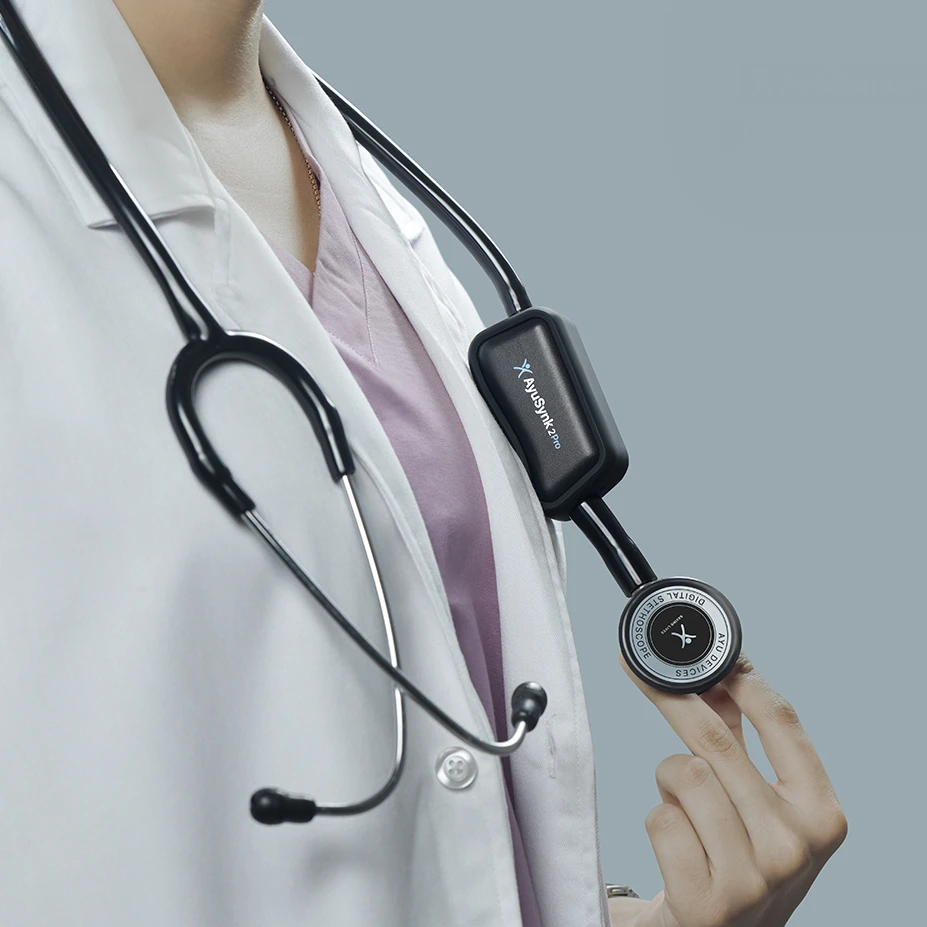
Devices like the AyuSynk 2 Pro Advance further enhance this process with high-fidelity sound capture, advanced noise reduction, and the ability to record, visualize, and share auscultation data seamlessly across care teams.
Importantly, wireless auscultation supports clinicians rather than replacing their judgment. It complements traditional auscultation by providing a clearer, more accessible way to interpret subtle heart or lung sounds.
Key Concerns Raised by Senior Clinicians
Accuracy Compared to Traditional Acoustic Stethoscopes
Some clinicians initially questioned whether digital processing could accurately capture the subtle heart and lung sounds captured by conventional stethoscopes. Concerns include:
- Sound may sometimes be electronic due to amplification or digital processing.
- AI stethoscopes can effectively detect subtle sounds like heart murmurs, fine crackles, or faint breath sounds, showing diagnostic performance similar to traditional stethoscopes.
But according to research, AI-assisted wireless stethoscopes can produce sound fidelity that is on par with or even better than traditional stethoscopes in controlled situations and with devices that are calibrated correctly.
Reliability in Different Clinical Environments
Wireless auscultation is very helpful in difficult settings like:
- Hospital wards and busy OPDs
- ICUs, or intensive care units
- Outreach health camps and rural health centers
Digital stethoscopes maintain clear auscultation in these situations, allowing for prompt clinical decisions, while traditional stethoscopes frequently falter due to background noise, patient movement, or proximity restrictions.
Interpretation of Digital Waveforms
Wireless auscultation devices often include waveform visualization, which can make interpreting heart and lung sounds easier. Still, these waveforms are meant to support and not replace what doctors hear with a traditional stethoscope. By combining post-processed data with careful listening, clinicians can make more informed decisions while using technology responsibly in everyday practice.
Reliable auscultation even in challenging clinical environments
What Clinical Studies Indicate About Wireless Auscultation
Evidence on Sound Quality and Signal Enhancement
Clinical research shows that contemporary digital stethoscopes have the following benefits:
- Improved sound quality through noise reduction and amplification
- Enhanced ability to identify minor pulmonary and cardiac problems
- Auscultation consistency across diverse contexts and users
Analyses of wireless and acoustic devices show that, in high-risk or noisy environments, digital processing can perform better than traditional stethoscopes without sacrificing diagnostic confidence.
Diagnostic Support Rather Than Replacement
Research consistently positions wireless auscultation as a supportive tool, reinforcing doctor-led diagnosis. Benefits include:
- Reliable documentation for follow-up and peer review
- Enhanced consistency across multi-physician assessments
- Ability to integrate findings into broader digital workflows
Insights from Practicing Doctors
Feedback from Senior Clinicians and Specialists
Clinicians who have used digital stethoscopes report:
- Improved sound clarity, particularly for faint heart and lung sounds
- Repeatable results that reduce subjectivity
- Confidence in diagnosing complex cases with supportive waveform visualization
Value of Recording and Review
The ability to capture auscultation sessions adds significant clinical value:
- Reviewing findings helps improve accuracy and minimize the risk of misdiagnosis.
- It encourages peer review and collaboration across multidisciplinary teams.
- It serves as a valuable teaching tool, allowing medical trainees to learn from patient cases.
Role of Post-Processing and Phonocardiograms
Why Post-Processed Data Matters
Post-processing converts captured body sounds into digital waveforms such as phonocardiograms and spectrograms, making interpretation easier. These phonocardiograms allow clinicians to:
- Connect visual patterns with audio results.
- Review borderline or subtle abnormalities more confidently
- Share findings securely for consultation without losing context
Understanding the Limitations
While digital waveforms are useful, clinicians are reminded that:
- They cannot replace live listening
- Clinical judgment remains central
- Post-processing is a supplementary tool, not a standalone diagnostic measure
Wireless Auscultation in High-Risk and Sensitive Scenarios
Wireless auscultation is particularly advantageous in:
- Infectious diseases like tuberculosis or airborne viral infections
- Pandemic settings requiring minimal clinician-patient contact
- Severely injured patients where proximity is limited
- Pediatric patients, where caregiver or parents’ presence is essential for comfort
In such cases, maintaining distance without compromising diagnostic quality is critical.
Institutional Considerations for Adoption
Standardization and Clinical Governance
Successful implementation requires:
- Protocol-based usage and training
- Clinician familiarization with device capabilities
- Integration into existing clinical workflows
Data Management and EMR Integration
Digital auscultation often allow:
- Secure storage of recordings
- Integration into electronic medical records (EMRs)
- Longitudinal tracking for patient monitoring and audit purposes
Wireless Auscultation as the most preferred Clinical Tool
Modern digital stethoscopes use advanced electronics, AI, and high-quality audio to deliver clear, reliable results. While they may cost more upfront, their ability to improve clinical decisions, patient safety, and record-keeping makes them a worthwhile investment, especially for healthcare institutions focused on quality and efficiency.
Conclusion
When used appropriately, wireless auscultation is a reliable, clinically validated tool that complements traditional auscultation. Clinical studies and feedback from senior physicians confirm its value in:
- Enhancing sound clarity in noisy or high-risk settings
- Supporting safe distance examinations
- Enabling accurate documentation, peer review, and training
For hospitals, clinics, and health programs in busy OPDs, rural centers, or outreach camps, wireless auscultation strengthens diagnostic confidence, collaboration, and overall quality of care making it a valuable tool for improving diagnostic accuracy, enabling collaboration, and strengthening overall quality of care..
Advanced solutions like the AyuSynk 2 Pro Advance bring together real-time auscultation, AI-supported analysis, and unlimited recording capabilities, making them highly reliable tools for modern clinical environments.
Clinically trusted digital auscultation for confident patient care

Dr. Ankit Kadarge
Dr. Ankit Kadarge is a writer, and Clinical Product Manager in MedTech who believes healthcare should be simple and understandable for everyone. He started his journey at Oxford Medical College, Bangalore, and soon discovered a love for writing, publishing over 20 articles with MedBound to make medical knowledge accessible.
Previously he has worked at ACKO, leading the life insurance vertical as a pilot doctor, where he gained a deeper understanding of how people experience and sometimes misunderstand healthcare. Today, he builds solutions that solve real problems for doctors and patients, blending his medical knowledge with product thinking.
On his blog, Ankit shares his experiences, learnings, and reflections on healthcare always in a way that’s easy to read and relate to.