How Remote Auscultation in Rural Healthcare Is Transforming Telehealth Delivery

Introduction
Video consultations have expanded access to clinicians, but they cannot reproduce every part of an in-person clinical assessment. A remote doctor can see the patient and discuss symptoms.
Yet the doctor cannot listen to heart or lung sounds.
This is unless the patient-side facility has the right equipment and trained support.
Remote auscultation in rural healthcare fills this gap. It lets staff record body sounds at a local clinic, telemedicine station, or field site. A clinician can review the sounds from another location.
The workflow can be live or asynchronous. Its value depends on correct device placement and clear sound quality. It also needs a clear clinical protocol. An appropriate clinician must review transmitted or recorded sounds on time.
What Is Remote Auscultation in Rural Healthcare?
Remote auscultation involves capturing and transmitting heart or lung sounds from the patient’s location to a clinician elsewhere. A digital stethoscope converts physiological sounds into electronic signals that can be amplified, recorded, stored, or transmitted.
A typical rural workflow includes:
- Trained clinical support: A nurse, health worker, paramedic, physician, clinical assistant, care provider, or clinical care coordinator places the device at standard auscultation points.
- Digital sound capture: The stethoscope captures and amplifies physiological sounds using the appropriate heart or lung mode.
- Live or recorded transmission: Sounds are transmitted during the consultation or recorded for later review when connectivity is limited.
- Remote clinical review: A reviewing clinician listens to the sound alongside the patient history, symptoms, and available measurements.
- Documentation and follow-up: Recordings and notes are stored according to the patient’s clinical and privacy protocol.
Why It Matters for Rural Telehealth
Video-only telehealth is useful for history-taking, visual assessment, follow-up conversations, and care coordination. It remains limited when a cardiac or respiratory presentation requires direct listening.
- Specialist access: A remote clinician can review sounds without requiring every patient to travel immediately to a higher-level facility.
- Better clinical context: Heart and lung sounds add information that symptoms and video alone cannot provide.
- Follow-up continuity: Recorded sounds can provide an audio reference when patients with chronic conditions return for review.
- Flexible connectivity: Medical professionals can use live transmission where networks are stable and recorded review where they are not.
- Structured escalation: The reviewing clinician can advise whether local management, further testing, or in-person referral is appropriate.
How the Remote Auscultation Workflow Operates
Step 1: Prepare the Patient and Device
The trained care provider explains the procedure, reduces avoidable environmental noise, and positions the patient appropriately. Charge the device, connect it, prepare it for use, and link it to the correct patient record.
Step 2: Capture Heart or Lung Sounds
The care provider follows the agreed auscultation positions. Amplification and the right heart or lung mode may improve hearing, but they cannot fix poor placement. They also cannot fix patient movement or poor listening technique.
Step 3: Transmit Live or Record for Review
During live tele-auscultation, the clinician can listen in real time. The clinician can ask the care provider to reposition the device. The clinician can also ask to repeat the recording if needed. Where connectivity is inconsistent, clinicians may record physiological sounds and share them later for asynchronous review.
Step 4: Clinical Review
The clinician reviews the recorded or transmitted physiological sounds alongside the patient’s history, symptoms, clinical assessment findings, and available investigations.
The AyuShare app presents recorded sound waveforms and spectrograms alongside the audio to support visual and sound correlation.
Step 5: Document the Plan
The clinician documents the findings from the remote review, along with recommendations, referral decisions, and the follow-up plan. Establish clear escalation protocols before implementation so medical professionals can identify when remote assessment is insufficient and requires an in-person evaluation.
Implementation Requirements
- Appropriate device: Choose a digital stethoscope that supports live, recorded, or hybrid remote auscultation. It should include proper amplification and heart and lung modes.
- Care-provider training: Training should cover patient preparation, correct placement, recording quality, patient-record accuracy, repeat capture, and escalation requirements.
- Connectivity plan: Assess each care environment and determine whether real-time, asynchronous, or hybrid clinical review is practical.
- Clinician availability: Define who will review the recordings, the expected review time, and the applicable referral or escalation pathway.
- Clinical data protocols: Patient identification, consent, access, storage, and sharing should follow the healthcare organisation’s requirements.
- Device readiness: Devices should remain charged, clean, functional, and available at the patient’s location.
Extend clinical listening beyond the hospital walls.
Video Teleconsultation vs Teleconsultation with Remote Auscultation
| Clinical Component | Video Teleconsultation | Teleconsultation with Remote Auscultation |
|---|---|---|
| Patient history and symptoms | Can be discussed remotely | Can be discussed alongside auscultation findings |
| Visual assessment | Supported through video | Supported through video |
| Heart and lung sound review | Not available through video alone | Physiological sounds can be captured and reviewed |
| Live clinical guidance | Limited to verbal and visual instructions | The clinician can request repositioning or repeat capture |
| Recording and playback | Physiological sounds are not recorded | Heart or lung sounds can be stored and replayed |
| Follow-up reference | Relies mainly on notes and other findings | Patient-linked audio may support later review |
| Connectivity requirement | Requires a stable video connection | Live review needs stable connectivity; recordings can be shared later |
| Support at the patient’s location | May only require assistance with the video consultation | Requires a trained care provider and digital stethoscope |
| Clinical limitation | Does not include auscultation | Does not replace in-person assessment when escalation is necessary |
How AyuSynk Digisteth Supports Rural Remote Auscultation
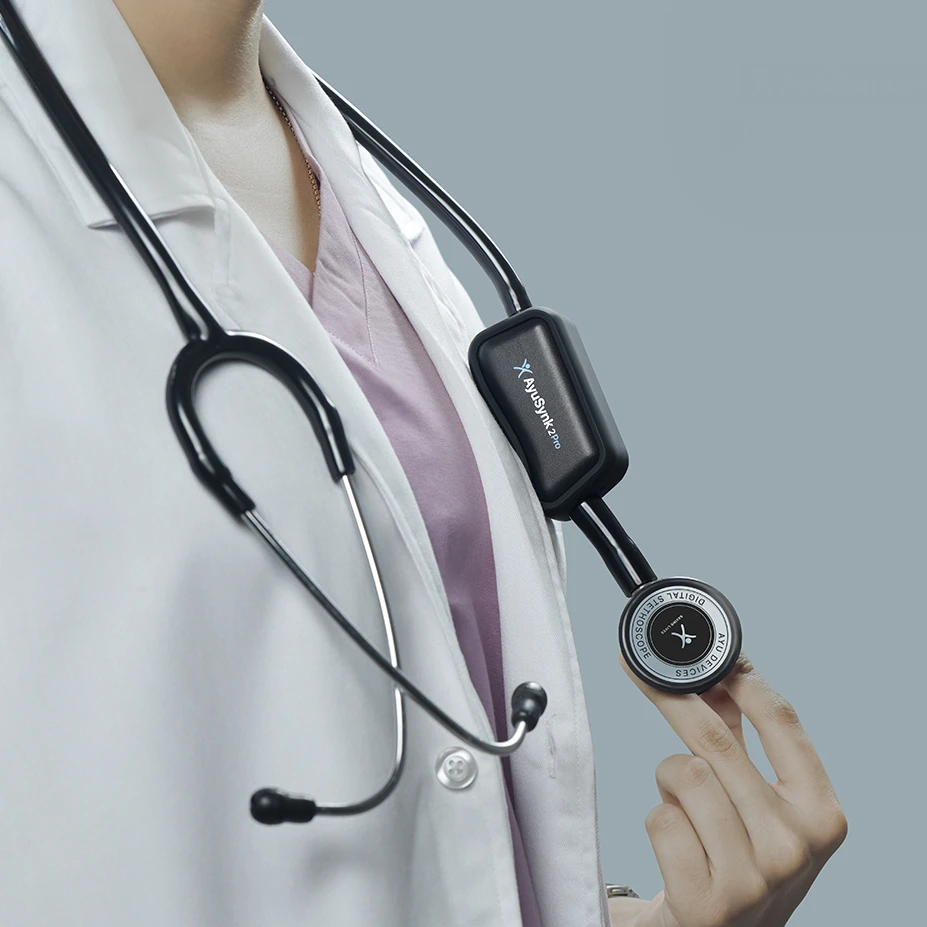
AyuSynk 2 Pro Advance supports tele-auscultation workflows in which a trained care provider or clinical care coordinator is present with the patient while a clinician listens from another location.
It provides up to 60x amplification, dedicated heart and lung modes, real-time noise cancellation, recording, and live transmission. Real-time tele-auscultation can be conducted across the globe, provided suitable connectivity and an appropriate clinical setup are available.
The AyuShare app supports patient-linked recording management, playback, clinical notes, and report generation. When pulmonary sounds are reviewed, the waveform may help the clinician relate visual changes to the corresponding audio. Respiratory interpretation must remain based on auscultation along with the patient’s complete clinical context.
Practical Use Cases
- Primary health centre consultations: A trained care provider captures physiological sounds at the primary health centre while a district or urban clinician reviews them live or at a later time.
- Telemedicine kiosks: A technically trained clinical assistant uses a digital stethoscope to add auscultation to a consultation conducted through a telemedicine kiosk.
- Health camps and community outreach: Care teams can record physiological sounds and arrange review by a specialist clinician when one is not available at the point of care.
- Chronic disease follow-up: Patient-linked recordings may provide an audio reference during clinically relevant follow-up assessments.
- NGO and public-health services: Standardised devices, care-provider training, and defined escalation protocols can support consistent remote auscultation across multiple care locations.
Practical Considerations and Limitations
- A trained operator is essential: Remote listening is only as useful as the patient-side placement and capture quality.
- The device must be with the patient: A standard video call cannot provide auscultation without a digital stethoscope at the patient location.
- Connectivity determines the workflow: Unstable networks may make recorded review more reliable than live transmission.
- Clinical context remains necessary: A sound recording should not be interpreted without the patient’s history, symptoms, clinical assessment findings, and relevant investigations.
- Lung-sound AI remains under development: AyuSynk digisteth does not currently provide AI-based lung-sound classification. This capability requires sufficient clinically validated data before it can be used responsibly.
- Remote review does not replace escalation: Some patients still require urgent transfer, imaging, laboratory testing, or in-person specialist assessment.
Conclusion
Remote auscultation makes rural telehealth more clinically complete by adding heart- and lung-sound listening to remote consultations. It can support access, follow-up, and referral decisions when the patient-side device, operator training, reviewer availability, and documentation process are all in place.
The AyuSynk 2 Pro Advance supports live tele-auscultation and recorded review, while AyuSynk 2+ can support local safe-distance listening and asynchronous workflows. In every model, auscultation remains clinician-led and dependent on correct capture and clinical context.
Frequently Asked Questions
What is remote auscultation in rural healthcare?
It uses a digital stethoscope at the patient location to capture heart or lung sounds for review by a clinician elsewhere. Sounds may be transmitted live or recorded for later review.
Who must be present with the patient?
A trained nurse, health worker, paramedic, or clinician must place and operate the digital stethoscope. Correct positioning is essential for a clinically useful recording.
Does remote auscultation require continuous internet access?
Live tele-auscultation requires a stable connection. Where connectivity is intermittent, recordings may be uploaded later for asynchronous review.
When is an in-person assessment required after remote auscultation?
An in-person assessment may be required when the sound quality is inadequate, urgent escalation is necessary, or the clinician requires imaging, laboratory investigations, physical evaluation, or treatment that cannot be completed remotely.
Which AyuSynk digisteth device supports real-time long-distance tele-auscultation?
AyuSynk 2 Pro Advance supports real-time tele-auscultation across the globe, subject to the patient-side setup and connectivity.
Bring clinical listening into rural telehealth workflows.

Dr. Ankit Kadarge
Dr. Ankit Kadarge is a writer, and Clinical Product Manager in MedTech who believes healthcare should be simple and understandable for everyone. He started his journey at Oxford Medical College, Bangalore, and soon discovered a love for writing, publishing over 20 articles with MedBound to make medical knowledge accessible.
Previously he has worked at ACKO, leading the life insurance vertical as a pilot doctor, where he gained a deeper understanding of how people experience and sometimes misunderstand healthcare. Today, he builds solutions that solve real problems for doctors and patients, blending his medical knowledge with product thinking.
On his blog, Ankit shares his experiences, learnings, and reflections on healthcare always in a way that’s easy to read and relate to.