Top Benefits of Using an AI-Powered Wireless Stethoscope in Clinical Practice

Introduction
Modern healthcare demands accurate, efficient, and safe auscultation. With rising patient numbers, noisy outpatient departments (OPDs), busy hospital wards, and high-risk environments like ICUs, traditional acoustic stethoscopes often fall short.
AI-powered wireless stethoscopes are emerging as a practical solution, combining the reliability of conventional auscultation with advanced digital signal processing and AI algorithms. These tools support clinical decision-making by improving sound clarity and documentation, bringing objectivity to the physician’s judgment.
In this blog, we explore how AI stethoscopes are improving clinical work, patient safety, and collaboration among healthcare teams.
Understanding AI-Powered Wireless Stethoscopes
What Is an AI Stethoscope?
An AI stethoscope, such as AyuSynk 2+, is more than just a smart device. It uses built-in microphones to capture heart and lung sounds, processes them, and converts them into digital signals for clearer listening and analysis.
These sounds are analyzed by AI and machine learning algorithms to improve clarity, reduce background noise, and provide graphic phonocardiograms. This keeps clinicians’ clinical experience at the center of diagnosis while enabling them to confidently detect subtle, low-grade (Grade 1-2) murmurs or lung abnormalities.
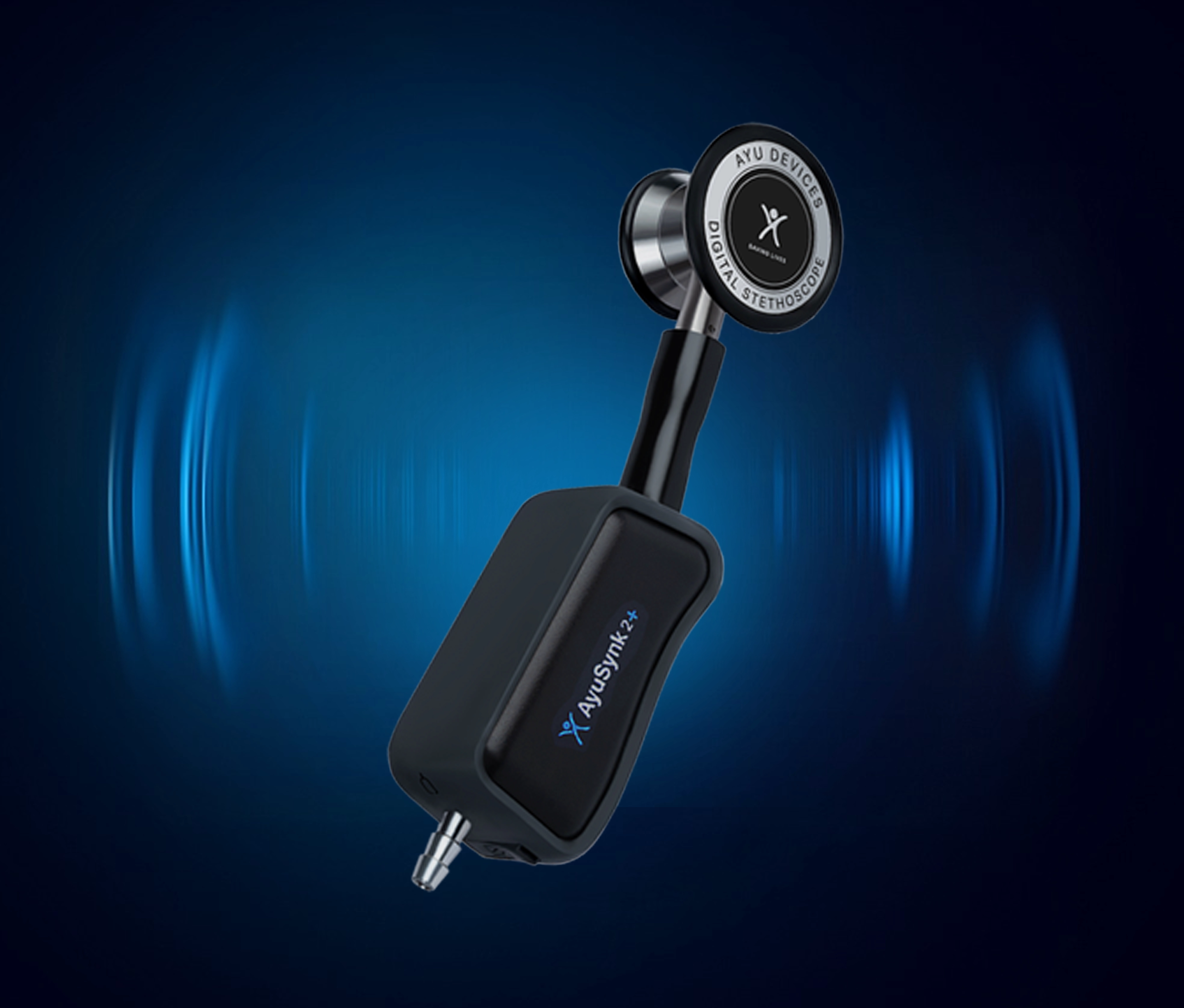
How an AI-Powered Wireless Stethoscope Works in Clinical Settings
AI stethoscopes use digital technology to capture heart and lung sounds, allowing clinicians to examine patients while maintaining a safe physical distance of ten meters. This is especially helpful in:
- Rural health centers and busy OPDs
- Individuals suffering from infectious diseases such as TB
- Children or patients in serious condition
Crucially, these devices guarantee sound quality and dependability in clinical settings because they are built for professional medical use.
Key Clinical Challenges in Traditional Auscultation
Even skilled clinicians face limitations with conventional stethoscopes:
Environmental Noise and Sound Interference
Because of the noise at OPDs, ICUs, and healthcare centres, it might be challenging to hear faint lung and heart sounds. The performance of devices like AyuSynk 2+ address this limitation with advanced amplification and noise reduction, delivering clearer, high-fidelity audio for improved clinical assessment.
Close-Contact Limitations in Certain Patient Scenarios
Doctors often need to examine patients with open wounds, serious injuries, or infectious diseases, which can raise safety and hygiene concerns. Wireless stethoscopes allow doctors to keep a safer distance, of about 10 meters, while still listening clearly and making accurate diagnoses.
Subjectivity and Documentation Gaps
Conventional auscultation mostly depends on the memory and expertise of the doctor. Reviewing, comparing, and sharing results for collaborative care is challenging, which can create subjectivity in the clinical diagnosis.
Smarter auscultation with clarity, safety, and confidence
Core Benefits of Using an AI-Powered Wireless Stethoscope
Enhanced Sound Clarity with Noise Suppression
AI-powered stethoscopes reduce background noise, even in high-volume settings like OPDs or rural health camps. Subtle heart murmurs or fine lung sounds become easier to detect with up to 60x amplification and dedicated Heart or Lung frequency filters.
Safe Distant Auscultation
Digital technology allows clinicians to listen from a safe distance, making examinations safer and more comfortable for both patients and staff. This is particularly valuable for:
- Pediatric patients who are more comfortable with their parents during check-ups
- Patients with open wounds or severe injuries
- Infectious conditions such as TB
- Airborne infection scenarios, including pandemics
For example, devices like the AyuSynk 2+ support safe-distance auscultation within a limited range using Bluetooth, making them suitable for real-time listening in the same room.
AI-Assisted Sound Processing and Visualization
While live auscultation waveforms are harder to interpret, AI-processed recordings generate phonocardiograms and spectrograms, making it easier to classify S1, S2, systole, and diastole accurately for diagnosis, teaching, or consultation purposes
Recording, Reporting, and Clinical Collaboration
Auscultation Recording and Report Generation
AI stethoscopes allow clinicians to generate structured reports from captured sounds, with visual phonocardiograms for better interpretation. This supports better clinical documentation and follow-up.
Peer Review and Collaborative Diagnosis
Reports and recordings from AI stethoscopes can be shared with colleagues over the internet for consultations or second opinions. Sounds can be securely shared via apps like AyuShare using cloud-based links, enabling seamless remote consultations and second opinions.
EMR Integration for Continuity of Care
Digital auscultation records can be integrated into electronic medical records (EMRs), allowing longitudinal tracking, audits, and more structured patient follow-ups.
Everyday Use in Clinical Practice
Clinics and OPDs
AI stethoscopes help doctors work faster and more comfortably in busy clinics. They let doctors move easily from one patient to another while still listening to heart and lung sounds clearly and accurately.
Teaching and Clinical Training
Recorded sounds can be used for education and case discussions, helping junior doctors and trainees learn from patient data, correlate auditory findings with visual phonocardiograms, and improve their auscultation skills.
Making AI-Powered Wireless Stethoscopes Accessible and Impactful
Feature-Rich Performance for Better Diagnosis
AI-driven sound enhancement, secure recording, and visualization tools make these devices reliable clinical aids, improving diagnostic accuracy and ease of use.
Cost-Effective Solution for Widespread Healthcare Access
Digital stethoscopes combine advanced features, user comfort, and accuracy at a highly cost-effective price point. Compared to other medical technologies that remain inaccessible in many parts of India, they support better care delivery in rural areas while helping reduce the overall economic burden on healthcare systems.
Why Clinics and Doctors Are Adopting AI Stethoscopes
- Improved diagnostic confidence through AI-assisted analysis
- Enhanced patient safety and comfort during examinations
- Better documentation and collaboration through secure recordings
- Alignment with digital, data-driven healthcare workflows
By integrating AI-powered wireless stethoscopes, clinics can modernize their diagnostic capabilities while maintaining high standards of patient care.
Conclusion
AI-powered wireless stethoscopes are transforming auscultation in modern clinical practice. They combine the familiarity of traditional stethoscopes with AI-enhanced sound clarity, safer patient interactions, and documentation support, without replacing the doctor’s judgment.
For clinics and practising doctors, adopting an AI stethoscope improves clinical outcomes, workflow efficiency, and patient satisfaction, while preparing healthcare teams for a more connected, data-driven future.
Better diagnostics through AI stethoscopes

Dr. Ankit Kadarge
Dr. Ankit Kadarge is a writer, and Clinical Product Manager in MedTech who believes healthcare should be simple and understandable for everyone. He started his journey at Oxford Medical College, Bangalore, and soon discovered a love for writing, publishing over 20 articles with MedBound to make medical knowledge accessible.
Previously he has worked at ACKO, leading the life insurance vertical as a pilot doctor, where he gained a deeper understanding of how people experience and sometimes misunderstand healthcare. Today, he builds solutions that solve real problems for doctors and patients, blending his medical knowledge with product thinking.
On his blog, Ankit shares his experiences, learnings, and reflections on healthcare always in a way that’s easy to read and relate to.