How Digital Stethoscopes Are Transforming Telemedicine for Remote Auscultation

Introduction
Telemedicine is no longer a futuristic idea; it’s becoming a key part of how healthcare is delivered worldwide. As more care moves outside traditional clinics and hospitals, doctors face challenges in how to perform physical examinations, especially listening to heart and lung sounds, without being physically close to the patient.
Traditional stethoscopes work well in person, but they can’t support remote or hybrid settings, and they struggle in busy or noisy environments like OPDs, rural health centers, or health camps. This is where digital stethoscopes and wireless auscultation tools come in, enabling doctors to listen, record, and share critical sounds remotely.
To fully understand this transformation, it’s important to distinguish between distant auscultation, where the clinician is nearby, and tele-auscultation, which can occur across global distances, even on the other side of the world,using cloud systems.
Understanding Auscultation in Telemedicine
What Is Wireless Auscultation?
Wireless auscultation records lung, heart, and other bodily sounds using microphones, processors, and speakers. These mechanical sounds are captured using microphones and converted into digital signals. In some advanced systems, AI-based processing helps enhance clarity and generate visual representations such as phonocardiograms.
Auscultation is a skill developed over time through repeated practice, and digital tools help clinicians learn, review, and improve their listening accuracy.
Typically, Bluetooth is used to transfer body sounds from the device to a nearby smartphone or tablet in real time, while internet connectivity is used to share a live streaming link with doctors across the globe during telemedicine consultations.
Distant Auscultation vs Remote Auscultation
Distant Auscultation:
- Transmits sound within a short distance (less than 10 meters) using Bluetooth.
- Permits doctors to keep a safe physical distance
- The doctor is still there, guaranteeing immediate context
Remote Auscultation (Tele-Auscultation):
- Uses the internet to send data over long distances.
- Permits telemedicine and remote consultations with experts.
- Perfect for remote monitoring teams, virtual clinics, follow-ups, and hub-and-spoke healthcare models.
By understanding this difference, healthcare professionals can choose the right technology for each situation.
Clinical-grade auscultation designed for seamless telemedicine care
Why Telemedicine Needs Advanced Auscultation Tools
Challenges in Remote Clinical Assessments
There are new difficulties with remote care:
- No direct physical assessment.
- Doctors often have to rely only on what patients say about their symptoms.
- There is limited access to clear, measurable heart and lung data, which is vital physiological sound information.
Without accurate listening to physiological sounds, diagnoses can be unclear or delayed.
Importance of Auscultation Data in Telehealth
Lung and heart sounds are crucial diagnostic indicators. Care teams can use wireless auscultation to:
- Record clear and reliable sound, even in noisy places like hospitals or outdoor camps.
- Send recordings for a professional medical evaluation.
- Make better clinical decisions during virtual consultations.
This guarantees more accurate, quicker, and safer remote care.
Role of Digital Stethoscopes in Telemedicine Workflows
Supporting Safe Distant Auscultation
Digital stethoscopes enable both distant and remote auscultation, allowing clinicians to examine patients safely and effectively across telemedicine workflows. This is especially useful for:
- Patients with infectious diseases like tuberculosis
- Airborne illnesses or pandemics
- Patients with open wounds or severe injuries
- Pediatric patients who are more comfortable with their parents during check-ups
Integration with Telemedicine Platforms
Modern devices can store and transmit recordings securely through cloud systems, enabling:
- Remote specialist consultations
- Tele-auscultation in hybrid care models
- Seamless collaboration between on-site and remote clinicians
They play a central role in connecting on-site assessments with remote clinical decision-making.
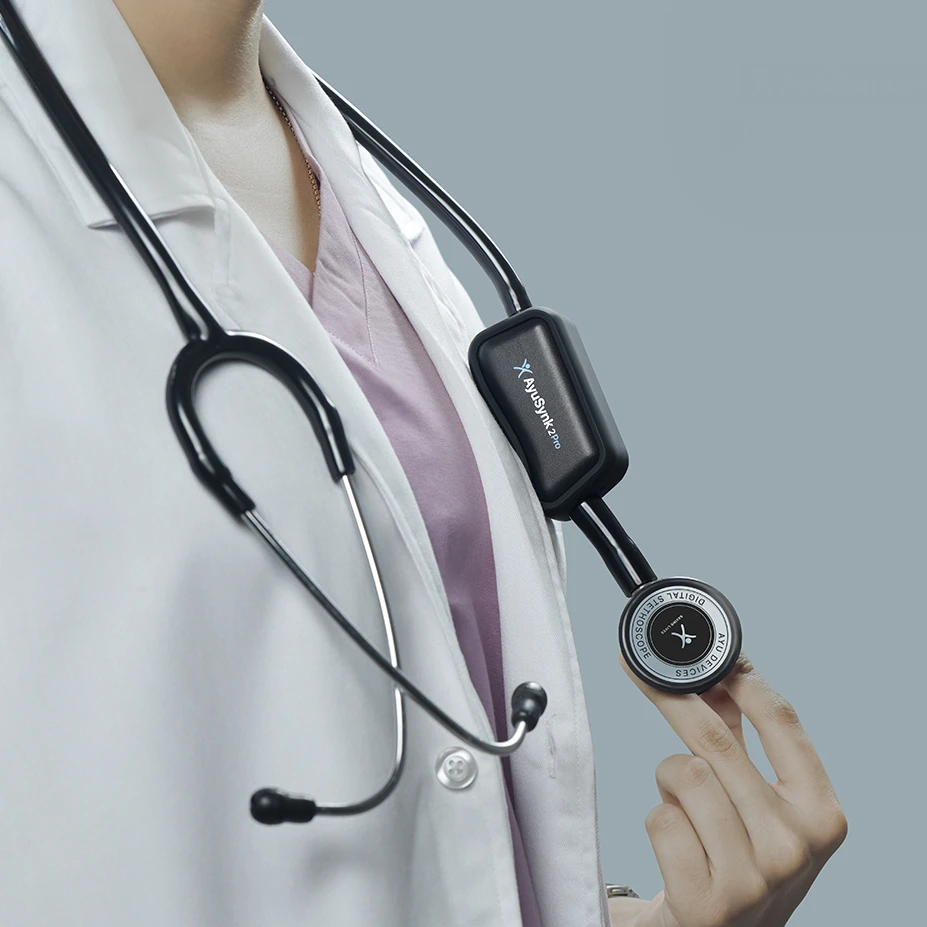
Devices like the AyuSynk 2 Pro Advance support real-time auscultation, advanced noise reduction, and the ability to record and share sounds, making them highly effective for both distant and tele-auscultation workflows.
Recording, Processing, and Clinical Interpretation
Auscultation Recording and Post-Processing
Digital stethoscopes record heart and lung sounds digitally. Using AI and signal processing:
- Background noise is reduced
- Sounds are amplified for clarity
- Phonocardiograms are generated for visual interpretation
Understanding the Phonocardiogram for Clinical Auscultation
Phonocardiograms are helpful but not a substitute for auscultation. They serve as a second set of checkpoints for objective and assisted auscultation.
Benefits for Telehealth Teams
Wireless auscultation offers several advantages:
- Access to auscultation data during remote consultations
- Improved collaboration between on-site and remote clinicians
- Better documentation and continuity of care
- Enhanced patient safety and comfort, especially in sensitive or high-risk scenarios
Use Cases in Telemedicine
Hospital-Led Telemedicine Programs
Remote consultations allow specialists to review recordings from peripheral or rural facilities, ensuring patients receive expert guidance without traveling long distances.
Virtual Clinics and Remote Monitoring
For follow-ups, remote teams can:
- Review previously recorded auscultation data
- Detect subtle changes in heart or lung health
- Make clinical decisions confidently
Data Sharing and System Integration
Secure Sharing for Collaboration
Recordings and phonocardiograms can be shared for peer review and multidisciplinary discussions, improving diagnostic confidence.
Integration with EMR and Digital Health Systems
Digital stethoscope data can integrate with electronic medical records, ensuring long-term tracking, continuity of care, and audit readiness.
Positioning Digital Stethoscopes in Telemedicine Ecosystems
These devices are:
- Professional-grade and designed for clinical use
- Equipped with advanced features, including AI-assisted sound processing
- Value-driven investment that prioritises accuracy, documentation and patient safety
They act as a critical bridge between physical examination and digital healthcare delivery, strengthening telemedicine systems without replacing clinical judgment.
Conclusion
Digital stethoscopes are transforming telemedicine by enabling reliable wireless auscultation across both in-person and remote care settings. By distinguishing between distant auscultation and tele-auscultation, healthcare teams can use these tools effectively, even in busy OPDs, rural centers, or health camps.
Advanced solutions like the AyuSynk 2 Pro Advance combine high-quality sound amplification, AI-supported analysis, and seamless data sharing, making them reliable tools for modern telemedicine systems.
Digital stethoscopes and wireless auscultation empower clinicians to deliver more accurate, faster, and collaborative remote care.
Bringing reliable auscultation to remote clinical care

Dr. Ankit Kadarge
Dr. Ankit Kadarge is a writer, and Clinical Product Manager in MedTech who believes healthcare should be simple and understandable for everyone. He started his journey at Oxford Medical College, Bangalore, and soon discovered a love for writing, publishing over 20 articles with MedBound to make medical knowledge accessible.
Previously he has worked at ACKO, leading the life insurance vertical as a pilot doctor, where he gained a deeper understanding of how people experience and sometimes misunderstand healthcare. Today, he builds solutions that solve real problems for doctors and patients, blending his medical knowledge with product thinking.
On his blog, Ankit shares his experiences, learnings, and reflections on healthcare always in a way that’s easy to read and relate to.