Why Clear Lung Sound Capture Is Essential in a Digital Stethoscope for Respiratory Assessment

Introduction
Respiratory auscultation is the process of listening to lung sounds during a clinical assessment to identify changes in respiratory sounds.
Pulmonologists listen for subtle respiratory sounds such as wheeze, crackles, and rhonchi, which may be difficult to hear in busy OPDs or hospital wards.
This is where a digital stethoscope for respiratory assessment comes in. It makes it easier to listen to lung sounds by amplifying them, reducing background interference and allowing for easy recording and replay for later review or learning purposes.
It supports a pulmonologist’s or clinician’s listening and documentation process, but it is not to be considered as a replacement for a clinician’s judgement.
This guide explains why lung-sound clarity matters and which digital features can support respiratory assessment without treating software or visual displays as diagnostic tools.
What Is Respiratory Auscultation?
Respiratory auscultation involves listening across standard chest positions to assess breath-sound intensity, symmetry, and added sounds. Findings must be interpreted with the patient history and relevant investigations.
Common adventitious lung sounds include:
- Wheeze: It is a continuous and high-pitched sound caused by narrow airways. It may vary from patient to patient across clinical conditions.
- Crackles: Brief, discontinuous sounds heard most commonly during inspiration. Fine crackles and coarse crackles both have different contexts clinically and must be interpreted with the complete lung assessment.
- Rhonchi: Rhonchi are low-pitched, continuous sounds that may be associated with secretions or obstruction in larger airways and may change after coughing.
Why Clear Lung-Sound Capture Matters
Poor capture makes an interpretation-dependent skill harder, especially in noisy environments where repeating auscultation in a quieter area may not be practical.
- Busy clinical environments: Background environmental noise such as conversations, equipment clattering, patients and staff moving and ventilation fans can interfere with subtle acoustic physiological sounds.
- Low-intensity breath sounds: Patient body type, shallow breathing, and hyperinflation can make it difficult to listen in on minute lung sounds.
- No audio reference: Acoustic auscultation does not provide recording and playback, leaving the clinician with only notes and memory for follow-up.
- Variation between listeners: Listener experience, hearing ability, placement technique, and surrounding conditions can influence how respiratory sounds are interpreted.
- Limited review options: Without a recording, clinicians may have fewer options for specialist review, teaching, or comparison during follow-up.
How a Digital Stethoscope Improves Respiratory Sound Capture
Step 1: Electronic Capture
A digital stethoscope can actively convert lung or any other physiological sounds into electronic signals in real-time. This allows for up to 60x amplification, dedicated lung filter, recording and sharing capabilities to support tele-auscultation.
Step 2: High Amplification
Digital processing can amplify faint breath sounds. AyuSynk digisteth devices support up to 60x amplification, which may make subtle respiratory sounds more audible in active clinical environments.
Step 3: Lung-Focused Filtering
A dedicated lung mode prioritises respiratory sound ranges and helps the clinician concentrate on the sounds being assessed. The filter supports audibility; it does not classify or diagnose the finding.
Step 4: Real-Time Noise Cancellation
Noise reduction supports listening in OPDs, wards, and screening settings where the environment cannot be controlled.
Step 5: Recording and Playback
Recordings can be reviewed after auscultation and compared across visits, supporting documentation, discussion, and teaching.
Step 6: Waveform Correlation
The AyuShare app can display recorded sound waveforms and spectrograms alongside the audio for visual correlation. These visuals helps in correlation of sounds to support better interpretation of diagnosis.
Step 7: Tele-Auscultation
Live sounds can be transmitted when a trained patient attendant, the device, and reliable connectivity are available. Correct placement remains essential.
Capture respiratory sounds that can be heard, recorded, and reviewed.
Key Features for Respiratory Assessment
- Clear, stable audio: Additional functions should support listening and documentation rather than distract from them.
- Clinically useful amplification: Amplification should improve audibility without replacing placement, technique, or judgement.
- Patient-linked recording: Recordings should be easy to name, retrieve, replay, and associate with the correct patient.
- Secure sharing and reporting: The AyuShare app can organise recordings, notes, and reports where review or referral is relevant.
- Appropriate remote-use support: Tele-auscultation requires a patient-side device, trained healthcare professional, and reliable network.
Factors That Affect Lung-Sound Capture During Respiratory Assessment
| Assessment Challenge | Effect on Auscultation | Digital Stethoscope Support | Clinical Consideration |
|---|---|---|---|
| Noisy OPDs and wards | Background noise may mask subtle lung sounds. | Real-time noise cancellation reduces interference. | Some environmental noise may remain. |
| Faint breath sounds | Quiet sounds may be difficult to hear. | Up to 60x amplification improves audibility. | Amplification does not interpret findings. |
| Competing sound frequencies | Other signals may distract from respiratory sounds. | A dedicated lung mode prioritises respiratory frequencies. | Lung filters do not diagnose conditions. |
| No audio record | Findings depend on notes and memory. | Recording and playback create an audio reference. | Review recordings with other clinical findings. |
| Follow-up comparison | Subtle changes may be difficult to recall. | Stored recordings support asthma and COPD follow-up. | Audio alone cannot indicate disease progression. |
| Listener variation | Experience and technique may affect interpretation. | Replay supports specialist review and training. | Clinical expertise remains essential. |
| Remote assessment | The pulmonologist may be in another location. | Tele-auscultation enables real-time remote listening. | Trained patient-side support and stable connectivity are required. |
| Waveform display | Visual patterns may accompany recorded audio. | Waveforms support audio correlation. | They cannot diagnose or classify respiratory findings. |
How AyuSynk Digisteth Supports Respiratory Assessment
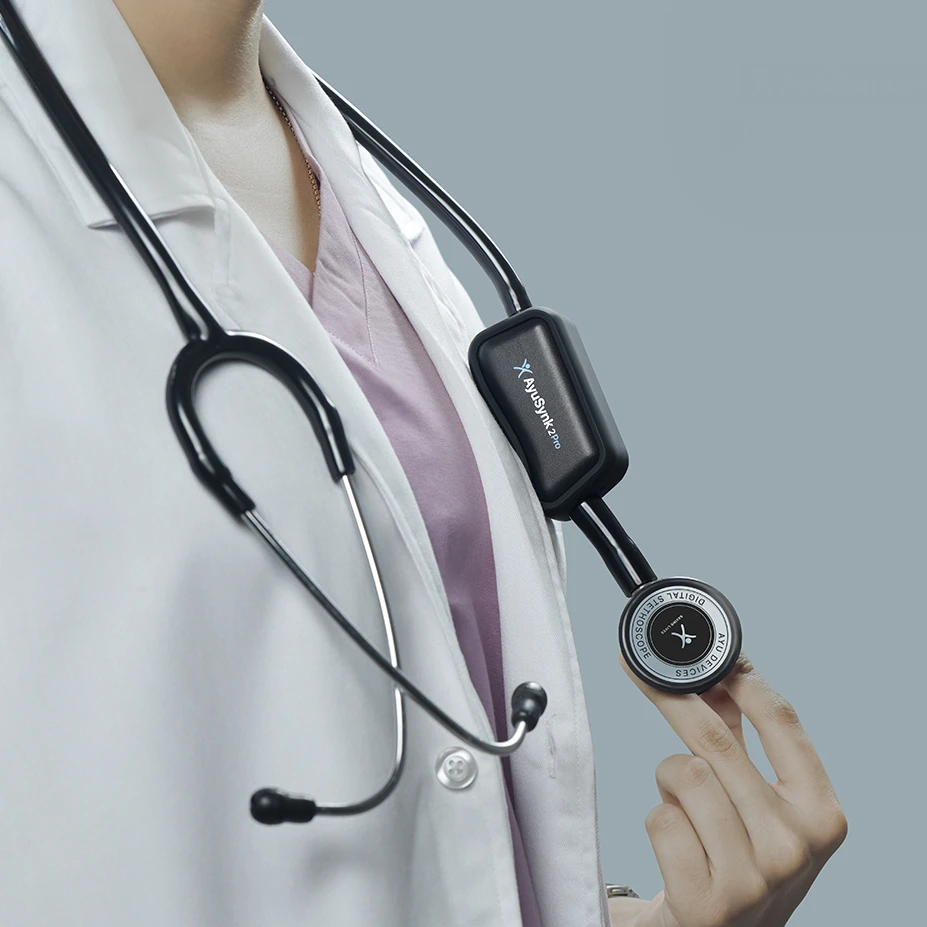
The AyuSynk 2 Pro Advance combines amplification, lung filtering, real-time noise cancellation, recording, and remote workflows for OPDs, wards, multi-specialty clinics, and teleconsultation set-ups.
Up to 60x amplification can make faint sounds more audible, while the lung filter supports respiratory listening. Real-time noise cancellation reduces environmental interference, and AyuShare app stores recordings for review and follow-up.
The AyuShare app displays recorded sound waveforms and spectrograms alongside the audio. These visuals help in the correlation of sounds to support better interpretation of the diagnosis. Direct detection of abnormalities such as wheeze, crackle or rhonchi is not available.
The AyuSynk 2 Pro Advance supports real-time tele-auscultation across the globe. Live use requires the device, a trained patient attender, and stable connectivity. AyuSynk 2 Pro Lite offers a focused outpatient setup with amplification, filtering, recording, and AyuShare app integration.
AyuSynk digisteth does not currently provide AI-based lung-sound classification. Lung-sound AI is in development and requires a substantial volume of validated clinical data before it can be positioned responsibly.
Clinical Use Cases
Pulmonology OPD and follow-up: Amplification and noise cancellation support listening, while recordings provide a later reference.
- COPD and asthma review: Recordings can complement symptoms, clinical assessment findings, and relevant investigations over time.
- Interstitial lung disease assessment: Amplification may make quiet basal crackles more audible, while diagnosis remains clinically led.
- General physician screening: An uncertain recording may be shared with a pulmonologist when appropriate.
- Teleconsultation requirements: A trained operator can place the device while a remote clinician listens in real time.
- Clinical education: Recorded sounds can support repeated listening and training in the correct clinical context.
Practical Considerations and Limitations
Digital tools improve sound access and documentation, but they do not remove the fundamentals of respiratory assessment.
- Clinical skill remains essential: Amplification does not interpret the sound or determine its clinical significance.
- Placement and patient cooperation matter: Incorrect positioning, clothing interference, movement, or shallow breathing can affect the recording.
- Waveforms are not diagnostic: Lung-sound displays may vary with breathing and movement and should only complement the audio.
- No current AyuSynk lung AI: AI-based lung-sound diagnosis or classification is not currently available in AyuSynk digisteth products.
- Tele-auscultation requires setup: A trained operator, patient-side device, and stable connection are required for live remote listening.
Conclusion
When we talk about respiratory auscultation, the ability to capture lung sounds clearly is central. A digital stethoscope can really improve audibility and significantly reduce environmental noise creating a perfect set-up to even record and review patient conditions. The most useful features include up to 60x sound amplification, a dedicated lung mode, real-time noise cancellation technology, recording & playback along with tele-auscultation support.
Waveforms correlate with audio, but interpretation remains physician-led and clinically contextual.
AyuSynk 2 Pro Advance brings these functions together while keeping auscultation physician-led.
Frequently Asked Questions
Why is sound clarity important in respiratory auscultation?
Wheeze, crackles, and rhonchi can be subtle or masked by external noise in clinical environments. Clear sound capture supports more consistent listening, but interpretation still depends on clinical skill and context.
How does a digital stethoscope support respiratory assessment?
It electronically captures and amplifies physiological sounds, reduces competing environmental noise, and allows recordings to be replayed or compared across visits.
Where should a digital stethoscope be placed during respiratory assessment?
Place the digital stethoscope at standard anterior, lateral, and posterior chest points, comparing corresponding areas on both sides. Correct placement and listening through a full respiratory cycle are essential for reliable lung-sound capture.
Can a digital stethoscope diagnose pneumonia or other respiratory conditions?
No. A digital stethoscope can amplify and record abnormal lung sounds, but diagnosis requires clinical history, physical evaluation, and relevant investigations such as spirometry or chest imaging.
What is required for respiratory tele-auscultation?
A digital stethoscope and trained operator must be present with the patient. The remote clinician also needs reliable connectivity to listen to the transmitted sound in real time.
Clearer respiratory assessment starts with better sound capture.

Dr. Ankit Kadarge
Dr. Ankit Kadarge is a writer, and Clinical Product Manager in MedTech who believes healthcare should be simple and understandable for everyone. He started his journey at Oxford Medical College, Bangalore, and soon discovered a love for writing, publishing over 20 articles with MedBound to make medical knowledge accessible.
Previously he has worked at ACKO, leading the life insurance vertical as a pilot doctor, where he gained a deeper understanding of how people experience and sometimes misunderstand healthcare. Today, he builds solutions that solve real problems for doctors and patients, blending his medical knowledge with product thinking.
On his blog, Ankit shares his experiences, learnings, and reflections on healthcare always in a way that’s easy to read and relate to.