Complete Guide to Selecting a Digital Stethoscope for Pulmonologists

Introduction
569.2 million! That is how many chronic respiratory cases that were recorded across the globe in 2023. Auscultation is commonly used by pulmonologists during respiratory assessment to listen for wheeze, crackles, rhonchi, and changes in breath-sound intensity.
The ability to hear subtle respiratory sounds is non-negotiable when choosing the right pulmonology stethoscope. These features can help specialists hear respiratory sounds more clearly, reduce external noise, record and replay sounds, prepare structured reports, and support tele-auscultation when required.
What Is a Pulmonology Stethoscope?
A pulmonology stethoscope is not a separate formal device category.
What it means is that it is a stethoscope chosen mainly for respiratory practices. A pulmonology stethoscope is designed to amplify lung sounds with a dedicated mode for lungs, still usable in a busy, noisy environment. The device is essential at the patient side for tele-auscultation, but every pulmonology stethoscope does not need to be described this way.
Why Does Choosing the Right Pulmonology Stethoscope Matter?
Respiratory auscultation relies on both listening conditions and clinical experience. A suitable device should address common workflow limitations without overstating what technology can determine.
- External sound disturbance: Conversations, equipment, ventilation systems, and movement may interfere with quiet respiratory sounds.
- Subtle sounds: Fine crackles, mild wheeze, or reduced breath-sound intensity may be difficult to listen to under poor listening conditions.
- No audio reference: An acoustic assessment leaves no recording that can be revisited during follow-up.
- Connected-care limitations: Traditional devices cannot transmit lung sounds during a remote clinical consultation.
How a Digital Pulmonology Stethoscope Works
Step 1: Capturing Lung Sounds Electronically
The chest piece is positioned at standard respiratory auscultation points. Sensors convert the patient’s lung sounds into electronic signals rather than transmitting them only through acoustic tubing.
Step 2: Amplification and Lung-Focused Filtering
The signal is amplified and processed through a lung-focused filter or mode. AyuSynk devices support up to 60x sound amplification, which make faint respiratory sounds more perceptible in active clinical environments.
Step 3: Real-Time Listening and Waveform Correlation
During real-time auscultation, the AyuShare app displays live sound waveforms as a visual reference alongside the audio. These visuals help in correlating with auscultated sounds for making better clinical decisions.
Step 4: Recording, Playback, and Documentation
Lung sounds can be recorded and replayed for clinical review, documentation, follow-up comparison, and training. Reports and notes can be organised through the connected platform when required.
Step 5: Tele-Auscultation and Sharing
In a remote workflow, a trained person places the device at the patient side while the chest physician listens from another location. Device availability, correct placement, trained support, and stable connectivity remain essential. The AyuSynk digisteth guide to remote auscultation workflows explains this setup in more detail.
Turn every respiratory assessment into a reviewable clinical record.
Key Features to Look for in a Pulmonology Stethoscope
Sound Amplification
Amplification should improve audibility without becoming harsh or distorting the sounds being assessed. The clinician should also be able to adjust the listening level comfortably.
Dedicated Lung Filter or Mode
A lung-focused mode prioritises respiratory frequencies. Its value should be judged by sound quality, ease of switching, and how naturally it fits the pulmonologist’s listening technique.
sary steps to the consultation.
External Sound Reduction
Real-time noise cancellation or denoise functionality can reduce environmental interference in busy OPDs and wards, helping the clinician concentrate on physiological sounds.
Recording and Playback
Recording creates an audio reference that can be replayed and compared across visits. It supports chronic respiratory follow-up, case documentation, and repeated listening while developing auscultation skills.
Tele-Auscultation Capability
For hospitals and connected-care set-ups, the device should support dependable real-time transmission and work with the organisation’s telemedicine setup.
Sound Management and Reporting
A connected platform should make it straightforward to organise recordings, add notes, generate reports, and manage patient records without adding unneces
How to Choose a Pulmonology Stethoscope for Clinical Use
| Clinical Requirement | What to Evaluate | Why It Matters in Pulmonology | AyuSynk Workflow Support |
|---|---|---|---|
| Listening in busy clinical settings | Adjustable amplification and real-time noise reduction | Conversations, equipment, and movement in OPDs or wards can interfere with subtle lung sounds. | Up to 60x amplification and denoise functionality support clearer listening in active environments. |
| Focusing on respiratory sounds | Availability of a dedicated lung filter or lung mode | A lung-focused mode prioritises respiratory frequencies during pulmonary auscultation. | A dedicated lung mode helps clinicians focus on breath sounds during assessment. |
| Reviewing sounds after assessment | Recording and playback capability | Stored lung sounds can be replayed for follow-up, documentation, learning, or specialist review. | Recordings can be captured, organised, and replayed through the AyuShare application. |
| Monitoring patients across visits | Structured storage, notes, and report generation | Documentation may support follow-up for asthma, COPD, interstitial lung disease, and other respiratory conditions. | The AyuShare app supports recordings and report generation for an organised review. |
| Supporting remote respiratory assessment | Real-time tele-auscultation and reliable connectivity | A chest physician may need to listen remotely when specialist access is limited. | AyuSynk digisteth supports tele-auscultation when the device and trained support are available at the patient side. |
| Sharing findings with clinical teams | Secure audio sharing and accessible records | Multidisciplinary teams may need to review lung sounds alongside other clinical findings. | Connected workflows can support authorised sound sharing and collaborative review. |
| Training students and junior clinicians | Replayable audio and waveform correlation | Repeated listening helps learners recognise respiratory sound characteristics and improve auscultation technique. | Recorded sounds can be replayed, while waveforms provide an accompanying visual reference. |
| Integrating the device into daily practice | Battery life, charging, cleaning, app compatibility, and ease of use | A clinically useful digital stethoscope must fit routine consultation and infection-control workflows. | AyuSynk digisteth combines portable listening with the AyuShare app-based recording and connected-care functions. |
| Maintaining responsible clinical interpretation | Clear limits on visualisation and automated classification | Waveforms and amplification support auscultation but cannot independently diagnose pulmonary conditions. | AyuSynk digisteth does not currently provide AI-based lung-sound classification; interpretation remains clinician-led. |
How AyuSynk Digisteth Supports Pulmonologists and Respiratory Care Teams
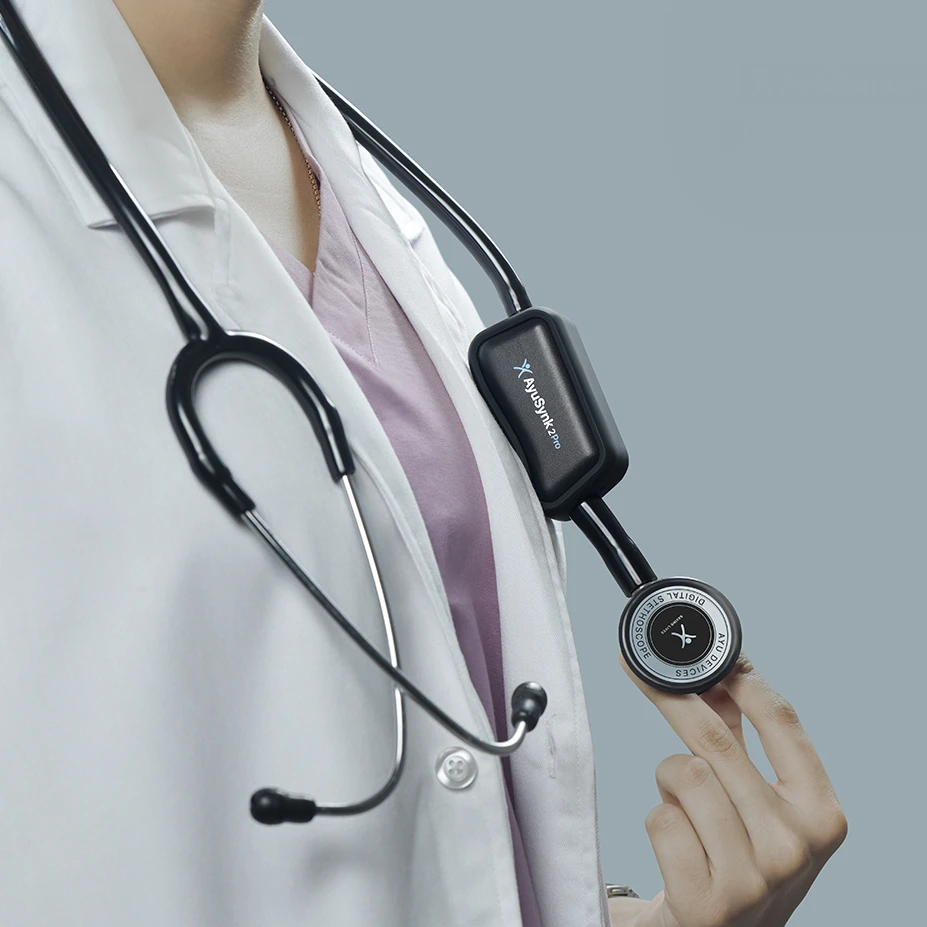
The AyuSynk 2 Pro Advance combines up to 60x amplification, dedicated heart and lung filters, denoise functionality, recording, playback, report generation, and real-time tele-auscultation. Through the AyuShare app, pulmonologists can review recordings and use waveforms as an accompanying visual reference.
AyuSynk 2 Pro Lite supports connected clinical and telemedicine workflows for practices that need real-time transmission with recording and app integration.
Both the AyuSynk 2 Pro Advance and the AyuSynk 2 Pro Lite do not currently provide AI-based lung-sound classification. This capability is under development and would require substantial clinically validated datasets.
Clinicians comparing deployment settings can also review AyuSynk digisteth overview of digital stethoscope use cases from OPD to ICU.
Clinical Use Cases for Chest Physicians
OPD Respiratory Clinical Assessment
Amplification, lung-focused filtering, and denoise support clearer listening in high-volume settings. A recording may also establish a baseline for later comparison.
COPD, Asthma, and Interstitial Lung Disease Follow-Up
Pulmonologists have the option to use stored recordings to compare them against known symptoms, spirometry, lung imaging and any other clinically relevant findings. Digital stethoscopes support amplified listening, recording, and review, but they are not standalone diagnostic tools or measures of treatment response.
Teleconsultation from Hospitals and Multi-Specialty Clinics
A trained professional operates the device as the pulmonologist listens from their clinic or hospital. This may support institutional teleconsultation where specialist access is limited. AyuSynk digisteth also outlines how wireless auscultation can fit cardiac and lung workflows.
Medical Education and Auscultation Training
Recorded sounds allow repeated listening and guided discussion with trainees. Waveforms are displayed for correlation, but learning should remain centred on the audio, correct placement, and clinical context.
Practical Considerations and Honest Limitations
- Accurate device placement and a structured auscultation method are still critical for reliable listening.
- Amplification can improve sound clarity, but it cannot correct improper technique or replace a comprehensive respiratory evaluation.
- Waveforms are intended only to support sound correlation and should not be interpreted as diagnostic indicators of pulmonary conditions.
- AyuSynk digisteth products do not currently offer AI-powered classification of lung sounds.
- Tele-auscultation depends on a patient-side device, trained assistance, and a stable internet connection.
- As with any digital medical device, AyuSynk digisteth requires regular charging, proper maintenance, and responsible handling of patient data.
The Future of Pulmonology Stethoscope Technology
The most clinically relevant direction for digital lung auscultation is better sound access, repeatable recordings, structured documentation, and dependable connected care. Future machine-learning applications will require large, representative, clinically validated datasets before they can be positioned responsibly in pulmonary workflows.
Conclusion
The right pulmonology stethoscope should help chest physicians listen clearly, manage external disturbance, record sounds when useful, and support connected clinical workflows without overstating the role of technology. AyuSynk 2 Pro Advance and AyuSynk 2 Pro Lite bring these digital functions into respiratory practice, while interpretation and clinical decision-making remain fully physician-led.
Frequently Asked Questions
How do I choose the right pulmonology stethoscope?
Choose a pulmonology stethoscope with sound amplification, a dedicated lung filter, noise reduction, recording and playback, and reliable battery life. Tele-auscultation and reporting features also support connected respiratory-care workflows.
Is a digital stethoscope better for lung sounds?
A digital stethoscope can amplify lung sounds, reduce external noise, and support recording and playback. The right choice depends on the pulmonologist’s clinical environment, auscultation technique, and documentation needs.
What is a lung filter in a digital stethoscope?
A lung filter prioritises respiratory frequencies to improve the clarity of breath sounds during pulmonary auscultation. It supports focused listening but does not independently diagnose or classify pulmonary conditions.
Can lung-sound recordings be compared across visits?
Yes. Digital stethoscope recordings can support comparison during asthma, COPD, and respiratory follow-up visits. They should be reviewed alongside symptoms, spirometry, imaging, clinical notes, and other relevant findings.
Can a pulmonology stethoscope be used in a noisy OPD?
A pulmonology stethoscope with amplification and real-time noise reduction can support clearer listening in busy OPDs and hospital wards. Correct placement and proper respiratory auscultation techniques must be followed strictly.
Choose a pulmonology stethoscope that fits your clinical workflow.

Dr. Ankit Kadarge
Dr. Ankit Kadarge is a writer, and Clinical Product Manager in MedTech who believes healthcare should be simple and understandable for everyone. He started his journey at Oxford Medical College, Bangalore, and soon discovered a love for writing, publishing over 20 articles with MedBound to make medical knowledge accessible.
Previously he has worked at ACKO, leading the life insurance vertical as a pilot doctor, where he gained a deeper understanding of how people experience and sometimes misunderstand healthcare. Today, he builds solutions that solve real problems for doctors and patients, blending his medical knowledge with product thinking.
On his blog, Ankit shares his experiences, learnings, and reflections on healthcare always in a way that’s easy to read and relate to.