Best Stethoscope for Pulmonologists to Accurately Detect Breathing Sounds

Introduction
When we talk about the overall respiratory disease statistics in India, over 55 million people are diagnosed with COPD and close to 38 million are coping with asthma, a report from the Global Burden of Disease Study states. This census was just in 2016.
Noisy environments such as busy OPDs, general wards or screening rooms can make it difficult to listen to subtle wheezes, crackles, and changes in breath sounds or minor changes in breathing intensity of a patient.
This is exactly what a pulmonologist must be looking for when searching for the best stethoscope for pulmonologists in India.
What Is Digital Auscultation, and Why Does It Matter for Pulmonologists?
Traditional acoustic stethoscopes may be affected by environmental noise, chest-piece placement, and the clinician’s hearing ability.
Digital auscultation removes this limitation by converting these mechanical sounds into electronic signals that are then amplified, filtered, recorded and shared for playback. This can help clinicians assess their patients more accurately by making the faintest sounds easier to hear. It must not be considered a replacement for traditional practices but only as a tool to assist during physical evaluation.
Why Stethoscope Choice Matters in Pulmonology Practice
Acoustic stethoscopes are easily limited by the amount of noise around them. To assess and treat conditions such as asthma, COPD or any other respiratory disease, using an advanced digital stethoscope gives you the option to amplify lung sounds, record and playback and also majorly assist in real-time tele-auscultation.
How Digital Stethoscopes Work for Pulmonologists
Step 1: Sound Capture and Amplification
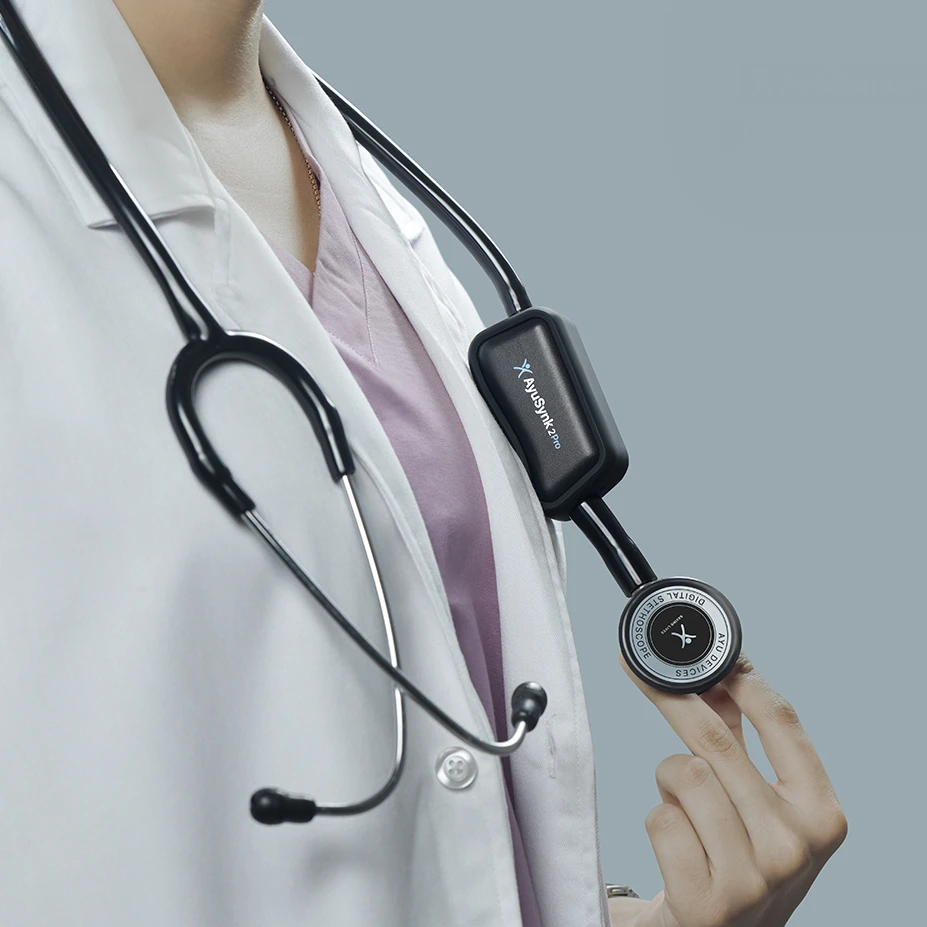
Electronically capturing and amplifying lung sounds can help pulmonologists provide the most accurate clinical assessment. AyuSynk 2 Pro Advance is designed to provide up to 60x sound amplification.
Step 2: Filtering for Lung Sound Clarity
A dedicated lung mode prioritises respiratory frequencies, helping the clinician focus on breath sounds such as wheeze and crackles.
Step 3: Real-Time Listening and Waveform Correlation
The clinician listens through the connected audio output, while the AyuShare app displays live sound waveforms for visual correlation. After recording, the sounds can be reviewed with phonocardiogram and spectrogram visualizations.
Pulmonary auscultation only uses digital stethoscopes as tools that provide a visual correlation to the sound itself. This feature alone cannot diagnose or classify lung conditions without being reviewed by a pulmonologist.
Step 4: Recording and Playback
Lung sounds can be recorded and replayed for follow-up comparison, documentation, teaching, or repeat review. The pulmonologist interprets every recording within the patient’s complete clinical picture.
Key Features That Make a Stethoscope Useful for Pulmonologists
Lung Sound Clarity and Amplification
High amplification may make quiet breath sounds more perceptible when conventional listening is difficult.
Dedicated Lung Filters
A dedicated lung filter or mode prioritises respiratory frequencies. Its performance should be assessed against validated device specifications and intended use.
Real-Time Noise Cancellation
Real-time noise cancellation reduces external disturbance in busy OPDs and wards.
Recording, Playback, and Clinical Documentation
Through the AyuShare app, clinicians can replay recordings, add notes, generate reports, and maintain structured records for comparison across visits.
Bluetooth Connectivity and Tele-Auscultation
Bluetooth supports mobile recording and review. AyuSynk 2 Pro Advance also enables real-time tele-auscultation when a trained person and the device are at the patient side and both locations have suitable connectivity.
Acoustic vs Digital vs Connected Digital Stethoscope: A Comparison for Pulmonologists
| Feature | Acoustic Stethoscope | Standard Digital Stethoscope | AI-Enabled Digital Stethoscope |
|---|---|---|---|
| Sound amplification | Natural acoustic transmission only | Moderate to high amplification, up to 40x | High amplification, up to 60x and above |
| Lung sound filters | None | Basic frequency adjustment | Dedicated heart and lung filters |
| External sound reduction | None | Partial in some models | Active real-time noise cancellation built in |
| Recording and playback | Not available | Available in most models | Available with playback speed control |
| Visualization | Not available | Basic waveform in some models | Phonocardiogram and Spectrogram Visualization |
| AI-assisted classification | Not available | Not available | Murmur detection available. Detection of lung sound abnormalities not available yet. |
| Remote sharing | Not possible | Limited in some models | Enabled via app platform |
| Tele-auscultation support | Not possible | Limited | Supported, varies by product |
| Clinical report generation | Not available | Partial in some models | Supported via AyuShare App |
Bring greater clarity and continuity to respiratory assessments.
How AyuSynk Digisteth Supports Pulmonologists in Clinical Practice
AyuSynk 2 Pro Advance combines 60x amplification, lung-focused listening, real-time noise cancellation, recording, playback, reports, and connected-care features. These improve sound access and workflow efficiency; they do not make a diagnosis.
Recorded sounds can be replayed through the AyuShare application, while recorded phonocardiograms and spectrograms provide a visual reference to support clinical correlation. AyuSynk digisteth does not currently provide AI-based lung-sound classification. This capability is under development and requires substantial, clinically validated datasets.
For connected workflows, it supports tele-auscultation with a patient-side device, trained support, and network access. Clinicians can also review digital stethoscope use cases from OPD to ICU and compare digital and acoustic stethoscopes.
Clinical Use Cases for Pulmonologists
OPD Respiratory Assessment
60x amplification, dedicated mode for lung sounds and a real-time noise cancellation feature, all contribute to clearer clinical assessments. It also allows recording and playback of lung sounds, helping pulmonologists compare lung sounds from previous sessions or aid in telemedicine consultations.
COPD, Asthma, and Interstitial Lung Disease Follow-Up
The option to record lung sounds and play them back can actively support clinicians in comparing and assessing patient symptoms alongside clinical documentation, spirometry, lung imaging, and other relevant investigations.
Telemedicine Consultations
Pulmonologists have the option to remotely assess patient symptoms by having a trained clinical care provider place the device. Although, it must be noted that correct placement, device availability and a stable connection is crucial for telemedicine consultations.
Medical Education and Team-Based Learning
Recorded sounds, sound waveforms, and spectrogram visualizations can support audio correlation, review, and clinical teaching.
Considerations and Honest Limitations
- Correct placement and auscultation techniques remain essential.
- Digital amplification cannot compensate for poor technique.
- Waveforms are correlation aids, not diagnostic displays for lung sounds.
- AyuSynk digisteth lung-sound AI is not currently available and remains under development.
- Tele-auscultation requires a patient-side device, trained support, and reliable connectivity.
- Digital devices require charging, maintenance, and appropriate data-handling practices.
The Future of Pulmonology Auscultation
Digital lung auscultation can support clearer listening, repeatable recordings, structured documentation, and connected care. The future is machine-learning. Any machine-learning application will demand a big, organised, clinically validated dataset for evaluating patient conditions.
The future of pulmonology auscultation is clear. It would support specialists in providing better, transparent care. It was never meant to replace the pulmonologist assessment, but to aid in better objectified auscultation.
Conclusion
When considering purchasing a stethoscope for pulmonologists, key factors such as audio amplification, noise reduction, recording & playback and remote auscultation features play a crucial role in supporting better clinical assessment.
AyuSynk 2 Pro Advance brings these functions together through the AyuShare app documentation, and tele-auscultation. Pulmonologists makes better clinically objectified decisions based on data-driven technology for the betterment of healthcare.
Frequently Asked Questions
What features should pulmonologists look for in a digital stethoscope?
Digital stethoscopes are a part of most pulmonologist kits. It must provide clear sound amplification, a dedicated lung mode, noise cancellation and an effective recording & playback feature for clearer body sound assessment and documentation. If you are a pulmonologist who handles remote teams or in workflows with multiple specialists, the tele-auscultation feature is non-negotiable.
Can a digital stethoscope detect wheezes and crackles?
Sound amplification, lung-focused filtering, and external noise reduction make subtle respiratory sounds clearer. However, interpretation still depends on correct technique and the pulmonologist’s clinical judgment.
Are waveforms useful for diagnosing lung conditions?
Yes. In the AyuShare app, live or recorded sound waveforms can provide a visual reference alongside the audio. They support clinical correlation but do not independently diagnose or classify lung conditions.
Does AyuSynk digisteth use AI to classify lung sounds?
No. AyuSynk digisteth does not currently offer AI-based lung-sound classification. This capability is under development and requires a large volume of clinically validated data.
Can AyuSynk digisteth be used for tele-auscultation?
Yes. AyuSynk 2 Pro Advance can support real-time tele-auscultation when a trained person and the device are present with the patient and both locations have suitable connectivity.
Hear, record, and review respiratory sounds with greater clarity.

Dr. Ankit Kadarge
Dr. Ankit Kadarge is a writer, and Clinical Product Manager in MedTech who believes healthcare should be simple and understandable for everyone. He started his journey at Oxford Medical College, Bangalore, and soon discovered a love for writing, publishing over 20 articles with MedBound to make medical knowledge accessible.
Previously he has worked at ACKO, leading the life insurance vertical as a pilot doctor, where he gained a deeper understanding of how people experience and sometimes misunderstand healthcare. Today, he builds solutions that solve real problems for doctors and patients, blending his medical knowledge with product thinking.
On his blog, Ankit shares his experiences, learnings, and reflections on healthcare always in a way that’s easy to read and relate to.