How Digital and Acoustic Stethoscopes Compare in Clinical Accuracy?

Does Your Stethoscope Affect Diagnosis Accuracy?
Even the smallest sound can provide important information in the medical field. A barely audible heart murmur, subtle crackles in the lungs, or early wheezing could indicate a condition that, if missed, might lead to a missed diagnosis. Even though imaging technology like X-rays and ECGs has revolutionized diagnoses, many doctors still use the simple stethoscope as their first point of contact.
However, stethoscopes differ from one another. The argument between digital vs traditional stethoscopes is now about accuracy, efficiency, and improving patient outcomes rather than just technology vs tradition. This blog helps healthcare professionals, medical students, and hospital owners make informed decisions by analysing actual situations in which choosing a stethoscope is important.
Understanding the Two Approaches to Auscultation
Traditional Stethoscopes
A physician’s trusted companion for over a century has been an acoustic stethoscope. It works by directly transmitting sounds from the patient’s body to the clinician’s ears through the tube. However, they rely heavily and are more dependent on the doctor’s subjective hearing, experience, and surroundings. Traditional acoustic stethoscopes lack capabilities such as sound amplification, ambient noise filtration, and digital recording, which limits the ability to share body sounds for consultation or teaching.
Digital Stethoscopes (Enhanced Listening)
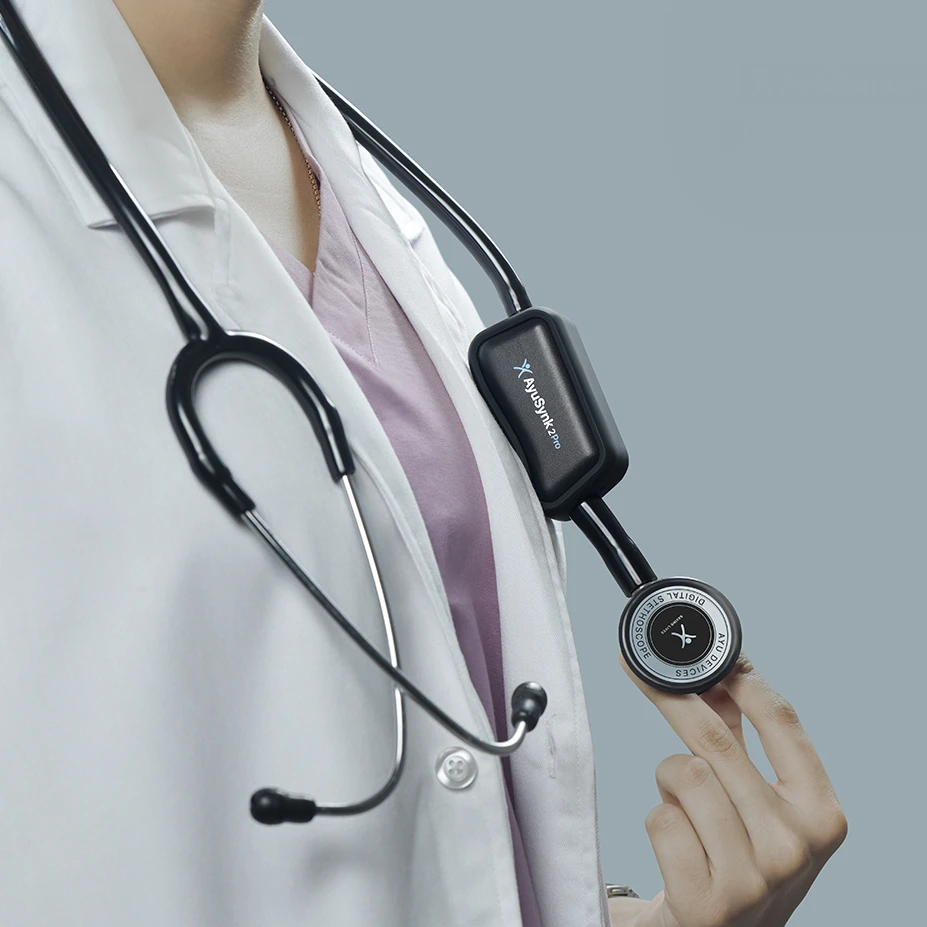
Body sounds are converted into electronic signals using a Bluetooth-enabled stethoscope. They record and store audio for playback, reduce background noise, and amplify even faint sounds. Many modern stethoscopes, like AyuSynk’s digital stethoscope, make remote consultations and teaching easier by connecting to mobile apps and cloud platforms. This technology improves accuracy and collaboration by converting subtle heart or lung sounds into visual phonocardiograms that can be analyzed.
What Do We Mean by “Clinical Accuracy”?
In auscultation, clinical accuracy goes beyond just hearing. It is about detecting the subtle abnormalities and interpreting them correctly. This is consistently done across different doctors and clinical settings.
Some key elements include:
- Detection of subtle sounds: Like murmurs, arrhythmias, crackles, and wheezing.
- Consistency: When two medical professionals listen to the same patient, they should recognize the same sounds.
- Performance in real-world conditions: Listening may be impacted by OPDs, ICUs, or noisy wards.
In other words, clinical accuracy is all about dependable, actionable information and not just about making the sounds audible.
Real Clinical Case Comparisons
Case 1: Detecting Faint Heart Murmurs in OPD Settings
In busy outpatient departments, subtle murmurs may be drowned out by loud background noise. Traditional stethoscopes often miss these faint signals, particularly when the patient is anxious or moving. Digital stethoscopes, with amplification and filtering, help doctors catch murmurs earlier, allowing timely intervention.
Case 2: Lung Sound Assessment in Respiratory Conditions
Assessing crackles in pneumonia or wheezing in asthma requires precision. Traditional stethoscopes rely on correct placement and a trained ear. Digital models enhance the clarity of lung sounds, making interpretation easier even for less experienced clinicians.
Case 3: High-Noise Environments (ICU / Emergency)
Intensive care units are often filled with ventilators, monitors, and alarms. In such high-noise environments, standard acoustic stethoscopes struggle. Digital stethoscopes with noise-cancelling technology isolate patient sounds for accurate assessment.
Digital stethoscopes improve accuracy in busy and high-noise clinical settings
Case 4: Teaching and Clinical Training
Medical students listening to a patient with a traditional stethoscope hear sounds once, with no opportunity for review. Digital stethoscopes allow recording, playback, and sharing, creating a powerful teaching tool that improves learning and skill retention.
Case 5: Remote Consultations and Second Opinions
Telemedicine has expanded rapidly, but traditional stethoscopes cannot transmit sounds remotely. Digital stethoscopes bridge the gap, allowing recordings to be shared securely with specialists for expert review, making rural or remote healthcare more accessible.
What Clinical Studies and Experience Suggest?
Research shows that AI-enabled digital stethoscopes can significantly improve detection of cardiac abnormalities. In one clinical study, AI-assisted auscultation achieved 92.3% sensitivity compared to 46.2% with standard auscultation, effectively detecting nearly twice as many cases of valvular heart disease.
Normal stethoscopes remain highly effective in quiet settings and when used by experienced clinicians. Both types have their value – it’s about matching the tool to the clinical scenario rather than following trends
Other Source: https://mkscienceset.com/articles_file/978-_article1765005397.pdf
Advantages and Limitations – A Practical View
Where Traditional Stethoscopes Still Excel?
- Reliability & Low Maintenance: They require no batteries or charging and are ready for immediate, continuous use, unlike digital devices that may lose power.
- Affordability: Generally much more cost-effective for students, nursing staff, and general practitioners.
- No Technical Troubleshooting: Free from risks of software bugs, network connectivity issues, or app-related errors.
Where Digital Stethoscopes Add Clinical Value?
- Enhanced sound clarity, amplification, and noise reduction.
- Recording, storage, and playback for documentation and teaching.
- Remote and telemedicine applications.
- Consistency across different clinicians.
- Example: AyuSynk digital stethoscope, like AyuSynk 2+, offers real-time sound streaming, external noise filtering, and mobile app integration, making it ideal for both hospital and telehealth use.
Choosing the Right Stethoscope for Your Practice
- High-volume OPDs: Digital stethoscopes improve detection and reduce diagnostic errors.
- Teaching hospitals: Recording and replay capabilities are invaluable for training students.
- Basic Clinical assessments: Traditional stethoscopes are simple, fast, and effective.
- Telemedicine / remote care: Digital stethoscopes are essential for transmitting auscultation data securely.
The choice should be guided by workflow, patient volume, and purpose – not simply by novelty.
What Hospital Buyers and Clinics Should Consider?
- Scalability: Can devices be deployed across departments efficiently?
- Integration: Compatibility with EMR/EHR systems.
- Cost vs. long-term value: Investment in digital stethoscopes may reduce diagnostic errors and improve efficiency.
- Reliability: Battery life, maintenance, and customer support.
- Suitability: ICU, OPD, pediatrics, telemedicine.
The Future: Will Digital Replace Traditional Stethoscopes?
Digital stethoscopes are not here to replace traditional ones; they are an evolution. Hybrid usage is likely, with both tools coexisting in hospitals. AI and data-driven diagnostics will increasingly integrate with digital auscultation, providing early warnings and predictive insights. Connected healthcare systems will allow physicians to access auscultation data anywhere, anytime.
Conclusion:
Both digital and traditional stethoscopes have their roles. Traditional stethoscopes remain useful for quick, bedside assessments, especially in quiet environments. Digital stethoscopes enhance detection, documentation, teaching, and remote care. The key is understanding your practice needs and selecting the tool that improves accuracy and patient outcomes.
The takeaway: it’s not about replacing tradition with technology; it’s about enhancing clinical decision-making, one heartbeat at a time.
FAQs
Is an electronic stethoscope more accurate than a traditional one?
In general, electronic stethoscopes are more accurate than traditional ones, especially when it comes to detecting faint sounds or in busy surroundings.
Can digital stethoscopes replace traditional ones?
No. They complement traditional stethoscopes, adding value through recording, amplification, and remote capabilities.
Are digital stethoscopes useful for students?
Yes, students can benefit greatly from digital stethoscopes, especially when studying auscultation through visual soundwave analysis, background noise reduction, and sound amplification.
Do digital stethoscopes work in telemedicine?
Yes, digital stethoscopes are quite useful in telemedicine since they allow for the remote, real-time auscultation of lung and heart sounds.
Need help choosing the right stethoscope for your practice?

Dr. Ankit Kadarge
Dr. Ankit Kadarge is a writer, and Clinical Product Manager in MedTech who believes healthcare should be simple and understandable for everyone. He started his journey at Oxford Medical College, Bangalore, and soon discovered a love for writing, publishing over 20 articles with MedBound to make medical knowledge accessible.
Previously he has worked at ACKO, leading the life insurance vertical as a pilot doctor, where he gained a deeper understanding of how people experience and sometimes misunderstand healthcare. Today, he builds solutions that solve real problems for doctors and patients, blending his medical knowledge with product thinking.
On his blog, Ankit shares his experiences, learnings, and reflections on healthcare always in a way that’s easy to read and relate to.