Understanding Remote Patient Auscultation Beyond Traditional Clinical Settings

Remote lung and heart sound recording is primarily supported by digital stethoscopes, Bluetooth-enabled stethoscopes, and electronic stethoscopes. These devices are designed to capture physiological sounds such as heart and lung sounds, and may support recording, visualization, transmission, and remote review by a clinician.
Unlike telemedicine platforms, diagnostic kits, or remote patient monitoring workflows, these stethoscopes are the actual medical devices used for auscultation. They play a central role in enabling remote auscultation by helping clinicians access recorded or transmitted body sounds from another location.
Introduction
The delivery of healthcare is quickly expanding outside of conventional hospital walls. Clinicians may now assess patients wherever they are because of developments in telemedicine, digital diagnostics, and connected care technology. Nearly half of the world’s population still lacks access to basic medical services, according to the World Health Organization (WHO). As a result, remote healthcare solutions are becoming more crucial for expanding accessibility and lowering healthcare inequities.
Remote patient auscultation has become a useful technique for cardiac and respiratory assessment, one of the many breakthroughs revolutionizing healthcare. Clinicians used to assess lung sounds, heart sounds, and other physiological sounds via in-person auscultation. However, there is an increasing need for systems that enable doctors to conduct meaningful clinical assessments remotely due to the increased need for virtual care, chronic disease management, and specialist access.
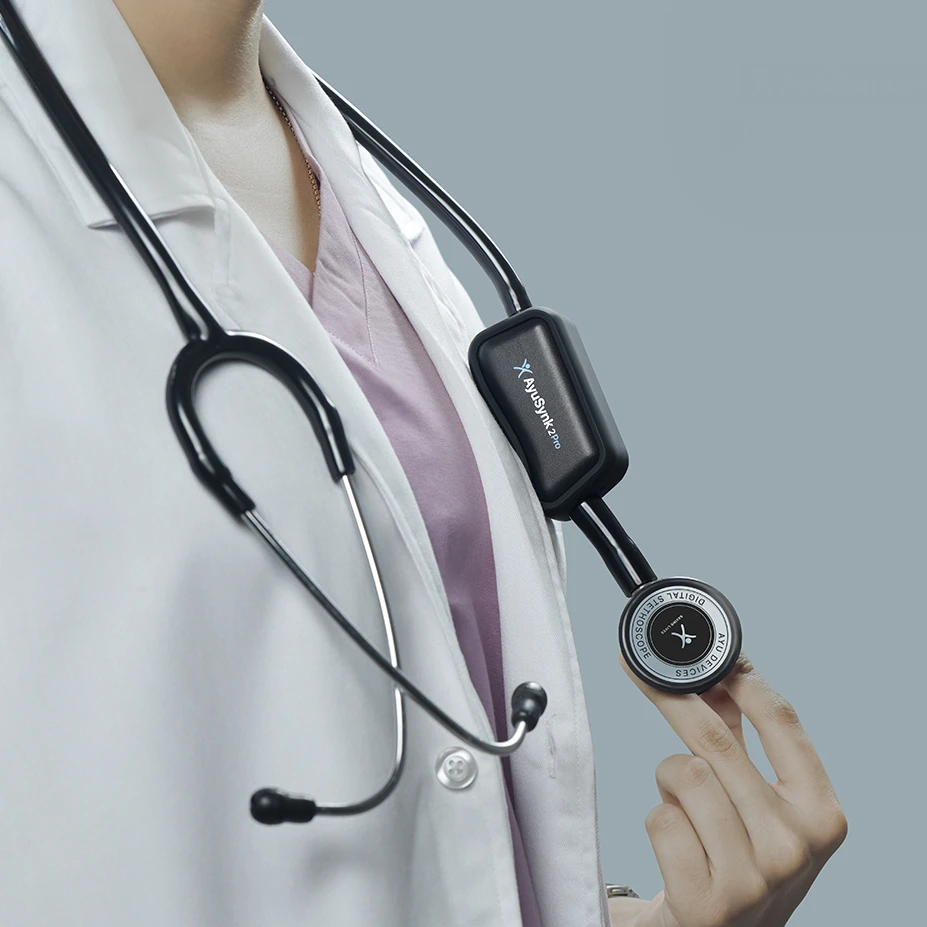
Clinicians can review physiological sounds from almost anywhere with the aid of modern remote auscultation solutions that integrate digital stethoscopes, cloud-based platforms, secure data transmission, and AI-assisted analysis. By providing real-time transmission of physiological sounds, recording, visualization, and AI-assisted evaluation within a single workflow, advanced tele-auscultation devices like the AyuSynk Digisteth 2 Pro Advance further promote connected care.
What is Remote Patient Auscultation?
Remote patient auscultation refers to the process of capturing, transmitting, and reviewing physiological sounds, such as heart sounds and lung sounds, when the healthcare professional and patient are located in different places.
Unlike conventional auscultation, where a clinician listens directly through a stethoscope during an in-person visit, remote auscultation enables physiological sounds to be recorded, shared, visualized, and analyzed using digital technologies.
This approach is particularly valuable for:
- Chronic disease management
- Follow-up clinical assessment
- Rural healthcare delivery
- Telemedicine consultations
- Home healthcare programs
- Specialist referrals
For patients living far from specialist centers, remote auscultation can reduce travel requirements while improving access to timely clinical evaluation.
How Doctors Review Heart and Lung Sounds Remotely?
Modern remote patient auscultation follows a structured workflow that ensures physiological sounds are captured accurately and reviewed efficiently.
Digital Recording Process
The process begins with a digital stethoscope placed on standard anatomical positions by a healthcare professional, caregiver, or trained patient.
The device captures:
- Heart sounds
- Lung sounds
- Respiratory patterns
- Vascular sounds
These physiological sounds are converted into digital signals that can be amplified, filtered, recorded, and transmitted.
For example, the AyuSynk 2 Pro Advance amplifies physiological sounds up to 60 times and includes dedicated heart and lung filters, helping clinicians capture clearer recordings for remote clinical assessment.
Cloud-Based Review Systems
Once captured, recordings are uploaded to secure cloud-based platforms that allow clinicians to review the data remotely.
Depending on system capabilities, clinicians may access:
- Recorded physiological sounds
- Waveforms
- Phonocardiograms
- Spectrograms
- Historical patient recordings
Platforms integrated with devices such as the AyuSynk 2 Pro Advance also allow clinicians to generate reports, review recordings at playback speeds of up to 0.25x, and compare physiological sounds over time.
Cloud-based access also enables collaboration between primary care physicians and specialists.
AI-Assisted Interpretation Tools
Artificial intelligence is increasingly being integrated into remote auscultation platforms.
AI-assisted tools can help identify:
- S1 heart sound
- S2 heart sound
- Systole
- Diastole
- Potential abnormalities
AI can support clinical decision-making by providing an additional layer of insight, but the final assessment should always remain with the physician.
One advantage of recorded auscultation is that AI can organize recordings into structured phonocardiograms that are easier to interpret. While live waveforms can be difficult to understand because they do not reflect a textbook format, recorded phonocardiograms become more clinically useful when AI helps classify S1, systole, S2, and diastole.
Built for reliable remote auscultation and collaboration
Remote Lung and Heart Sound Recording Devices
The success of remote patient auscultation depends heavily on the quality of the recording device being used.
Clinical Accuracy Considerations
When selecting a remote lung and heart sound recording device, healthcare organizations should evaluate:
- Frequency response accuracy
- Physiological sound clarity
- Recording quality
- AI-assisted analysis support
- Integration with telemedicine platforms
Studies have shown that amplified auscultation can improve the detection of subtle cardiac findings, particularly during screening and follow-up assessments.
How AyuSynk 2 Pro Advance Supports Remote Patient Auscultation?
Healthcare organizations seeking reliable remote auscultation solutions require devices specifically designed for tele-auscultation and connected care.
The AyuSynk 2 Pro Advance has been developed to support advanced remote patient auscultation workflows through a combination of high-quality sound capture, tele-auscultation capabilities, AI-assisted analysis, and seamless data sharing.
Key features include:
- Up to 60x sound amplification
- Unlimited real-time screening for two years
- AI-based abnormality detection
- Dedicated heart and lung filters
- Recording and sharing capabilities
- Phonocardiogram and spectrogram visualization
- Report generation
- AyuShare platform integration
- Playback speeds up to 0.25x
Unlike many conventional digital stethoscopes, the AyuSynk 2 Pro Advance is specifically designed for real-time transmission of high-fidelity physiological sounds, making it suitable for telemedicine consultations and remote clinical assessment.
Another important advantage is that AyuSynk Pro is not restricted by a distance range, enabling healthcare organizations to deploy tele-auscultation services across geographically separated locations without limitations associated with safe distant auscultation systems.
This makes it particularly useful for:
- Telemedicine networks
- Rural healthcare programs
- Specialist referral systems
- Government healthcare initiatives
- Hospital-at-home programs
- Connected care ecosystems
By combining amplification, recording, visualization, and AI-assisted review, the device supports more structured and efficient remote clinical assessment workflows.
Role of Continuous Patient Monitoring at Home
Healthcare is increasingly shifting toward proactive disease management rather than reactive treatment.
Chronic Disease Tracking
Patients living with cardiovascular and respiratory conditions often require regular assessment of physiological changes.
Remote auscultation allows clinicians to monitor patients without requiring frequent clinic visits.
Examples include:
- Heart failure management
- Chronic obstructive pulmonary disease (COPD)
- Asthma monitoring
- Valvular heart disease follow-up
Early Warning Detection
Changes in physiological sounds may indicate disease progression before symptoms become severe.
Remote monitoring programs help clinicians identify these changes earlier and intervene sooner.
Post-Treatment Monitoring
Following hospitalization or treatment, ongoing assessment can support recovery monitoring and reduce unnecessary readmissions.
Home-based monitoring provides continuity between hospital discharge and long-term care.
Telemedicine Integration in Remote Auscultation
Remote auscultation delivers maximum value when integrated into broader telemedicine ecosystems.
Video Consultation Synchronization
Clinicians can perform virtual consultations while simultaneously reviewing transmitted physiological sounds.
This creates a more comprehensive clinical assessment experience than video alone.
Electronic Health Record Integration
Many modern systems support integration with electronic health records (EHRs), allowing clinicians to:
- Store recordings
- Track patient progress
- Compare historical data
- Document findings efficiently
Data Sharing Across Clinicians
Remote auscultation supports collaborative care by allowing specialists to review recordings and provide additional clinical opinions.
This can improve decision-making and reduce delays in specialist referrals.
Benefits of Remote Patient Auscultation
Faster Clinical Assessment
Physicians can access physiological sound recordings quickly, reducing delays in review and consultation.
Reduced Hospital Visits
Patients with stable chronic conditions may require fewer in-person appointments while still receiving regular monitoring.
Improved Chronic Care Outcomes
Regular assessment supports better disease management and earlier identification of clinical deterioration.
Better Access to Specialists
Remote auscultation helps connect patients in underserved areas with cardiologists, pulmonologists, and other specialists.
Enhanced Clinical Documentation
Recorded physiological sounds create a longitudinal record that can be reviewed over time, improving continuity of care.
Challenges in Remote Auscultation
While remote auscultation offers significant advantages, several challenges remain.
Data Quality Concerns
Recording quality may vary depending on:
- Device quality
- Placement technique
- User training
- Environmental conditions
Patient Compliance
Successful monitoring depends on patients or caregivers following recommended recording procedures consistently.
Technical Limitations
Factors such as internet connectivity and software compatibility may occasionally affect performance.
Training Requirements
Auscultation is not an innate ability; it is a skill developed through repetitive practice. Healthcare professionals must receive appropriate training to maximize the value of remote auscultation technologies.
Future of Remote Cardiac and Pulmonary Monitoring
The future of remote patient auscultation is closely linked to advances in artificial intelligence and connected healthcare.
AI-Powered Predictive Healthcare
Future AI systems may identify subtle physiological changes before symptoms become clinically apparent.
Wearable Integration
Remote monitoring devices are expected to integrate more closely with wearable health technologies.
Smart Home Healthcare Systems
Connected home healthcare platforms may eventually combine periodic physiological sound assessment with vital signs, activity tracking, and predictive analytics, while keeping auscultation as an on-demand, clinician-guided process rather than continuous monitoring.
Expansion of Hospital-at-Home Programs
Healthcare systems worldwide are increasingly exploring hospital-at-home models that rely on remote diagnostics and monitoring technologies.
Remote auscultation is expected to play a central role in these programs.
Conclusion
Remote patient auscultation is transforming how clinicians evaluate heart sounds and lung sounds beyond traditional healthcare settings. By combining digital stethoscopes, secure cloud infrastructure, telemedicine platforms, and AI-assisted analysis, healthcare providers can perform meaningful clinical assessments regardless of location.
As healthcare continues to embrace connected care models, remote auscultation will become increasingly important for chronic disease management, specialist access, rural healthcare delivery, and continuous patient monitoring at home.
Solutions such as the AyuSynk 2 Pro Advance demonstrate how modern tele-auscultation technologies can support high-quality remote clinical assessment through advanced sound amplification, recording, visualization, AI-assisted analysis, and unrestricted-distance tele-auscultation capabilities.
Organizations that invest in remote auscultation today are positioning themselves for a future where healthcare is more accessible, connected, and patient-centered.
FAQs
What is remote patient auscultation?
Remote patient auscultation is the process of capturing and transmitting physiological sounds such as heart sounds and lung sounds to a clinician located elsewhere for clinical assessment.
Can doctors listen to heart sounds remotely?
Yes. Using digital stethoscopes and telemedicine platforms, clinicians can review heart sounds in real time or through recorded sessions.
How accurate is remote lung sound recording?
Modern digital stethoscopes can provide highly accurate physiological sound recordings when used with proper placement techniques and quality transmission systems.
Is remote patient monitoring safe?
Yes. Secure telemedicine systems use encryption, access controls, and healthcare compliance standards to protect patient data.
What devices support remote auscultation?
Remote auscultation is supported by digital stethoscopes, Bluetooth-enabled stethoscopes, and electronic stethoscopes that can capture physiological sounds precisely and enable them to be recorded, transmitted, or reviewed remotely by a clinician.
Remote auscultation is shaping the future of care

Dr. Ankit Kadarge
Dr. Ankit Kadarge is a writer, and Clinical Product Manager in MedTech who believes healthcare should be simple and understandable for everyone. He started his journey at Oxford Medical College, Bangalore, and soon discovered a love for writing, publishing over 20 articles with MedBound to make medical knowledge accessible.
Previously he has worked at ACKO, leading the life insurance vertical as a pilot doctor, where he gained a deeper understanding of how people experience and sometimes misunderstand healthcare. Today, he builds solutions that solve real problems for doctors and patients, blending his medical knowledge with product thinking.
On his blog, Ankit shares his experiences, learnings, and reflections on healthcare always in a way that’s easy to read and relate to.