Remote Auscultation Setup Guide for Devices, Workflow and Best Practices

Introduction
From a convenience-driven service, telemedicine has developed into an essential healthcare delivery strategy. The World Health Organization (WHO) reports that telehealth use increased dramatically following the COVID-19 pandemic, and healthcare systems all over the world are still investing in remote diagnostic capabilities to increase accessibility and close treatment gaps.
Despite the widespread use of video consultations, there is still a problem that needs to be resolved: how can doctors conduct meaningful cardiac and respiratory assessments without being physically present with the patient?
Healthcare workers can now listen to, record, analyze, and exchange physiological sounds at a distance thanks to the advent of remote auscultation setup options.
Modern telemedicine auscultation systems combine advanced digital stethoscopes, secure communication platforms, cloud-based storage, and AI-assisted analysis tools to support remote clinical assessment.
Whether supporting rural healthcare centers, telemedicine kiosks, specialist consultations, or post-discharge monitoring programs, remote auscultation is becoming an important component of connected healthcare.
As remote healthcare expands, purpose-built tele-auscultation solutions such as the AyuSynk 2 Pro Advance are helping healthcare providers perform real-time clinical assessment by enabling secure transmission, recording, and analysis of physiological sounds across different locations.
What is Remote Auscultation Setup?
A remote auscultation setup is a clinical workflow that enables medical professionals to assess physiological sounds, such as heart and lung sounds, without being physically present at the patient’s location.
This workflow uses a digital stethoscope, a medical device designed to capture physiological sounds and aid in successful remote auscultation. The recorded sounds can be securely transmitted to a medical expert for review, interpretation, and clinical assessment.
Unlike traditional auscultation, where a clinician listens directly at the point of care, remote auscultation allows sound collection, recording, visualization, and review across different locations while keeping the clinician still involved from any location with an internet connection.
This talent is especially useful for:
- Consultations via telemedicine
- Delivery of healthcare in rural areas
- Referrals from specialists
- In-home medical services
- Management of chronic illnesses
- Clinical evaluation follow-up
Core Components of a Remote Auscultation System
A complete telemedicine auscultation system typically includes three key elements:
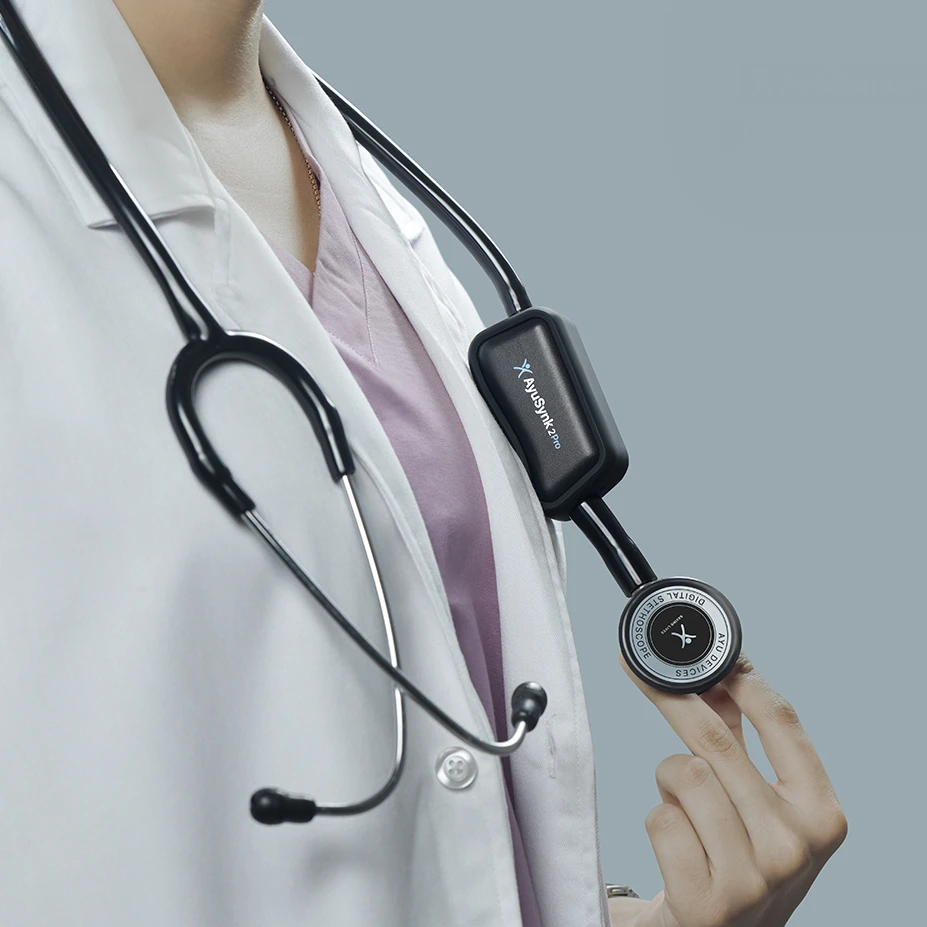
Digital Stethoscope Device
The digital stethoscope captures physiological sounds and converts them into electronic signals for amplification, recording, and transmission.
Modern systems often provide:
- Sound amplification
- Heart and lung filters
- Recording capability
- Sound visualization
- AI-assisted classification
For example, the AyuSynk 2 Pro Advance combines up to 60x sound amplification, dedicated heart and lung filters, AI-assisted detection, and real-time tele-auscultation capabilities, making it suitable for remote clinical workflows where sound clarity and transmission quality are essential.
Telemedicine Platform
The telemedicine platform acts as the communication bridge between the patient location and the clinician.
It enables:
- Real-time consultations
- Data sharing
- Sound review
- Clinical collaboration
Cloud Storage Infrastructure
Cloud-based systems allow healthcare organizations to:
- Store patient recordings
- Review historical data
- Share clinical findings
- Maintain documentation continuity
How Remote Auscultation Works in Clinical Practice?
A remote auscultation workflow follows a structured process.
Step 1: Patient-Side Sound Capture
A trained healthcare worker, nurse, technician, or physician places the digital stethoscope on specific anatomical locations.
The device captures physiological sounds such as:
- Heart sounds
- Lung sounds
- Vascular sounds
The sounds are immediately converted into digital signals.
Step 2: Data Transmission
The recorded or real-time sounds are transmitted through a secure network connection.
Depending on the setup, transmission may occur through:
- Mobile applications
- Telemedicine platforms
- Cloud systems
- Integrated healthcare networks
Step 3: Physician Review
The clinician receives the transmitted physiological sounds for evaluation.
Depending on the system capabilities, physicians may review:
- Live auscultation streams
- Recorded sounds
- Waveforms
- Phonocardiograms
- Spectrograms
The ability to replay recordings provides a major advantage compared to traditional auscultation.
Cloud enabled architecture supports scalable telemedicine services
Telemedicine Auscultation System Architecture
A successful remote auscultation setup requires seamless integration between devices, software, and clinical workflows.
Device Layer
This includes:
- Digital stethoscope hardware
- Mobile devices
- Tablets
- Clinical workstations
Application Layer
Applications provide:
- Recording controls
- Data management
- Clinical visualization
- Report generation
Cloud Layer
Cloud infrastructure supports secure storage, data backup, specialist collaboration, long-term patient tracking, and cloud-based processing of AI predictions, such as identifying whether findings are normal or abnormal, or whether specific clinical patterns are present or absent.
Through integration with the AyuShare platform, the AyuSynk 2 Pro Advance allows healthcare teams to securely store recordings, generate reports, review phonocardiograms and spectrograms, and collaborate with specialists remotely.
This architecture allows healthcare organizations to scale telemedicine services across multiple locations.
Remote Heart Sound Monitoring Device Features
Not all digital stethoscopes are designed for remote care.
A high-quality remote heart sound monitoring device should include several critical features.
Real-Time Sound Capture
Real-time transmission enables clinicians to hear physiological sounds as they are captured.
This supports immediate clinical assessment and specialist consultation.
High-Fidelity Sound Transmission
Cardiac sounds often contain subtle features that influence clinical decisions.
High-fidelity transmission helps preserve sound quality during transfer.
Important specifications include:
- Wide frequency response range
- High signal accuracy
- Sound amplification
- Dedicated heart and lung filters
Devices such as the AyuSynk 2 Pro Advance are designed specifically for high-fidelity transmission of physiological sounds. With support for amplification, filtering, recording, and visualization, clinicians can perform more structured assessments even when patients and specialists are located in different regions.
AI Interpretation Support
AI-assisted systems can help classify recorded sounds into:
- S1
- S2
- Systole
- Diastole
It is important to note that AI supports clinical interpretation rather than replacing physician judgment.
How AyuSynk 2 Pro Advance Supports Remote Auscultation Workflows?
Healthcare organizations implementing tele-auscultation programs require solutions specifically designed for remote clinical assessment.
The AyuSynk 2 Pro Advance has been developed to support these workflows through a combination of sound enhancement, tele-auscultation capabilities, recording, and AI-assisted analysis.
Key capabilities include:
- Up to 60x sound amplification
- Unlimited real-time screening
- AI-based abnormality detection
- Dedicated heart and lung filters
- Recording and sharing capabilities
- Phonocardiogram and spectrogram visualization
- Report generation
- AyuShare platform integration
Unlike older systems, the AyuSynk 2 Pro Advance is built for real-time transmission of high-fidelity physiological sounds during telemedicine consultations.
An important advantage is that AyuSynk Pro is not restricted by a distance range, allowing healthcare organizations to deploy tele-auscultation services across geographically separated locations.
This makes it particularly useful for:
- Telemedicine hubs
- Rural health programs
- Specialist referral networks
- Government healthcare initiatives
- Hospital-at-home programs
By combining real-time auscultation with recording and AI-assisted review, the platform supports more structured remote clinical assessment.
Secure Transmission of Heart Sounds
Data security remains a critical consideration for remote healthcare systems.
Patient information must be protected throughout the entire transmission process.
Data Encryption
Most telemedicine systems utilize:
- End-to-end encryption
- Secure cloud storage
- Role-based access controls
These measures help protect sensitive patient information.
Regulatory Compliance
Healthcare organizations typically align systems with regulatory frameworks such as:
- HIPAA (United States)
- GDPR (European Union)
- Local healthcare privacy regulations
Compliance supports patient confidentiality and secure clinical operations.
Remote Patient Monitoring in Healthcare
Remote auscultation increasingly supports broader remote patient monitoring initiatives.
Chronic Disease Management
Patients with chronic cardiovascular conditions often require ongoing monitoring.
Remote assessment allows clinicians to track changes without requiring frequent hospital visits.
Post-Discharge Follow-Up
Research suggests that early follow-up after hospital discharge can reduce readmission rates.
Remote auscultation enables physicians to evaluate recovery progress while patients remain under assisted care.
Rural Healthcare Support
According to WHO estimates, nearly half of the world’s population lacks access to essential healthcare services.
This is where tele-auscultation solutions such as the AyuSynk 2 Pro Advance can play an important role. Its ability to transmit physiological sounds in real time without distance limitations makes it valuable for specialist consultations, government healthcare programs, and rural healthcare networks.
Remote diagnostic systems help bridge this gap by connecting specialists with underserved communities.
Best Practices for Remote Auscultation Setup
Successful implementation requires standardized processes.
Standardized Recording Protocols
Consistent recording techniques improve reliability.
Clinicians should establish:
- Fixed anatomical positions
- Standard recording durations
Device Calibration
Regular device checks help maintain sound quality and accuracy.
Clinician Training
Technology alone does not guarantee effective auscultation.
Training remains essential because auscultation skills improve through practice and experience.
Platforms like AyuShare that support recording and playback can also enhance training. For example, recordings captured using the AyuSynk 2 Pro Advance can be reviewed later as phonocardiograms and spectrograms, helping clinicians better understand cardiac cycles through AI-assisted classification of S1, systole, S2, and diastole.
Structured education programs can improve consistency across healthcare teams.
Challenges in Remote Auscultation
Despite significant progress, challenges remain.
Sound Distortion
Network limitations may occasionally affect transmission quality.
Connectivity Dependence
Stable internet access remains important for real-time tele-auscultation.
Clinical Adoption
Some healthcare professionals require time to adapt to digital workflows and remote assessment methods.
However, growing familiarity with telemedicine continues to reduce these barriers.
Future of Remote Diagnostic Systems
Remote auscultation is expected to become increasingly sophisticated over the coming years.
Key developments include:
AI-Powered Tele-Auscultation for Cardiology
AI-powered tele-auscultation helps identify normal or abnormal findings as an additional layer within clinical assessment.
Hospital-at-Home Models
Healthcare systems are increasingly exploring care delivery outside traditional facilities.
Predictive Monitoring Systems
Future platforms may identify risk patterns before symptoms become clinically apparent.
These innovations have the potential to improve early intervention and patient outcomes.
Conclusion
Remote auscultation is transforming how healthcare organizations deliver cardiac and respiratory assessment beyond traditional clinical settings.
Solutions such as the AyuSynk 2 Pro Advance demonstrate how modern telemedicine auscultation systems are evolving beyond basic sound transmission. By combining real-time tele-auscultation, AI-assisted analysis, recording, report generation, and secure data sharing, they help healthcare organizations deliver more connected and efficient care.
As healthcare continues moving toward connected care models, remote auscultation will play an increasingly important role in improving access to specialist expertise, supporting rural populations, enhancing chronic disease management, and expanding remote patient monitoring capabilities.
Organizations that invest in structured remote auscultation setup today will be better positioned to meet the evolving demands of modern healthcare delivery.
FAQs
What is remote auscultation?
Remote auscultation is the process of capturing and transmitting physiological sounds such as heart and lung sounds to a clinician located elsewhere for clinical assessment.
How does a telemedicine auscultation system work?
It uses a digital stethoscope, software platform, and secure communication network to capture, transmit, and review physiological sounds remotely.
Is remote heart sound monitoring accurate?
Modern systems can provide high-quality physiological sound transmission, especially when using devices designed for tele-auscultation and standardized recording protocols.
What devices are needed for a remote auscultation setup?
A digital stethoscope, communication platform, mobile device or workstation, internet connection, and secure storage infrastructure are typically required.
Is remote auscultation used in hospitals today?
Yes. Many hospitals, telemedicine programs, rural healthcare initiatives, and specialist referral networks now use remote auscultation to support connected care and remote clinical assessment.
Remote auscultation expands access to quality healthcare

Dr. Ankit Kadarge
Dr. Ankit Kadarge is a writer, and Clinical Product Manager in MedTech who believes healthcare should be simple and understandable for everyone. He started his journey at Oxford Medical College, Bangalore, and soon discovered a love for writing, publishing over 20 articles with MedBound to make medical knowledge accessible.
Previously he has worked at ACKO, leading the life insurance vertical as a pilot doctor, where he gained a deeper understanding of how people experience and sometimes misunderstand healthcare. Today, he builds solutions that solve real problems for doctors and patients, blending his medical knowledge with product thinking.
On his blog, Ankit shares his experiences, learnings, and reflections on healthcare always in a way that’s easy to read and relate to.