Complete Cardiology Stethoscope Buying Guide for Acoustic Digital and AI Enabled Models

Introduction
One of the most often used devices in medicine, particularly in cardiology, is still the stethoscope. Auscultation is still essential for initial cardiac screening and clinical evaluation, even with the development of imaging methods like cardiac MRI, CT angiography, and echocardiography.
However, the demands placed on cardiologists today are significantly different from those of previous decades. Higher patient volumes, increasing cardiovascular disease prevalence, and growing expectations for diagnostic accuracy have transformed what clinicians expect from a cardiology stethoscope.
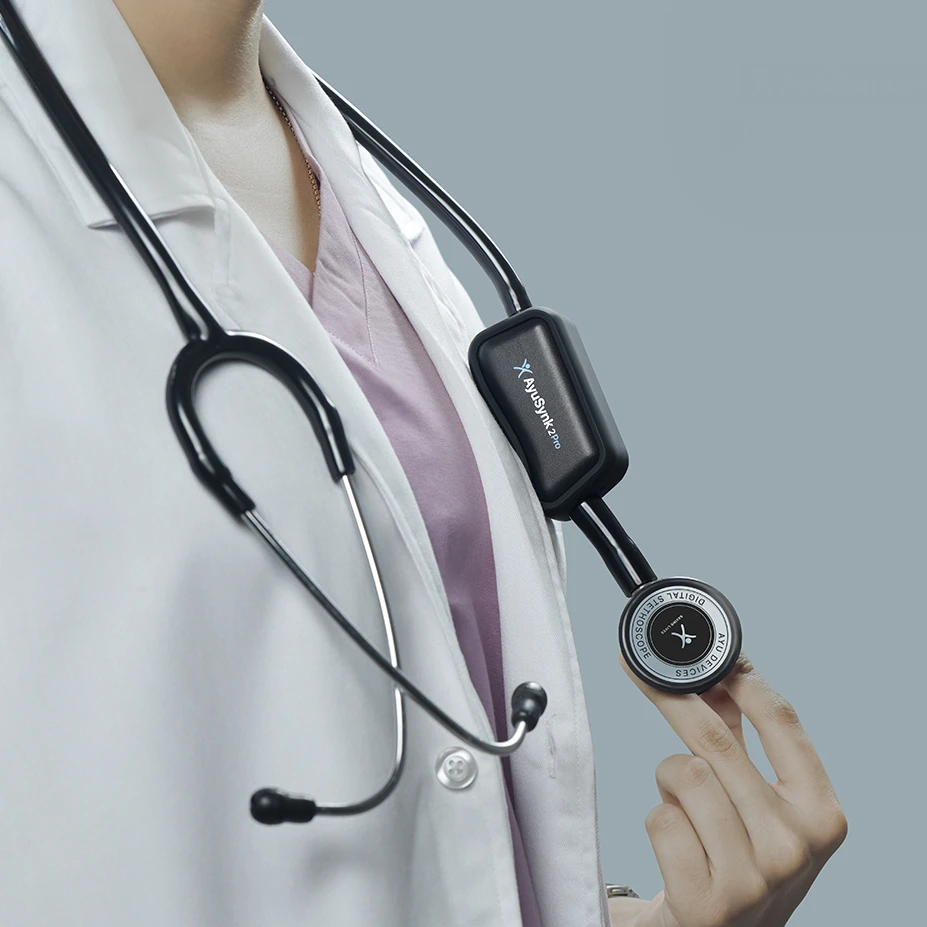
Traditional acoustic devices served generations of physicians well. Yet modern healthcare increasingly requires recording capabilities, data sharing, AI-assisted analysis, and clearer identification of subtle physiological sounds. Devices such as the AyuSynk 2+ reflect this shift by combining sound amplification, recording, phonocardiogram visualization, and AI-assisted support within a single cardiology auscultation platform.
As a result, many clinicians are now evaluating whether an acoustic, digital, or AI-enabled stethoscope best supports their workflow. This guide explores the differences and helps cardiologists, hospital buyers, and healthcare organizations make informed decisions.
What is a Cardiology Stethoscope?
A cardiology stethoscope is a specialist auscultation instrument used to assess cardiovascular function by detecting heart sounds, murmurs, rhythm patterns, and other physiological signals produced by cardiac activity.
Cardiology focused stethoscopes are designed to hear cardiology sounds with clarity and analyze low-pitch sounds better than traditional general-purpose stethoscopes.
Clinicians can evaluate patients with accuracy, thanks to the AI tech integrated into modern stethoscopes. Here’s what you can read more clearly:
- Anomalies of the heart valves
- Abnormalities in heart rhythm
- Congenital Heart abnormalities
- Indications of heart failure
- Unusual blood flow patterns and murmurs
Auscultation is still a useful first-line assessment method, especially in general care, cardiology clinics, emergency rooms, and rural healthcare settings, according to research published in cardiovascular medical publications.
Types of Cardiology Stethoscopes
Acoustic Stethoscopes
These traditional devices transmit physiological sounds directly from the chest piece to the clinician’s ears through hollow tubing.
Digital Stethoscopes
Digital stethoscopes convert physiological sounds into electronic signals that can be amplified, filtered, recorded, and replayed.
AI-Enabled Stethoscopes
AI-enabled systems build upon digital technology by adding automated pattern recognition, heart sound classification, waveform analysis, and clinical decision support capabilities.
Why Choosing the Right Cardiology Stethoscope Matters?
Selecting the right cardiology stethoscope directly impacts diagnostic accuracy and clinical efficiency.
Diagnostic Precision
Many cardiac abnormalities initially present as subtle physiological changes. Faint murmurs or extra heart sounds may be difficult to identify using conventional devices.
Enhanced sound processing improves the ability to detect these changes earlier.
Workflow Efficiency
Modern healthcare environments demand faster documentation and collaboration.
Clinicians increasingly need to:
- Record heart sounds
- Share findings with specialists
- Track patient progress over time
- Support remote consultations
These requirements extend beyond what traditional acoustic stethoscopes can offer.
Emergency and Critical Care
In emergency settings, clinicians often work in environments with considerable external sound interference.
Tools that enhance physiological sounds while minimizing external disturbances can support faster and more confident decision-making.
Choose auscultation technology that matches clinical needs
Acoustic vs Digital vs AI-Enabled Stethoscopes
| Feature | Acoustic Stethoscopes | Digital Stethoscopes | AI-Enabled Stethoscopes |
|---|---|---|---|
| How They Work | Transmit physiological sounds directly through tubing to the clinician’s ears. | Convert physiological sounds into electronic signals for enhancement and processing. | Combine digital auscultation with intelligent algorithms for automated sound analysis. |
| Advantages | • No batteries required • Easy to use • Lightweight and durable • Familiar to most clinicians |
• Sound amplification • Heart and lung filtering • Recording and playback • Sound sharing • Visualization capabilities |
• Automatic identification of S1 and S2 • Classification of systole and diastole • Detection of abnormal sound patterns |
| Diagnostic Support | Relies entirely on clinician experience and hearing ability. | Enhanced sound clarity helps clinicians identify subtle physiological sounds more effectively. | Assists clinicians by recognizing patterns and highlighting findings that may require further evaluation. |
| Recording Capability | Not available | Available for documentation, follow-up comparison, and education. | Available along with automated analysis of recorded sounds. |
| Playback Functionality | Not available | Supports playback and detailed review of recorded physiological sounds. | Supports playback with AI-assisted classification and interpretation. |
| Visualization | Not available | Displays waveforms and spectrograms for better review. | Displays AI interpretations of murmur presence or absence, classifies murmurs as loud, soft, or absent, and predicts S1, S2, systole, and diastole-related events. |
| Sound Amplification | Not available | Available, often with significant amplification of physiological sounds. | Available with intelligent signal analysis. |
| Clinical Limitations | Performance depends heavily on clinician experience. Subtle murmurs may be difficult to identify in noisy environments. | Requires battery power and familiarity with digital workflows. | Supports AI-assisted murmur identification through cloud-based processing requiring a stable internet connection. Final clinical interpretation remains the clinician’s responsibility. |
| Best Use Cases | Routine clinical assessment, medical training, and remote areas where electricity may be limited. | Cardiology clinics, hospitals, education, documentation, and follow-up assessments. | Advanced cardiac screening, high-volume cardiology workflows, structured analysis, and decision-support environments. |
| Example in Practice | Traditional acoustic auscultation. | Devices such as Avusynk 2+ allow clinicians to record physiological sounds, review them at playback speeds of up to 0.25×, generate reports, and visualize recordings through phonocardiograms and spectrograms. | Modern intelligent auscultation systems that classify heart sounds and support more structured clinical assessment. |
Signal Amplification in Heart Sound Devices
One of the most important advances in modern cardiology stethoscope technology is signal amplification in heart sound devices.
Heart sounds are often low in intensity.
Factors affecting audibility include:
- Patient body habitus
- Clinical environment
- Clinician experience
- Device quality
Amplification improves sound perception by increasing the intensity of physiological signals without compromising clarity.
Modern devices such as the AyuSynk 2+ provide up to 60x sound amplification, helping cardiologists hear subtle murmurs and additional heart sounds more clearly during routine screening and complex cardiac evaluations.
Why Amplification Matters?
Amplified sounds help clinicians detect:
- Early-stage murmurs
- Valve abnormalities
- Gallops
- Additional heart sounds
Research suggests that enhanced auscultation systems improve recognition of subtle cardiac findings, particularly among trainees and less experienced clinicians.
Noise Filtering Technologies
Modern devices also use filtering systems that help separate cardiac and respiratory frequency ranges.
Importantly, these systems reduce external noise while preserving physiological sounds.
This distinction is critical because clinicians need to hear body sounds clearly without interference from environmental distractions.
The AyuSynk 2+ incorporates dedicated heart and lung filters along with in-device external noise reduction to improve the clarity of physiological sounds in busy clinical environments.
Best Stethoscope for Cardiac Specialists – Key Features
When evaluating the best stethoscope for cardiac specialists, several factors should be considered.
Frequency Response Accuracy
Cardiac sounds often occur across different frequency ranges.
A quality device should capture:
- Low-frequency gallops
- Mid-frequency heart sounds
- High-frequency murmurs
Accurate frequency response improves clinical assessment quality.
Noise Cancellation Capability
External noise reduction improves clarity during screening in:
- OPDs
- ICUs
- Emergency departments
- Telemedicine kiosks
Recording and Playback Support
Recording capabilities allow clinicians to:
- Track disease progression
- Compare sounds over time
- Support medical education
- Facilitate specialist consultation
AI Interpretation Support
AI-assisted review can help classify:
- S1
- S2
- Systole
- Diastole
Recorded sounds become easier to interpret because AI organizes the phonocardiogram into clinically meaningful segments.
In systems such as the AyuSynk 2+, AI-assisted review helps identify S1, S2, systole, and diastole from recorded heart sounds, supporting more structured clinical assessment and teaching.
Why AyuSynk 2+ Fits the Needs of Modern Cardiology Practice?
Among the newer generation of cardiology stethoscope solutions, the AyuSynk 2+ combines sound enhancement, visualization, recording, and AI-assisted analysis into a single platform.
Designed for clinicians who require more than basic auscultation, it offers features that support both routine screening and advanced cardiac assessment.
Key capabilities include:
- Up to 60x sound amplification
- In-device heart and lung filters
- Bluetooth connectivity
- AI-based detection support
- Recording and sharing capabilities
- Playback speeds up to 0.25x
- Report generation
- Phonocardiogram and spectrogram visualization
One of its strongest advantages is the ability to convert recorded heart sounds into structured visual formats.
While live waveforms can be difficult to interpret, recorded phonocardiograms become easier to understand because AI helps identify S1, systole, S2, and diastole.
The device also supports safe distant auscultation up to 10 meters, making it valuable for connected care workflows and supervised clinical assessments.
For cardiologists seeking a balance between advanced functionality, clinical practicality, and affordability, AyuSynk 2+ presents a compelling option.
Role of Professional Stethoscopes in Clinical Practice
H3: ICU Monitoring
Continuous cardiac assessment remains essential in intensive care settings.
Enhanced auscultation tools support rapid evaluation when immediate decisions are required.
Emergency Cardiac Assessment
Emergency physicians often need to assess cardiac status quickly.
Improved sound clarity can help identify abnormalities faster.
Routine Cardiac Screening
Early detection remains one of the strongest predictors of better cardiovascular outcomes.
High-quality auscultation tools support more effective screening programs.
Solutions such as the AyuSynk 2+ also allow clinicians to maintain recorded patient histories, making it easier to compare heart sounds across multiple visits and monitor changes over time.
How AI is Transforming Cardiology Stethoscopes?
Artificial intelligence is increasingly becoming part of cardiovascular assessment workflows.
Automated Heart Sound Classification
AI systems can identify:
- S1
- S2
- Systole
- Diastole
This improves consistency in interpretation.
Early Disease Detection Support
AI algorithms can highlight patterns that may warrant further investigation.
Clinical Decision Support
Rather than replacing clinicians, AI acts as an additional layer of support.
This can be especially valuable in high-volume environments where rapid decisions are necessary.
Procurement Checklist for Medical Buyers
Healthcare organizations evaluating cardiology stethoscope solutions should consider the following:
Compliance Standards
Ensure devices comply with applicable medical device regulations and quality requirements.
Durability
The device should withstand daily clinical use.
Integration Capabilities
Consider compatibility with:
- Hospital information systems
- Telemedicine platforms
- Mobile applications
Cost vs Value
Rather than focusing solely on purchase price, evaluate:
- Clinical utility
- Recording capabilities
- AI support
- Long-term usability
- Training benefits
A device that improves screening accuracy and workflow efficiency often delivers greater long-term value.
For example, the AyuSynk 2+ combines recording, visualization, AI-assisted analysis, Bluetooth connectivity, and report generation in a single device, helping healthcare organizations maximize clinical value without investing in multiple separate tools.
Conclusion
The cardiology stethoscope has evolved significantly from its acoustic origins. While traditional devices remain useful, modern clinical environments increasingly benefit from digital and AI-enabled solutions.
Features such as sound amplification, recording, phonocardiogram visualization, AI-assisted interpretation, and secure data sharing are reshaping how cardiologists perform clinical assessments.
Devices such as the AyuSynk 2+ demonstrate how modern cardiology stethoscopes are evolving from simple listening tools into comprehensive clinical assessment platforms that support better documentation, collaboration, and patient follow-up.
For clinicians seeking the best stethoscope for cardiac specialists, the decision should be based on diagnostic accuracy, workflow requirements, and long-term clinical value.
As cardiovascular disease continues to remain a leading global health challenge, advanced auscultation tools will play an increasingly important role in supporting early detection, better documentation, and more informed clinical decisions.
FAQs
What is the difference between acoustic and digital cardiology stethoscopes?
Acoustic stethoscopes transmit physiological sounds directly through tubing, while digital stethoscopes amplify, record, filter, and replay sounds for improved analysis.
Are AI-enabled stethoscopes reliable?
AI-enabled stethoscopes can support clinical assessment by classifying heart sounds and identifying patterns. However, in line with a human-in-the-loop approach, AI output should be used only as an additional layer to support objective clinical judgment and should not replace the clinician’s assessment or decision-making.
What is signal amplification in stethoscopes?
Signal amplification increases the intensity of physiological sounds, making subtle cardiac findings easier to hear and evaluate.
Which is the best stethoscope for cardiac specialists?
The best choice depends on clinical needs. Many specialists now prefer digital or AI-enabled systems that offer amplification, recording, visualization, and decision-support features. Devices such as the AyuSynk 2+ combine these capabilities with phonocardiogram visualization, AI-assisted review, and Bluetooth-enabled sharing for modern cardiology workflows.
Do hospitals prefer digital stethoscopes today?
Many hospitals and specialist clinics are increasingly adopting digital stethoscopes because they support documentation, collaboration, training, and remote clinical assessment.
Better tools enable more reliable heart assessment

Dr. Ankit Kadarge
Dr. Ankit Kadarge is a writer, and Clinical Product Manager in MedTech who believes healthcare should be simple and understandable for everyone. He started his journey at Oxford Medical College, Bangalore, and soon discovered a love for writing, publishing over 20 articles with MedBound to make medical knowledge accessible.
Previously he has worked at ACKO, leading the life insurance vertical as a pilot doctor, where he gained a deeper understanding of how people experience and sometimes misunderstand healthcare. Today, he builds solutions that solve real problems for doctors and patients, blending his medical knowledge with product thinking.
On his blog, Ankit shares his experiences, learnings, and reflections on healthcare always in a way that’s easy to read and relate to.