Best Stethoscope for Cardiologists with Murmur Detection Heart Sound Recording and AI Review

Introduction
Diagnostics in cardiology are getting more complicated, and there is a growing demand for quicker, more accurate, and more organized clinical evaluation. Auscultation is still one of the initial methods for assessing cardiac health, even as imaging and laboratory tests continue to advance.
Traditional acoustic stethoscopes, however, are not very good at picking up on minute physiological changes like early rhythm shifts or weak murmurs. The use of modern devices, such as digital stethoscopes for cardiology that provide amplification, recording, and organized waveform inspection, has clearly changed as a result.
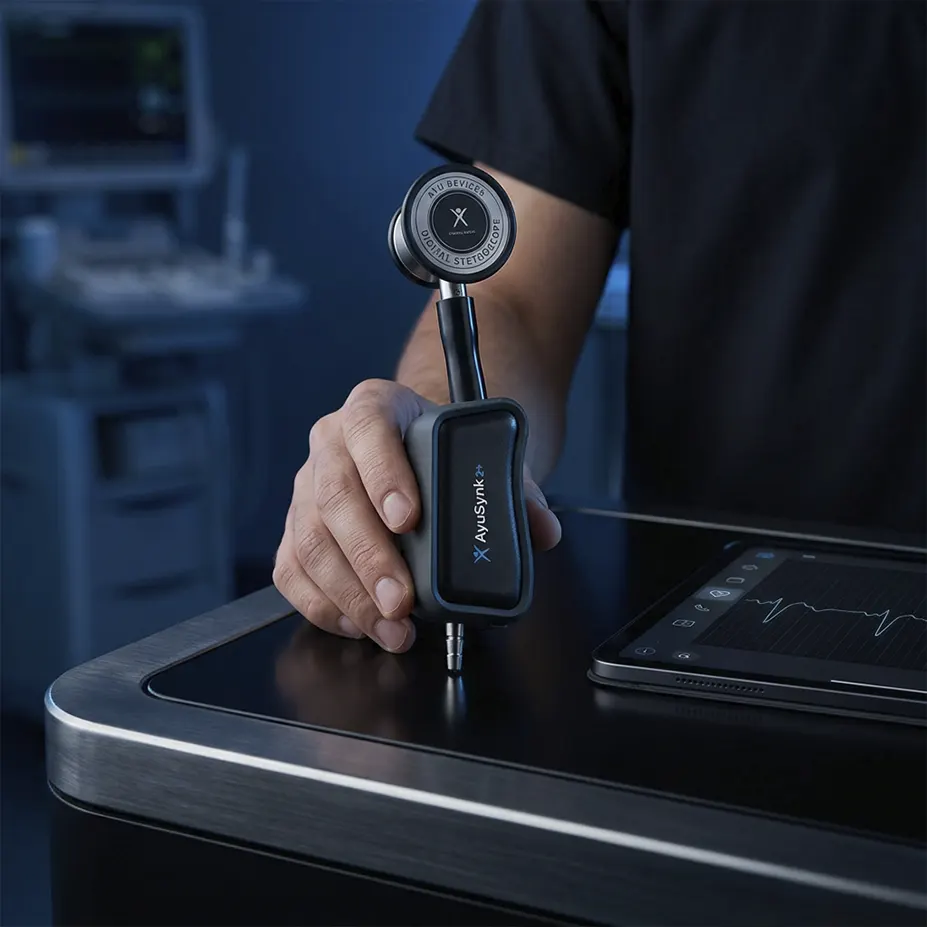
This shift is driving the adoption of advanced tools like AyuSynk 2+, which support structured heart sound recording, waveform review, and AI-assisted interpretation for improved clinical confidence.
In 2026, the definition of the best stethoscope for cardiologists is no longer limited to sound transmission alone. It now includes clarity of heart sounds, ability to detect murmurs accurately, support for recording, and AI-assisted interpretation for clinical confidence.
To further enhance workflow continuity, recorded heart sounds from AyuSynk 2+ can also be accessed and reviewed through the AyuShare app, allowing clinicians to store, revisit, and compare physiological recordings over time for better decision-making.
What is a Smart Cardiology Stethoscope?
A smart cardiology stethoscope is a specialized auscultation device intended to record, analyze, and optimize physiological sound data for better cardiac assessment.
An electronic stethoscope for heart sounds transforms physiological sounds into digital signals that may be amplified, filtered, and examined, compared to traditional acoustic instruments.
This makes it possible for cardiologists to identify minute changes in heart activity that might not be audible with traditional devices.
Key Technologies Behind Smart Stethoscopes
Smart stethoscopes integrate multiple technologies that improve diagnostic precision:
- Digital sound amplification: Enhances weak heart signals for better clarity
- Frequency filtering steth: Separates heart and lung sound ranges for focused analysis
- AI-based cardiac signal interpretation: Helps classify patterns such as S1, S2, systole, and diastole
- Waveform visualization tools: Displays heart sounds as phonocardiogram and spectrogram formats
These technologies work together to support structured clinical assessment.
Why Do Cardiologists Need Advanced Stethoscopes Today?
The global rise in cardiovascular diseases has significantly increased the demand for early and accurate detection tools.
Key reasons for adoption include:
- Higher prevalence of undiagnosed heart conditions requiring early murmur detection
- Increased patient load in outpatient and emergency settings
- Need for consistent diagnostic accuracy across different clinicians
- Integration of EHR workflows with medical devices.
Recent clinical insights suggest that structured auscultation tools can improve early murmur detection sensitivity by up to 25-30% when compared to conventional listening methods, especially in noisy clinical environments.
Devices such as AyuSynk 2+ are increasingly being used in structured cardiac screening workflows because they allow clinicians to revisit and analyze heart sounds beyond real-time auscultation.
Key Features of the Best Stethoscope for Cardiologists
Superior Heart Sound Clarity
One of the most important features is enhanced clarity of heart sounds. Advanced medical devices help:
- Detect low-intensity murmurs
- Improve separation of high and low-frequency cardiac signals
- Support clearer identification of subtle valve abnormalities
This directly improves diagnostic confidence during screening.
Murmur Detection and Pattern Recognition
Smart medical devices support structured murmur evaluation by:
- Identifying systolic and diastolic murmurs
- Highlighting abnormal sound patterns
- Supporting AI-assisted anomaly detection
This helps reduce subjective interpretation differences between clinicians.
Heart Sound Recording and Playback
Recording is a major advancement in cardiac auscultation.
Benefits include:
- Clinical documentation of patient heart sounds
- Comparison of heart sounds over time
- Playback at reduced speeds for detailed review
Recorded signals can be analyzed as:
- Phonocardiogram (PCG)
- Spectrogram
In tools like AyuSynk 2+, these recorded signals can be reviewed at reduced playback speeds, allowing better interpretation of subtle variations in cardiac cycles.
Additionally, with the AyuShare app, clinicians can securely access recorded heart sounds, organize patient files, and review historical cardiac data across visits, improving continuity of care and longitudinal assessment.
This makes complex cardiac patterns easier to study and understand.
Noise Reduction in Clinical Environments
External disturbances can interfere with auscultation accuracy. Advanced stethoscopes reduce external noise while preserving physiological sounds.
This improves:
- Clarity in OPD environments
- Accuracy in ICU and emergency wards
- Focus during rapid clinical assessments
This ensures clinicians hear only relevant physiological signals.
Noise reduction enhances clinical auscultation accuracy
AI-Based Cardiac Review Support
AI-based tools assist clinicians by:
- Supporting decision-making in borderline cases
- Identifying early risk indicators
- Classifying cardiac cycle components such as S1, S2, systole, and diastole
While AI does not replace clinical judgment, it provides structured support for better evaluation.
For example, AyuSynk 2+ provides AI-assisted identification of cardiac cycle components such as S1, S2, systole, and diastole, helping clinicians maintain consistency during screening.
Cardiology Digital Stethoscope vs Traditional Stethoscope
| Feature | Traditional Stethoscope | Cardiology Digital Stethoscope |
|---|---|---|
| Sound Clarity | Limited | Enhanced with amplification |
| Murmur Detection | Dependent on experience | Improved via filtering |
| Recording Capability | Not available | Available |
| Clinical Efficiency | Manual interpretation | Structured review support |
| Data Usage | None | Phonocardiogram & spectrogram |
Digital stethoscopes clearly improve both diagnostic structure and workflow efficiency.
Role of AI in Smart Cardiac Auscultation
Artificial intelligence is becoming an important part of cardiac assessment.
Key roles include:
- Pattern recognition in heart sounds
- Identification of abnormal cardiac rhythms
- Early risk prediction support
- Assistance in structured clinical decision-making
AI enables more consistent interpretation, especially in high-volume clinical environments.
How AyuSynk 2+ Supports Advanced Cardiac Auscultation?
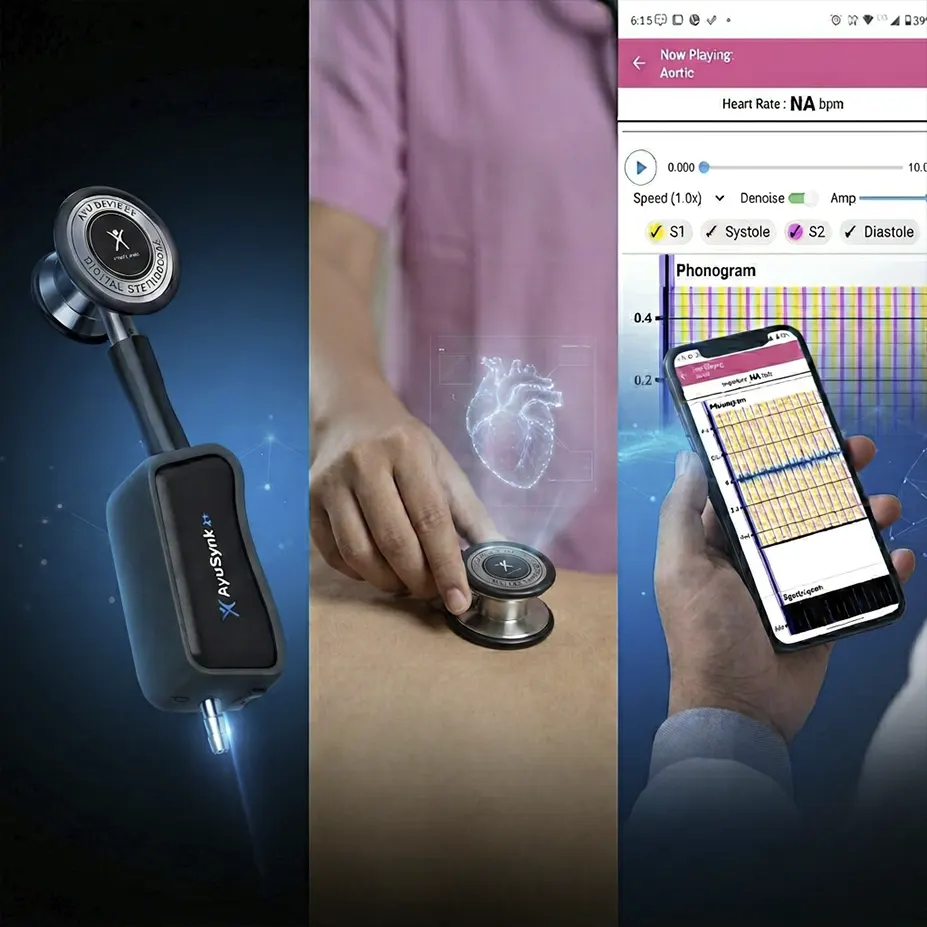
AyuSynk 2+ is designed for cardiologists who need clarity, structured review, and reliable recording during clinical assessment. It supports advanced auscultation workflows by combining sound enhancement with intelligent analysis tools.
With up to 60x sound amplification, clinicians can hear subtle physiological variations more clearly, which is especially useful in early murmur detection and cardiac screening.
The device enables:
- Recording and playback of heart sounds at reduced speed (up to 0.25x) for detailed review
- Visualization of cardiac signals through phonocardiogram and spectrogram formats
- AI-based detection support for identifying S1, S2, systole, and diastole patterns
- Heart and lung filters to isolate specific physiological sounds
- Report generation for long-term patient tracking and comparison
Unlike traditional tools that depend only on real-time listening, AyuSynk 2+ allows clinicians to revisit, analyze, and compare heart sounds over time. This improves consistency in interpretation, especially in cases where murmurs are subtle or intermittent.
It is particularly useful in:
- outpatient cardiology screening
- follow-up evaluations
- clinical teaching and training
- remote consultation workflows
Recorded data from AyuSynk 2+ can be seamlessly managed through the AyuShare app, allowing clinicians to store cases, revisit past recordings, and track progression across follow-ups.
AyuSynk 2+ helps bridge the gap between real-time auscultation and structured cardiac analysis, making it a strong fit for smart cardiology practice.
Clinical Use Cases in Cardiology
- Detection of heart murmurs in outpatient screening
- Continuous cardiac monitoring in ICU environments
- Pre-surgical cardiac evaluation for risk assessment
- Remote cardiology consultations for second opinions
In outpatient and remote settings, medical devices like AyuSynk 2+ help clinicians maintain continuity of care by enabling structured recording and review of cardiac sounds.
These use cases demonstrate how smart stethoscopes support both routine and advanced care.
What to Consider Before Choosing a Cardiology Stethoscope?
Key factors include:
- Frequency response range for accurate sound capture
- Amplification strength for weak signal detection
- AI-assisted interpretation capability
- Battery performance for clinical workload
- Compatibility with hospitals and apps
Choosing the right system improves both efficiency and diagnostic quality.
Future of Cardiology Auscultation Technology
The future of cardiac auscultation is moving toward:
- AI-first diagnostic support
- Remote cardiac monitoring expansion
- Predictive screening for heart disease
- Integration with full hospital digital ecosystems
This evolution will make cardiac assessment more structured, scalable, and accessible.
Conclusion
Selecting the best stethoscope for a cardiologist today involves more than just sound quality. It requires a combination of clarity, recording capability, and intelligent analysis tools that support accurate cardiac evaluation.
The shift toward cardiology digital stethoscopes reflects a broader transformation in healthcare, where data-driven interpretation and AI-assisted review improve clinical consistency and patient outcomes.
Platforms like the AyuShare app, combined with devices such as AyuSynk 2+, further strengthen this ecosystem by enabling structured review, storage, and sharing of cardiac sound data for continuous clinical improvement.
As technology continues to evolve, advanced auscultation tools will play a central role in improving early detection, diagnosis accuracy, and overall cardiac care delivery.
FAQs
What is the best stethoscope for cardiologists today?
A smart cardiology digital stethoscope with amplification, recording, and AI-assisted review capabilities.
How does a cardiology digital stethoscope improve diagnosis?
It enhances heart sound clarity, reduces external noise, and enables structured waveform analysis.
Can AI detect heart murmurs accurately?
AI can support murmur detection by identifying patterns, but clinical validation is still essential.
What features should cardiologists look for in a stethoscope?
Amplification, noise reduction, recording capability, waveform visualization, and AI support.
Is a digital stethoscope better than an acoustic one for cardiology?
Yes, for smart workflows, as it offers better clarity, documentation, and analysis tools.
Smart stethoscopes enhance early detection capabilities

Dr. Ankit Kadarge
Dr. Ankit Kadarge is a writer, and Clinical Product Manager in MedTech who believes healthcare should be simple and understandable for everyone. He started his journey at Oxford Medical College, Bangalore, and soon discovered a love for writing, publishing over 20 articles with MedBound to make medical knowledge accessible.
Previously he has worked at ACKO, leading the life insurance vertical as a pilot doctor, where he gained a deeper understanding of how people experience and sometimes misunderstand healthcare. Today, he builds solutions that solve real problems for doctors and patients, blending his medical knowledge with product thinking.
On his blog, Ankit shares his experiences, learnings, and reflections on healthcare always in a way that’s easy to read and relate to.