Why Electronic Stethoscopes Are Becoming the Preferred Choice for Doctors in 2026?

Introduction
Healthcare in 2026 is increasingly driven by smart medical technologies, connected care systems, and data-assisted clinical decision-making. Hospitals, clinics, and telemedicine networks are rapidly adopting advanced diagnostic tools that improve efficiency, accuracy, and patient monitoring.
Doctors today work in highly demanding environments where they must manage growing patient loads, complex clinical conditions, and faster diagnosis expectations. As a result, traditional diagnostic tools are evolving to meet the needs of modern healthcare delivery.
One of the most noticeable shifts is the growing adoption of electronic stethoscopes across multiple medical specialties.
The increasing popularity of electronic stethoscope benefits is closely linked to improvements in sound amplification, denoise technology, recording capabilities, AI-assisted analysis, and connected healthcare integration.
While acoustic stethoscopes continue to remain important in clinical practice, modern electronic systems provide enhanced functionality that supports more efficient and informed clinical assessment.
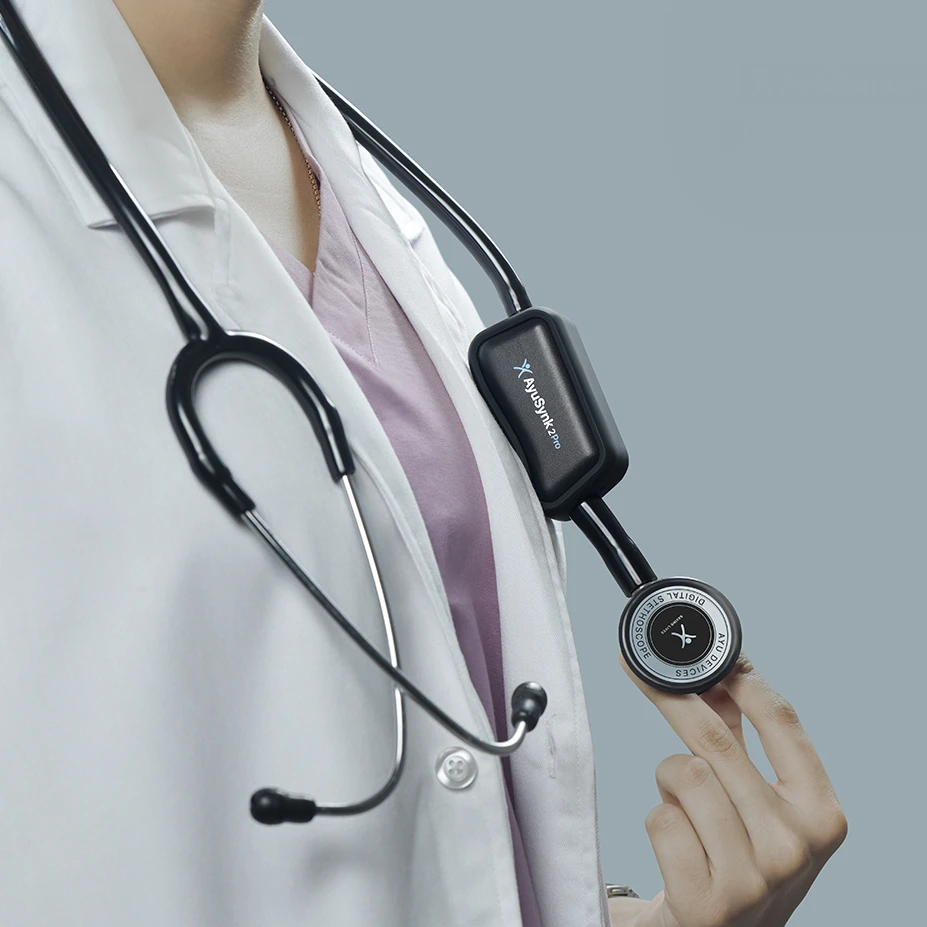
Solutions such as the AyuSynk Digisteth are helping redefine auscultation by combining sound clarity, advanced stethoscope features, visualization, recording, and tele-auscultation capabilities into a practical connected care solution.
What is an Electronic Stethoscope?
An electronic stethoscope is a modern auscultation device that captures physiological sounds electronically, amplifies them, analyzes them digitally, and allows doctors to analyze, record, and transfer them more effectively.
Electronic stethoscopes transform sounds into electronic signals for improved processing, in contrast to traditional acoustic stethoscopes that transfer sounds mechanically through tubes.
This approach facilitates:
- Improved amplification of sound
- Enhanced clarity
- Filtering of sound
- Playback and recording
- Visualization
- Integration of connected care
In busy healthcare settings where accuracy and productivity are vital, electronic stethoscopes are becoming more and more useful.
How Does It Work?
Electronic stethoscopes use sensitive acoustic sensors to detect physiological sounds from the body.
The sounds are then:
- Converted into electronic signals
- Amplified digitally
- Processed through filtering systems
- Delivered to the clinician with improved clarity
Many systems also allow:
- Recording
- Playback
- Sound visualization
- Remote sharing
- AI-assisted analysis
Difference from Traditional Acoustic Stethoscopes
The main difference in the digital vs acoustic stethoscope comparison lies in how sounds are processed.
Traditional acoustic stethoscopes:
- Depend on mechanical sound transmission
- Offer no recording capability
- Have limited amplification
- Cannot integrate with digital systems
Electronic stethoscopes provide:
- Amplified auscultation technology
- Denoise features
- Sound visualization
- Data storage
- Connected care integration
These capabilities support more advanced clinical workflows.
Key Components and Technology Behind Electronic Stethoscopes
Sensors and Sound Capture
Sensitive electronic sensors capture physiological sounds with higher precision than standard acoustic transmission.
Amplification Systems
Electronic amplification enhances subtle physiological sounds, helping clinicians detect abnormalities more clearly.
For example, the AyuSynk Digisteth ecosystem provides up to 60x amplification for clearer respiratory and cardiac assessment.
Digital Signal Processing
Digital processing helps:
- Filter external sounds
- Improve clarity
- Separate heart and lung frequencies
- Support sound visualization and analysis
Why Are Doctors Switching to Electronic Stethoscopes in 2026?
Several healthcare trends are accelerating the shift toward electronic auscultation systems.
Increased Diagnostic Demands
Doctors today are expected to diagnose conditions more quickly and accurately while managing high patient volumes.
Need for Precision in Busy Clinical Environments
Busy OPDs, emergency departments, and ICUs often contain significant external sounds that can affect traditional auscultation.
Electronic systems improve focus on physiological sounds through amplification and denoise technology.
Growth of Digital Healthcare Ecosystems
Healthcare systems increasingly rely on:
- Electronic health records
- Telemedicine
- Remote consultation
- AI-assisted analysis
- Connected monitoring systems
Electronic stethoscopes integrate naturally into these digital healthcare workflows.
Noise reduction improves clinical assessment in busy settings
Top Electronic Stethoscope Benefits in Modern Clinical Practice
Superior Sound Amplification and Clarity
One of the most important electronic stethoscope benefits is improved sound clarity.
Amplified auscultation technology helps clinicians:
- Detect subtle heart sounds
- Hear faint lung abnormalities
- Improve respiratory assessment
- Reduce the risk of missed findings
The AyuSynk 2 Pro lite provides advanced sound amplification with dedicated heart and lung filters for improved clinical assessment.
Noise Reduction in Busy Clinical Settings
Healthcare environments are often crowded and noisy.
Electronic stethoscopes help minimize external sounds during:
- OPD consultations
- ICU assessments
- Emergency care
- Bedside clinical evaluation
The in-device denoise feature in AyuSynk Digisteth improves clarity by reducing ambient interference.
Recording, Playback, and Documentation
Unlike traditional stethoscopes, electronic systems can record physiological sounds for:
- Follow-up comparison
- Clinical documentation
- Specialist consultation
- Longitudinal tracking
- Medical education
Playback at slower speeds also supports better understanding of complex auscultation findings.
Recorded sounds can be visualized through phonocardiograms and spectrograms, helping clinicians interpret patterns more consistently.
Enhanced Diagnostic Accuracy
Electronic stethoscopes support more objective clinical assessment by improving sound quality and enabling comparison over time.
This becomes particularly useful in:
- Complex respiratory conditions
- Cardiac assessments
- Chronic disease monitoring
- Follow-up evaluations
AI-assisted analysis can further support abnormality detection and pattern recognition.
Integration with Digital Health Systems
Modern healthcare increasingly depends on connected systems.
Electronic stethoscopes now integrate with:
- Mobile applications
- Electronic health records
- Telemedicine platforms
- Remote consultation systems
The AyuSynk Digisteth integrates with the AyuShare platform for recording, visualization, and secure sound sharing.
A Practical Comparison of Digital vs Acoustic Stethoscope
| Feature | Acoustic Stethoscope | Electronic Stethoscope |
|---|---|---|
| Sound Amplification | Limited | Up to 60x amplification |
| Noise Reduction | Minimal | Advanced denoise support |
| Recording Capability | No | Yes |
| Playback | No | Yes |
| Visualization | No | Phonocardiograms & spectrograms |
| Telemedicine Integration | No | Yes |
| Longitudinal Tracking | Limited | Supported |
| AI-Assisted Analysis | No | Available in advanced systems |
This comparison highlights why many clinicians are shifting toward electronic systems in 2026.
Advanced Stethoscope Features Driving Adoption in 2026
Several advanced stethoscope features are accelerating adoption across healthcare systems.
Bluetooth Connectivity
Bluetooth-enabled stethoscopes allow clinicians to:
- Share sounds
- Connect with apps
- Support tele-auscultation
- Enable collaborative care
AI-Assisted Analysis
AI-assisted systems can help identify patterns in physiological sounds and support clinical interpretation.
Real-Time Visualization
Visualization tools display physiological sounds as:
- Phonocardiograms
- Spectrograms
- Waveform patterns
Recorded waveforms are easier to understand because AI-assisted classification can help identify S1, systole, S2, and diastole more clearly.
Remote Sharing Capabilities
Electronic stethoscopes support remote consultation by enabling clinicians to securely share recordings with specialists.
Use Cases Across Medical Specialties
Cardiology
Electronic stethoscopes support clearer cardiac sound assessment and visualization.
Pulmonology
Amplified auscultation technology improves respiratory sound monitoring and abnormal breath sound detection.
Pediatrics
Children often produce faint physiological sounds that benefit from enhanced amplification.
General Practice
Electronic stethoscopes improve routine clinical assessment and patient documentation in everyday practice.
The AyuSynk 2 Pro Lite is particularly effective for routine screening and connected outpatient workflows.
How Electronic Stethoscopes Enable Telemedicine and Remote Care?
Remote healthcare delivery continues to expand globally.
Electronic stethoscopes support telemedicine by enabling:
- Real-time sound sharing
- Remote specialist consultation
- Connected respiratory assessment
- Collaborative clinical evaluation
For telemedicine kiosks, digital stethoscopes can be integrated effectively for remote auscultation. However, in hospital teleconsultation scenarios, one practical challenge remains that electronic stethoscopes may not always be readily available in patient homes.
The AyuSynk 2 Pro lite is specifically designed for tele-auscultation and connected care integration.
What to Consider When Choosing the Best Electronic Stethoscope in 2026?
Selecting the best electronic stethoscope 2026 depends on several important factors.
Sound Quality and Amplification
Clear sound reproduction is essential for accurate clinical assessment.
Noise Cancellation
Denoise technology improves usability in busy healthcare settings.
Ease of Use
Devices should integrate smoothly into everyday clinical workflows.
Battery Life
Long battery performance supports continuous daily use.
Compatibility with Apps and Systems
Integration with connected care platforms and telemedicine systems is increasingly important.
The AyuSynk Digisteth combines amplification, denoise technology, visualization, recording, Bluetooth connectivity, and AI-assisted support within a practical clinical workflow.
Challenges and Considerations
Learning Curve for New Users
Clinicians transitioning from acoustic devices may require time to adapt to electronic workflows and sound interpretation.
Cost vs Long-Term Value
Electronic stethoscopes involve higher upfront investment compared to acoustic models. However, recording, telemedicine integration, and connected care capabilities can provide long-term clinical value.
Integration with Existing Workflows
Healthcare organizations should ensure compatibility with current digital healthcare systems and telemedicine platforms.
The Future of Auscultation and What Lies Ahead
The future of auscultation is closely tied to advances in:
- Artificial intelligence
- Connected healthcare
- Predictive analytics
- Remote monitoring
- Smart hospital ecosystems
AI-powered analysis may increasingly support:
- Early abnormality detection
- Risk prediction
- Clinical decision support
- Longitudinal respiratory and cardiac monitoring
Electronic stethoscopes are expected to become standard tools within modern connected healthcare environments.
Conclusion
Electronic stethoscope benefits are driving a major transformation in clinical assessment and modern healthcare delivery in 2026.
By improving sound clarity, reducing external interference, enabling recording and visualization, and supporting connected care systems, electronic stethoscopes are becoming the preferred choice for doctors across multiple specialties.
Solutions like the AyuSynk Digisteth demonstrate how advanced stethoscope features can improve efficiency, clinical confidence, respiratory assessment, cardiac evaluation, and telemedicine integration.
As healthcare systems continue evolving toward AI-assisted and connected care ecosystems, electronic stethoscopes are positioned to play an increasingly important role in improving diagnostic quality and patient outcomes.
FAQs
What are the key electronic stethoscope benefits?
Electronic stethoscope benefits include sound amplification, denoise technology, recording, playback, visualization, telemedicine integration, and AI-assisted analysis support.
How is a digital stethoscope different from an acoustic one?
A digital stethoscope electronically amplifies and processes physiological sounds, while acoustic stethoscopes rely only on mechanical sound transmission.
Are electronic stethoscopes worth it in 2026?
Electronic stethoscopes provide valuable advantages in modern healthcare settings including improved clarity, connected care integration, documentation, and telemedicine support.
What advanced stethoscope features should doctors look for?
Important features include amplification, denoise technology, Bluetooth connectivity, recording, playback, visualization, and telemedicine compatibility.
Which is the best electronic stethoscope in 2026?
The best electronic stethoscope depends on clinical requirements, but solutions like the AyuSynk Digisteth offer strong functionality for modern connected healthcare workflows with amplification, recording, visualization, and tele-auscultation capabilities.
Smart auscultation devices improve accuracy and patient care

Dr. Ankit Kadarge
Dr. Ankit Kadarge is a writer, and Clinical Product Manager in MedTech who believes healthcare should be simple and understandable for everyone. He started his journey at Oxford Medical College, Bangalore, and soon discovered a love for writing, publishing over 20 articles with MedBound to make medical knowledge accessible.
Previously he has worked at ACKO, leading the life insurance vertical as a pilot doctor, where he gained a deeper understanding of how people experience and sometimes misunderstand healthcare. Today, he builds solutions that solve real problems for doctors and patients, blending his medical knowledge with product thinking.
On his blog, Ankit shares his experiences, learnings, and reflections on healthcare always in a way that’s easy to read and relate to.