Can an AI Stethoscope for Pulmonology Make Lung-Sound Review More Efficient?

An AI stethoscope for pulmonology combines digital auscultation with software that can process recorded lung sounds. In clinically validated systems, AI can help classify or flag patterns such as wheeze or crackles and bring selected segments to a clinician’s attention.
It is designed to complement clinical expertise, its value lies in making lung sounds easier to capture, replay, and review when findings are brief, subtle, or affected by placement, breathing effort, and external noise.
Why Lung-Sound Review Matters
Lung sounds can influence whether a patient needs closer respiratory assessment. Wheeze, crackles, rhonchi, reduced air entry and changes in breath-sound intensity can provide useful clues, but they still need to be interpreted with symptoms and other findings.
The consequences of delayed respiratory assessment are important. WHO estimates that asthma affected 363 million people in 2023 and caused 442,000 deaths, while under-diagnosis and under-treatment remain challenges in lower-resource settings. Better lung-sound review cannot solve this burden alone, but it can help preserve findings that deserve further attention rather than relying on one listening moment.
What Is Missing in Conventional Acoustic Auscultation?
An acoustic stethoscope provides a live sound but not a recording to revisit later. If a finding is faint, intermittent or masked by external noise, the clinician may need to listen again or rely on memory.
Research using recorded lung sounds has shown variation in agreement when observers classify crackles and wheezes. The limitation is not the value of acoustic auscultation itself; it is the dependence on the moment of capture, listening conditions and clinical experience.
What Can an AI Stethoscope for Pulmonology Add?
In validated systems, AI can classify or flag patterns within a recording and help clinicians focus on shorter segments instead of repeatedly searching through longer audio.
A 2025 systematic review of paediatric lung-sound AI reported promising results for wheeze and abnormal-sound detection, but also highlighted differences in datasets, labelling methods and external validation. AI output should therefore be treated as review support, not a diagnosis.
The useful workflow is simple: capture clear audio, retain the original recording, use AI only where it has been clinically validated, and let the clinician decide what the finding means.
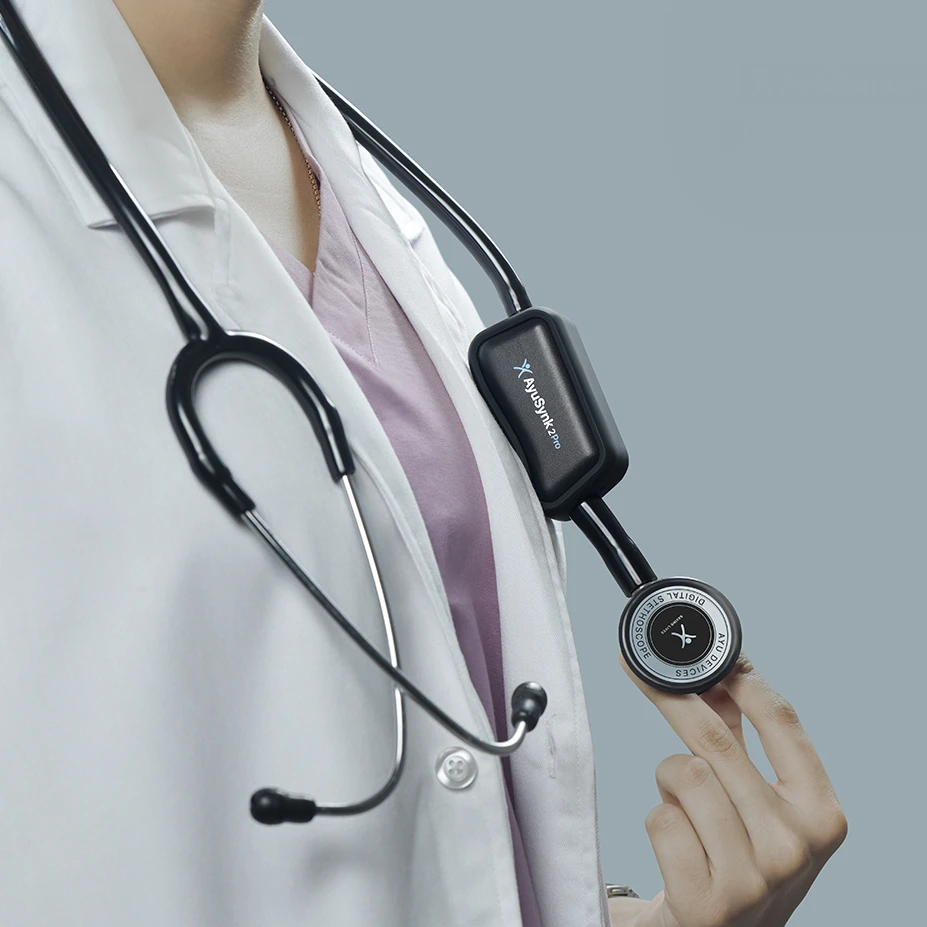
How AyuSynk 2 Pro Advance Supports Lung Auscultation
AyuSynk 2 Pro Advance supports up to 60x amplification, dedicated heart and lung filters, recording, sound visualisation, report generation, sharing and playback down to 0.25x with the AyuShare App.
For pulmonology, clinicians can record lung auscultation sounds, replay a short section more slowly, review a waveform, and share the recording to specialists for reviews. The original audio remains the primary clinical reference.
AyuSynk digisteth does not currently provide AI-based lung-sound classification. Its current role is digital capture and clinician-led review, not automated classification of wheeze, crackles, asthma or other respiratory conditions.
Make Lung Sounds Easier to Revisit with the AyuSynk 2 Pro Advance
A Simple Asthma Review Scenario With AyuSynk 2 Pro Advance
Consider a patient with asthma who presents with cough, chest tightness and wheeze. During the consultation, the clinician can use AyuSynk 2 Pro Advance to record lung sounds from relevant chest positions before treatment.
After the prescribed medication is given and the patient reports improvement, lung sounds can be recorded again from the same positions under similar conditions. The clinician can then replay and review the earlier and later recordings, using the audio and waveform as references to assess how the respiratory sounds have changed over time.
This creates a repeatable clinical reference instead of relying only on memory from the first auscultation. Any change in wheeze or breath-sound characteristics must still be interpreted alongside symptoms, physical evaluation and investigations such as spirometry where indicated. AyuSynk supports the record, review and comparison process, while the clinical interpretation remains with the physician.
Does an AI Stethoscope for Pulmonology Make Lung-Sound Review More Efficient?
It can to a certain extent, when recorded lung sounds are reviewed alongside their waveforms to provide a more objective reference for pulmonology assessment. This allows clinicians to revisit and compare respiratory sounds more systematically, while validated AI systems further support the review by flagging potential anomalies that require closer clinical attention.
Current limitations matter. Lung-sound AI studies use different datasets, devices and labels, and many models have limited external validation. Hospitals should check whether the AI is validated for the intended population and device, whether clinicians can access the original audio, and how poor-quality recordings are handled.
Used responsibly, an AI stethoscope for pulmonology can make review easier to revisit and more consistent.
Conclusion
An AI stethoscope for pulmonology is most useful when it helps clinicians capture a lung sound once and review it more carefully. AI can support classification or prioritisation in validated systems, while digital recording, replay and visualisation make the sound easier to revisit. AyuSynk 2 Pro Advance supports that digital review workflow today, with interpretation remaining clinician-led.
Frequently Asked Questions
What can AI identify in lung-sound recordings?
Validated AI systems can classify or flag patterns such as wheeze or crackles. Performance depends on the dataset, population, device and validation process.
Does AyuSynk digisteth classify lung sounds with AI today?
No. AyuSynk digisteth supports digital lung-sound capture, replay, visualisation, reporting and sharing, but not AI-based lung-sound classification.
Can an AI stethoscope diagnose asthma?
No. Lung sounds are one part of asthma assessment. Diagnosis requires clinician evaluation and relevant testing such as spirometry where indicated.
Why is replay useful in pulmonology?
Replay helps clinicians compare a patient’s previous respiratory sounds with current recordings to understand whether there has been a change or improvement over time, alongside symptoms and other clinical findings.
AyuSynk Digisteth Offers a More Reviewable Pulmonology Workflow

Dr. Ankit Kadarge
Dr. Ankit Kadarge is a writer, and Clinical Product Manager in MedTech who believes healthcare should be simple and understandable for everyone. He started his journey at Oxford Medical College, Bangalore, and soon discovered a love for writing, publishing over 20 articles with MedBound to make medical knowledge accessible.
Previously he has worked at ACKO, leading the life insurance vertical as a pilot doctor, where he gained a deeper understanding of how people experience and sometimes misunderstand healthcare. Today, he builds solutions that solve real problems for doctors and patients, blending his medical knowledge with product thinking.
On his blog, Ankit shares his experiences, learnings, and reflections on healthcare always in a way that’s easy to read and relate to.