How Cardiologists and Pulmonologists Choose the Right Stethoscope for Heart and Lung Sounds

Choosing the best stethoscope for cardiologists and pulmonologists is not simply about finding the loudest device. Cardiac and respiratory auscultation require different listening priorities.
Cardiology depends heavily on timing, low-frequency detail, S1, S2, additional heart sounds and murmurs. Pulmonology requires comparison of breath sounds across multiple chest positions and recognition of wheeze, crackles or rhonchi within the wider respiratory assessment. Research on electronic stethoscope acoustics places expected heart-sound spectra at roughly 20 to 500 Hz and breath sounds at roughly 100 to 1000 Hz.
The filtering and review options becomes the core feature for a digital stethoscope making it work for both the specialities to assess and objectify auscultated sounds.
Heart and Lung Auscultation Have Different Priorities
A cardiologist may need to judge when a sound occurs within the cardiac cycle, whether an additional S3 or S4 is present, and how a murmur changes with position or listening site. Brief or low-frequency findings can demand careful repeat listening.
A pulmonologist moves across anterior, lateral and posterior chest positions while comparing inspiration, expiration, symmetry and adventitious lung sounds. These findings are interpreted with the wider respiratory assessment.
Each specialty needs a stethoscope that preserves the information relevant to its clinical question.
| Clinical priority | Cardiology | Pulmonology |
|---|---|---|
| Main listening focus | S1, S2, additional S3/S4 and murmur timing | Breath sounds, wheeze, crackles, rhonchi |
| Useful digital support | Heart filter, amplification, recording and slower replay | Lung filter, amplification, real-time noise cancellation, recording and replay |
| Visual review | Live waveform during auscultation; phonocardiogram and spectrogram for recorded cardiac sounds | Waveform for sound correlation |
| Clinical use-case boundary | ECG and echocardiography when necessary | Spirometry, imaging and other respiratory investigations when necessary |
What Cardiologists Need From a Digital Stethoscope
For cardiology, amplification is useful when it preserves low-frequency detail rather than simply increasing volume. A 2026 acoustics study found electronic stethoscopes provided amplification across expected spectra for digitised heart and breath sounds, showing why frequency response matters alongside headline amplification numbers.
Recording and replay make a brief auscultation reviewable. A murmur or additional heart sound can be revisited and compared across cardiac positions. Slower playback and cardiac visualisation can add another reference for timing.
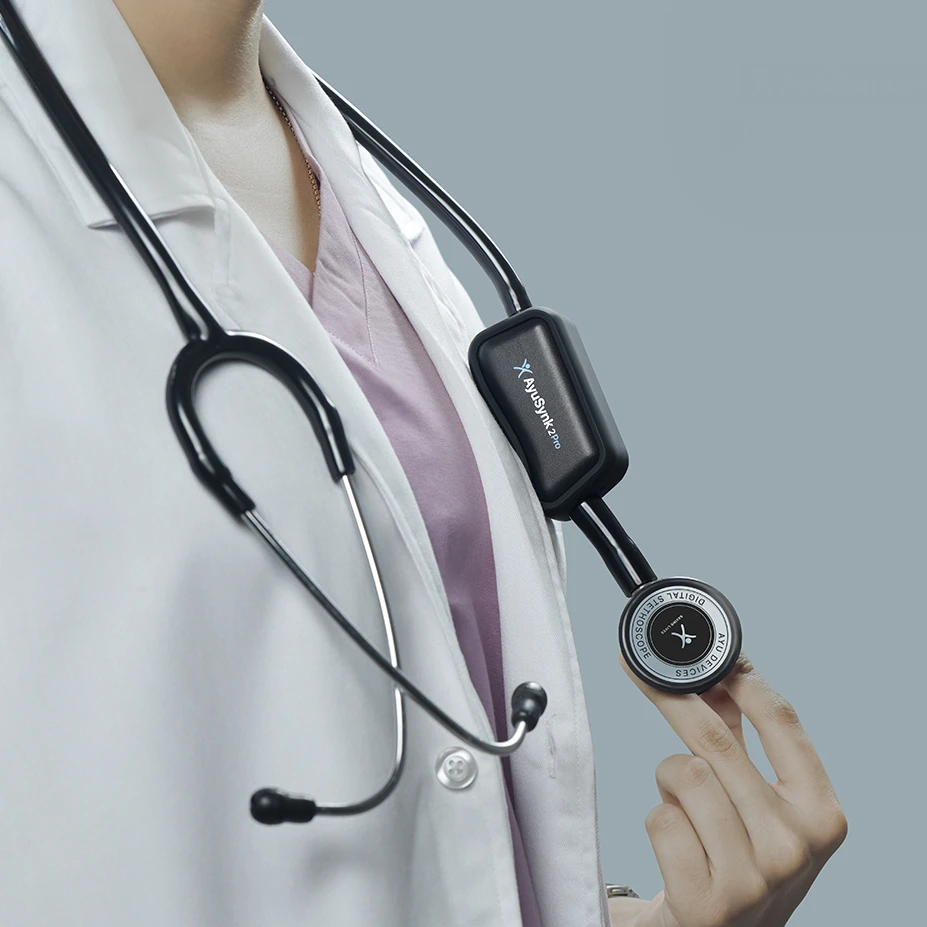
Hear the Detail Each Specialty Needs with AyuSynk 2 Pro Advance
What Pulmonologists Need From A Digital Stethoscope
Lung auscultation depends on patterns across breathing cycles and chest positions. Normal and adventitious sounds differ in pitch, timing and distribution, so clear capture and side-to-side comparison matter.
A lung-focused filter, amplification and reduction of environmental interference can support listening in busy settings. Recording allows respiratory sounds to be replayed or shared for specialist discussion. Waveforms support visual correlation with the audio, but they do not diagnose a pulmonary condition on their own.
AyuSynk 2 Pro Advance does not currently provide AI-based lung-sound classification. Interpretation therefore remains clinician-led.
What Makes One Stethoscope Practical Across Both Specialties
Heart and lung auscultation do not rely on exactly the same frequency characteristics. Heart sounds are concentrated more heavily in lower-frequency ranges, while respiratory sounds extend into higher frequencies. The ranges can overlap, but the clinical information being prioritised is different.
That is why a digital stethoscope intended for both specialties needs to adapt its filtering to the listening task rather than simply amplify every sound in the same way.
AyuSynk 2 Pro Advance provides dedicated heart and lung filters. The heart filter supports cardiac auscultation where lower-frequency heart sounds and murmurs require careful listening, while the lung filter supports respiratory auscultation where breath sounds and adventitious sounds occur across a different frequency range.
This ability to switch the listening focus allows the same digital stethoscope to support both cardiology and pulmonology while respecting the different acoustic requirements of each specialty. Recording, replay and amplification then provide additional ways to review the sound after it has been auscultated.
One Device, Two Specialist Interpretations
For a patient with breathlessness, the cardiologist may focus on murmurs, additional heart sounds and their timing within the cardiac cycle. The pulmonologist may focus on airflow, symmetry, wheeze, crackles or other respiratory findings.
The same digital stethoscope can support both assessments by adapting the listening filter to the clinical task. The device supports sound capture and review, while interpretation remains specific to the clinician’s specialty and the wider clinical assessment.
Conclusion
The best stethoscope for cardiologists and pulmonologists should be flexible enough to adapt to the different acoustic requirements of heart and lung auscultation. Cardiologists need clarity across lower-frequency cardiac sounds, heart-focused filtering and repeatable review. Pulmonologists need clear respiratory sound capture across multiple chest positions, lung-focused filtering and reliable replay.
AyuSynk 2 Pro Advance supports both workflows through dedicated heart and lung filters, amplification, recording, playback and visual review. This allows one digital stethoscope to adapt to different specialist listening needs while keeping clinical interpretation with the physician.
Frequently Asked Questions
Can the same digital stethoscope be used by cardiologists and pulmonologists?
Yes. One device can support both when it provides appropriate heart and lung filtering, amplification and recording. Interpretation and follow-up still differ by specialty.
What features are most useful for cardiologists?
Low-frequency clarity, heart-focused filtering, amplification, recording and replay are especially useful. Cardiac visualisation can add a timing reference where supported.
What features are most useful for pulmonologists?
Lung-focused filtering, amplification, reduction of environmental interference and recording help clinicians compare respiratory sounds across chest positions and breathing cycles.
When should echocardiography or spirometry be considered after auscultation?
Echocardiography may be considered when heart sounds, murmurs, symptoms, or other findings require further evaluation of cardiac structure and function. Spirometry may be appropriate when respiratory symptoms or lung findings require objective assessment of airflow and lung function. Digital auscultation supports the initial assessment and helps guide when further testing may be needed.
Choose Your Stethoscope Around the Way You Work

Dr. Ankit Kadarge
Dr. Ankit Kadarge is a writer, and Clinical Product Manager in MedTech who believes healthcare should be simple and understandable for everyone. He started his journey at Oxford Medical College, Bangalore, and soon discovered a love for writing, publishing over 20 articles with MedBound to make medical knowledge accessible.
Previously he has worked at ACKO, leading the life insurance vertical as a pilot doctor, where he gained a deeper understanding of how people experience and sometimes misunderstand healthcare. Today, he builds solutions that solve real problems for doctors and patients, blending his medical knowledge with product thinking.
On his blog, Ankit shares his experiences, learnings, and reflections on healthcare always in a way that’s easy to read and relate to.