What is a Modern Stethoscope? Features That Go Beyond Traditional Tools

Introduction
The stethoscope has been an essential tool in healthcare for decades. It has helped doctors in many ways, from listening to heartbeats to assessing lung sounds, to make crucial decisions. Technology has transformed this simple device into a modern stethoscope over time, which is capable of detecting more than basic sounds now.
Modern stethoscopes enable physicians to gather data, analyze physiological signals, enhance sounds, and even transmit information online for consultations. Both diagnosis and patient care are enhanced by these developments.
The meaning of a modern stethoscope, its differences from traditional devices, and the features that make it an essential part of modern healthcare will all be covered in this blog.
What is a Modern Stethoscope?
An advanced version of the traditional stethoscope is known as a modern stethoscope. It uses digital technology to capture, amplify and analyze body sounds such as heartbeats, murmurs, and lung sounds, unlike a traditional stethoscope.
Key features of a modern stethoscope include:
- Sound amplification to hear subtle physiological sounds
- Noise reduction to filter out external disturbances
- Recording and storage for tracking patient history
- Connectivity with apps for real-time monitoring and telemedicine
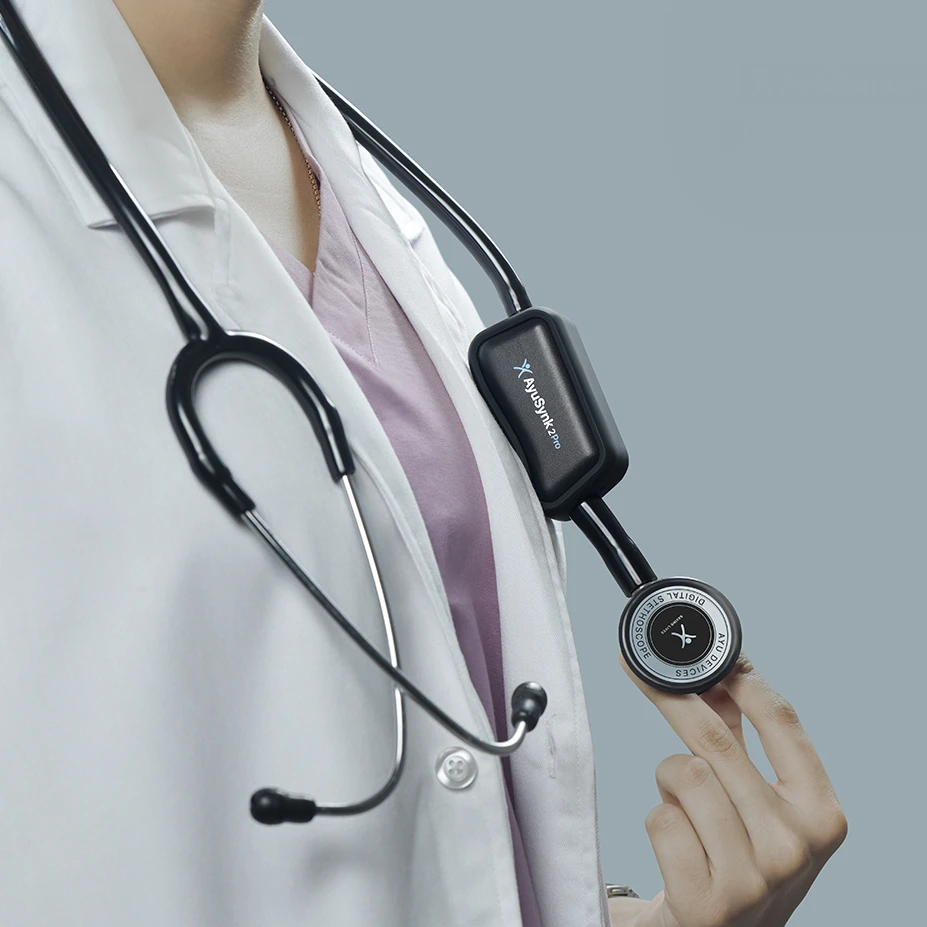
These features are best demonstrated by devices like the AyuSynk 2 Pro Advance, which offers unlimited real-time screening, AI-assisted murmur detection, and smooth integration with telemedicine platforms.
How a Traditional Stethoscope Works
Traditional stethoscopes operate through simple mechanical sound transmission. The body sounds from the chestpiece are transferred through a hollow tube to the doctor’s ears.
The traditional stethoscope’s effectiveness depends on:
- The doctor’s hearing ability
- Clinical experience
- A quiet environment
They are reliable, but these tools cannot record sounds, analyze data, or share findings remotely.
How a Modern Stethoscope Works
Modern stethoscopes convert body sounds into digital signals. These signals can be:
- Amplified for clearer perception
- Filtered to remove external noise
- Analyzed using apps or software
For instance, the AyuSynk 2 Pro Advance provides advanced noise cancellation, applies specialized heart and lung filters, and amplifies sounds up to 60 times. Additionally, it enables doctors to share, visualize, and record auscultation data for better diagnosis.
Traditional vs Modern Stethoscope: Key Differences
| Feature | Traditional | Modern |
|---|---|---|
| Sound Quality and Clarity | Basic sound transmission | Amplified, clear, and filterable for specific body sounds |
| Recording and Playback | Cannot record sounds | Can record and replay sounds for analysis |
| Data Sharing | No sharing capability | Shareable with other doctors for collaboration or telemedicine |
| Dependence on Technology | Does not require power | Requires a battery. Supports internet and Bluetooth connectivity on a smartphone. |
Key Features of a Modern Stethoscope
Sound Amplification
Modern stethoscopes can amplify faint physiological sounds, helping doctors detect minor abnormalities that may be missed by the human ear alone.
The AyuSynk 2 Pro Advance, for instance, amplifies sounds up to 60 times, making it easier to hear subtle murmurs or lung irregularities even in noisy environments.
Noise Reduction Technology
Digital stethoscopes filter external noise, such as background hospital sounds, so the doctor hears only relevant body sounds. This improves listening accuracy, particularly in busy clinics or emergency wards.
Recording and Data Storage
Modern stethoscopes can store patient data securely. Doctors can review recordings for follow-ups, compare historical data, and track changes over time. The AyuSynk 2 Pro Advance provides unlimited real-time recordings for two years, which is ideal for ongoing patient monitoring.
Mobile App Connectivity
Many modern stethoscopes connect with apps like AyuShare, enabling real-time auscultation monitoring, remote consultations, and easy data sharing with specialists.
Visualization of Sound Waves
Some devices display heart and lung sound patterns on a screen. Waveforms such as phonocardiograms and spectrograms help doctors better understand and interpret physiological signals.
Modern stethoscopes deliver precise diagnoses with advanced features
Advanced Features to Look for in a Modern Stethoscope
High Acoustic Sensitivity
Modern stethoscopes capture even faint heart and lung sounds, which is critical for early detection of conditions like murmurs or respiratory irregularities.
Active Noise Cancellation
This technology further reduces unwanted sounds from the environment, ensuring only body sounds are amplified and analyzed.
Dual-Sided Chest Piece
Some stethoscopes come with dual-sided chest pieces to accommodate both adult and pediatric patients.
Comfortable Design for Long Use
Soft ear tips and lightweight construction make it easier for doctors to use the stethoscope for extended periods without discomfort.
Durable Build Quality
A reliable stethoscope is built to withstand long-term clinical use. Devices like the AyuSynk 2 Pro Advance are designed for durability in hospital and telemedicine settings.
Benefits of Using a Modern Stethoscope
Better Diagnostic Accuracy
Amplified and filtered sounds reduce the risk of missing critical details, supporting accurate diagnosis.
Faster Decision Making
Clear recordings and AI-assisted analysis allow doctors to identify issues quickly, speeding up patient care.
Improved Patient Monitoring
Stored recordings provide a history of patient health, which helps in long-term monitoring and follow-ups.
Supports Telemedicine
Modern stethoscopes enable remote diagnosis. Doctors can assess patient health data in real time, even from a distance.
Challenges of Modern Stethoscopes
Dependence on Battery and Software
These devices require proper maintenance, charging, and app compatibility to function effectively.
Higher Cost
Modern stethoscopes are more expensive than traditional ones, though the benefits often outweigh the cost.
Learning Curve
Some training is needed to operate advanced features like AI analysis, waveform interpretation, and app connectivity.
Where Modern Stethoscopes Are Most Useful
- Hospitals and clinics
- Cardiology and pulmonology departments
- Telemedicine and remote healthcare
- Emergency and critical care units
Devices like the AyuSynk 2 Pro Advance are particularly valuable in telemedicine setups, as they allow unlimited real-time screenings and remote consultations.
How Modern Stethoscopes Support Remote Diagnosis
Doctors can record, analyze, and share patient sounds instantly. Specialists in different locations can review the data, making it easier to provide care to patients in remote areas.
Common Mistakes to Avoid When Choosing a Modern Stethoscope
- Selecting based only on price.
- Ignoring sound amplification and noise reduction features.
- Not checking app compatibility.
- Overlooking durability and battery life.
Choosing wisely ensures a device that improves patient care and lasts in clinical settings.
Future of Stethoscopes in Healthcare
Modern stethoscopes will continue to evolve with technology. Future developments may include:
- AI-based automatic diagnosis.
- Better integration with electronic health systems.
- Enhanced remote monitoring features.
They will remain a critical part of digital healthcare, supporting both doctors and patients.
Conclusion
A modern stethoscope is no longer just a listening device. It is a smart tool that enhances diagnosis, monitoring, and patient care.
With features like sound amplification, recording, AI analysis, and remote data sharing, devices such as the AyuSynk 2 Pro Advance provide clear advantages over traditional stethoscopes.
As healthcare becomes more digital, modern stethoscopes will become an indispensable part of everyday medical practice.
FAQs
What is a modern stethoscope used for?
It is used to listen, record, and analyze body sounds for better diagnosis and patient monitoring.
Is a modern stethoscope better than a traditional one?
It offers advanced features, but traditional stethoscopes still have value depending on the clinical scenario.
Can modern stethoscopes record sounds?
Yes, most can record and store patient sounds for future comparison.
Do modern stethoscopes require an app like AyuShare?
Many modern stethoscope models connect to apps for advanced analysis and secure data sharing.
Are modern stethoscopes useful for telemedicine?
Yes, they are extremely useful for remote diagnosis and consultation.
Modern stethoscopes improve diagnosis accuracy and patient outcomes

Dr. Ankit Kadarge
Dr. Ankit Kadarge is a writer, and Clinical Product Manager in MedTech who believes healthcare should be simple and understandable for everyone. He started his journey at Oxford Medical College, Bangalore, and soon discovered a love for writing, publishing over 20 articles with MedBound to make medical knowledge accessible.
Previously he has worked at ACKO, leading the life insurance vertical as a pilot doctor, where he gained a deeper understanding of how people experience and sometimes misunderstand healthcare. Today, he builds solutions that solve real problems for doctors and patients, blending his medical knowledge with product thinking.
On his blog, Ankit shares his experiences, learnings, and reflections on healthcare always in a way that’s easy to read and relate to.