The Auscultation Gap in Telemedicine That Video Cannot Fill

Video consultations can show breathing effort, skin colour, facial expression and movement, while allowing patients to describe their symptoms. What video cannot provide on its own is access to heart and lung sounds. A telemedicine stethoscope helps fill that gap by adding auscultation to the virtual consultation.
A digital stethoscope can transmit physiological sounds for tele-auscultation or record them for later clinical review. In remote auscultation, a trained medical professional remains with the patient, positions the chestpiece correctly, and the remote clinician listens and interprets the sounds alongside the wider clinical information. It adds auscultation to remote clinical assessment while other parts of the physical evaluation remain separate.
Why the Physical Evaluation Gap Still Matters
Telemedicine improves access and convenience, but physical evaluation remains a recurring limitation. A 2025 scoping review of 49 teleurology studies identified lack of physical evaluation as the most frequently reported challenge, appearing 30 times across the reviewed literature.
That gap matters in cardiopulmonary assessment. A conversation can describe breathlessness and video may show respiratory effort. Neither provides the heart or lung sounds heard during auscultation.
This workflow is easier to establish in telemedicine kiosks, primary health centres, satellite clinics or other structured care locations where a digital stethoscope can be part of the patient-side setup. A standard home video consultation cannot provide auscultation unless a compatible device is available with the patient.
What Remote Auscultation Adds to Virtual Assessment
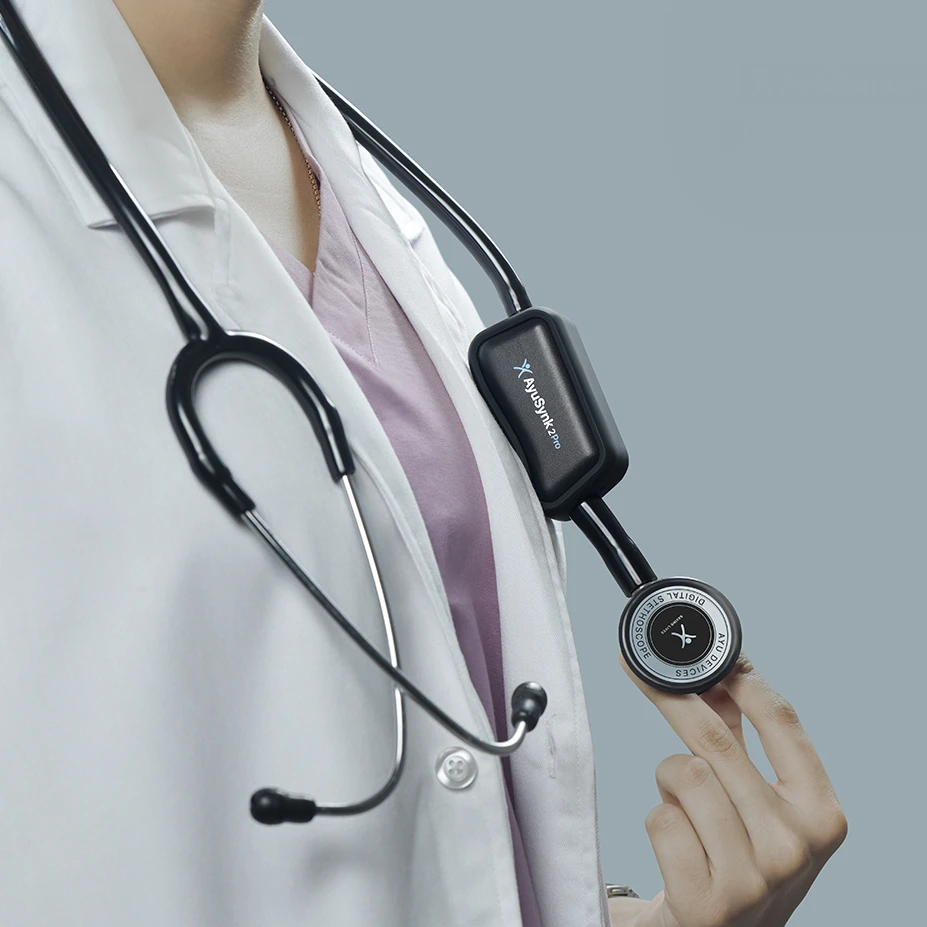
A digital stethoscope for telemedicine allows for heart and lung auscultation Depending on the device and workflow, clinicians can listen to heart and lung sounds in real time, save recordings, or share them for later clinician or specialist review.
The remote clinician can listen to the auscultation sounds directly rather than relying only on symptoms discussed over a video call without supporting medical or clinical data. That information can support decisions about further evaluation, investigation, referral, or an in-person visit.
A telemedicine stethoscope still needs the basics to be right:
- A compatible digital stethoscope must be with the patient.
- A trained clinical care provider or appropriately trained person must position it correctly.
- Suitable connectivity is required between the patient-side and clinician-side locations for real-time transmission.
- The clinician must interpret the sounds alongside symptoms, history, vital signs, and other relevant findings.
Add Auscultation to the Virtual Consultation
How AyuSynk 2 Pro Advance Fits the Telemedicine Workflow
AyuSynk 2 Pro Advance is designed for tele-auscultation or real-time transmission of physiological sounds. It supports up to 60x amplification, heart and lung filters, recording, sharing, sound visualisation, report generation, and playback through the AyuShare App.
A trained patient-side care provider positions the stethoscope correctly while the remote clinician listens in real time, or the auscultation sounds can be recorded for later review where the workflow supports it. This can be set up in telemedicine centres, satellite clinics, rural care settings, and hospital networks where the patient and clinician are in different locations.
Correct chestpiece placement and clinical judgement remain essential. The device adds auscultation data that a standard video feed cannot provide.
A Practical Example in a Remote Respiratory Review
Consider a patient at a rural health centre with cough and breathlessness while the reviewing physician is at a larger hospital. During the remote consultation, a trained care provider can place the digital stethoscope at the required chest positions while the physician listens remotely.
The sounds do not establish a diagnosis on their own. They add information that can help the physician decide whether an in-person assessment, spirometry, imaging or another investigation is appropriate.
What Current Evidence Says About Remote Auscultation
Small controlled studies support the feasibility of connected auscultation while showing important limits. In one randomized pilot study, classification of most simulated lung and cardiac sounds using a Bluetooth-connected remote system was comparable with direct auscultation, although some sounds differed. Another internet-connected pilot found similar overall classification, while direct cardiac auscultation performed better on one cardiac score.
Both were small simulator-based studies, so they demonstrate feasibility under the studied conditions rather than proving that remote auscultation performs identically across every patient, device or clinical environment.
Remote auscultation can extend a virtual consultation, but it is not a replacement for bedside evaluation. Recording quality, connectivity, placement, clinician experience, and the clinical question still matter.
Where Remote Auscultation Fits in Virtual Care
A telemedicine stethoscope addresses one specific gap in virtual care: video and conversation alone do not provide heart and lung sounds. Remote auscultation gives the clinician direct access to those auscultation sounds while keeping interpretation and decisions about further evaluation clinician-led.
AyuSynk 2 Pro Advance supports real-time tele-auscultation, recording, sharing and review within connected-care workflows while the wider physical evaluation remains part of the clinician’s assessment.
Frequently Asked Questions
Can a video consultation provide heart and lung auscultation on its own?
No. A compatible digital stethoscope must be available with the patient and positioned correctly. A standard home video consultation does not provide auscultation unless that patient-side setup is available.
What is a telemedicine stethoscope?
It is a digital stethoscope used in a connected workflow so physiological sounds can be transmitted or shared for clinician review during remote care.
Who should position the stethoscope during remote auscultation?
A trained clinical care provider, healthcare professional, or appropriately trained person should position the chestpiece according to the clinical workflow.
When is an in-person assessment still needed after remote auscultation?
The clinician may recommend an in-person assessment when symptoms, auscultation findings or other clinical information require further physical evaluation or investigation. Remote auscultation adds heart and lung sound information, but it does not provide every element of an in-person assessment.
Bring Auscultation Into Connected Care

Dr. Ankit Kadarge
Dr. Ankit Kadarge is a writer, and Clinical Product Manager in MedTech who believes healthcare should be simple and understandable for everyone. He started his journey at Oxford Medical College, Bangalore, and soon discovered a love for writing, publishing over 20 articles with MedBound to make medical knowledge accessible.
Previously he has worked at ACKO, leading the life insurance vertical as a pilot doctor, where he gained a deeper understanding of how people experience and sometimes misunderstand healthcare. Today, he builds solutions that solve real problems for doctors and patients, blending his medical knowledge with product thinking.
On his blog, Ankit shares his experiences, learnings, and reflections on healthcare always in a way that’s easy to read and relate to.