How Digital Stethoscopes Can Support Doctors Using Hearing Aids

For doctors who use hearing aids or cochlear implants, choosing a stethoscope is not only about amplification. The more practical question is whether the listening setup works comfortably with the clinician’s hearing device and whether the stethoscope provides enough flexibility for everyday auscultation.
Digital stethoscopes can add amplification, filtering, recording and replay. Bluetooth connectivity may also be relevant when evaluating a listening setup, but compatibility depends on the specific hearing aid or cochlear implant and the connection method being used.
Frequency response still matters because some clinically relevant heart sounds occur in lower frequency ranges. The right setup therefore needs to consider both the clinician’s hearing needs and how the stethoscope works with their hearing device.
Why Low-Frequency Heart Sounds Can Be Harder to Hear
Some clinically relevant heart sounds occur in lower frequency ranges and can be harder for some clinicians with hearing loss to perceive. Simply increasing overall volume does not guarantee that every clinically relevant frequency becomes equally audible.
A published proof-of-concept on digital frequency translation shifted sounds below 50 Hz into a 200 Hz range that is easier for the human ear to detect. The authors proposed it as potentially useful for hearing-impaired physicians and noisy settings. The broader point is that auscultation accessibility depends on frequency handling, not volume alone.
An Acoustic Stethoscope Can Fall Short
An acoustic stethoscope does not provide adjustable amplification, recording or replay. Correct chestpiece placement is essential with both acoustic and digital stethoscopes; if the chestpiece is not positioned correctly, the auscultation sound may not be heard or recorded clearly. A digital stethoscope adds the ability to amplify and record the sound so it can be reviewed again when needed.
A 2026 acoustic study of commercially available digital stethoscope models also shows why choosing an amplified stethoscope by a headline “times amplification” number alone can be misleading. It found substantial variation in frequency response across digital stethoscopes and cautioned that manufacturer amplification figures do not necessarily predict output at every clinically relevant frequency.
Make Auscultation Easier to Revisit
What Digital Auscultation Adds for Doctors With Hearing Difficulties
Depending on the clinician’s hearing device and listening preference, useful considerations include:
- Bluetooth connectivity and hearing-device compatibility. Bluetooth availability can be relevant for clinicians using hearing aids or cochlear implants, but compatibility depends on the specific hearing device and connection method and should be checked before use.
- Adjustable amplification to make faint physiological sounds easier to hear.
- Heart- and lung-focused filters to emphasise the sound range being assessed.
- Reduction of environmental interference in busy clinical settings.
- Recording and replay so an auscultation sound can be reviewed again instead of relying on one listening moment.
- Waveform review as an additional visual reference alongside the audio. For recorded cardiac sounds, phonocardiogram and spectrogram review may also support clinical correlation where available.
There is no single listening setup that suits every clinician. A 2025 Occupational Medicine report describing two healthcare students using hearing aids and cochlear implants showed that different hearing needs required different stethoscope accommodations. The practical takeaway is to evaluate the stethoscope together with the clinician’s actual hearing device and preferred listening setup.
How AyuSynk 2 Pro Advance Supports Accessible Auscultation
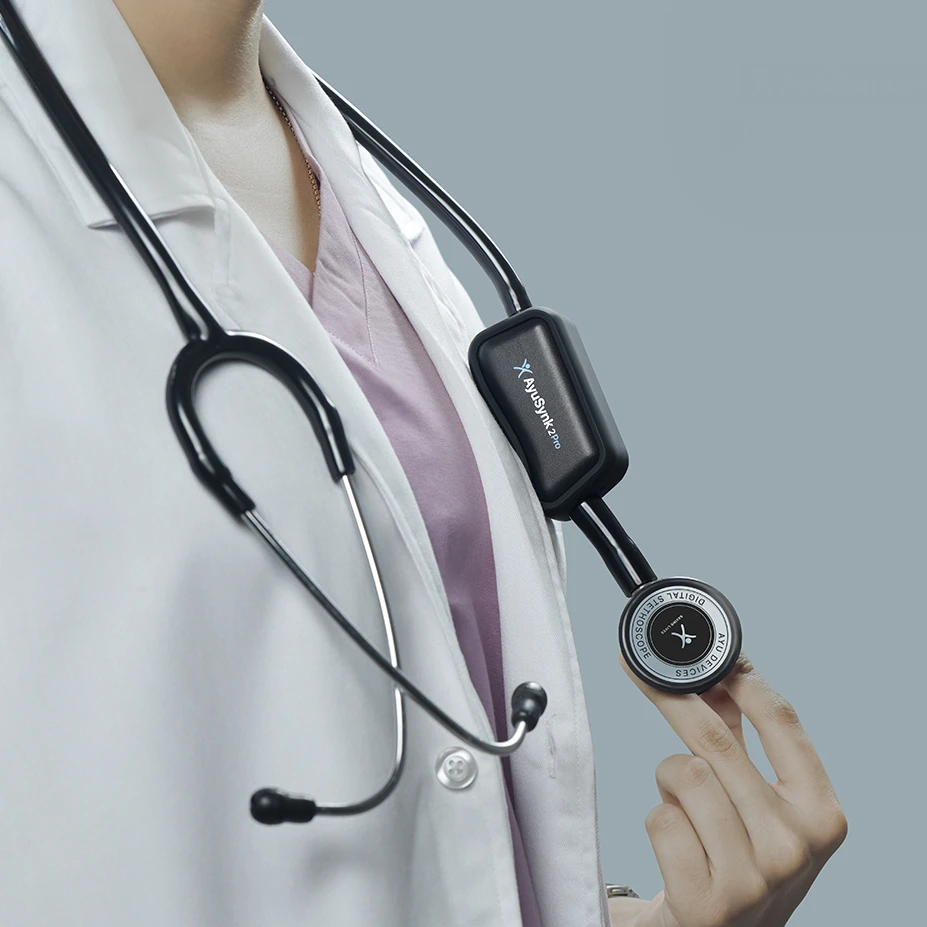
AyuSynk 2 Pro Advance offers up to 60x amplification, dedicated heart and lung filters, real-time noise cancellation, recording, playback up to 0.25x, sound visualisation and report generation through the AyuShare App. These features give clinicians more control over how physiological sounds are heard and reviewed.
For doctors using hearing aids or cochlear implants, Bluetooth availability should not be treated as universal hearing-device compatibility. The specific hearing device, connection method and preferred listening setup should be checked before use.
What to Check Before Using a Digital Stethoscope With Hearing Aids
Start with the clinician’s actual hearing device and preferred listening setup. Check whether the hearing aid or cochlear implant can be used comfortably during auscultation, what connection method is available, whether the stethoscope earpiece interferes with the hearing device, and whether amplification, filtering, recording and replay add practical value.
A trial in the clinician’s real working environment can be more informative than a specification sheet alone. The goal is not maximum volume. It is a listening setup that makes relevant heart and lung sounds easier to perceive while supporting the clinician’s usual auscultation technique.
The Right Setup Depends on Hearing-Device Compatibility
For doctors using hearing aids or cochlear implants, choosing a digital stethoscope is not simply about selecting the highest amplification. Compatibility with the hearing device, comfort during auscultation, frequency response, filtering, recording and replay all matter.
AyuSynk 2 Pro Advance adds amplification, heart and lung filters, recording and replay to the auscultation workflow. Where hearing aids or cochlear implants are involved, the listening setup should be checked individually before clinical use.
Frequently Asked Questions
Can doctors with hearing loss use a digital stethoscope?
Yes. Digital stethoscopes can provide amplification, filtering and alternative review options. The best setup depends on the clinician’s hearing profile and the device used.
Can a stethoscope work with hearing aids?
Some digital stethoscope setups can be used with hearing aids or cochlear implants, but compatibility is not universal. The hearing device, connection method and comfort should be checked individually.
Is more amplification always better for hearing-impaired doctors?
No. Frequency response and sound quality matter as much as headline amplification. A device should make the clinically relevant frequencies more accessible without adding distortion or discomfort.
Does Bluetooth mean a digital stethoscope will connect to any hearing aid?
No. Bluetooth availability does not guarantee compatibility with every hearing aid or cochlear implant. The specific hearing device and connection method should be checked before use.
Find a Listening Setup That Fits Your Practice

Dr. Ankit Kadarge
Dr. Ankit Kadarge is a writer, and Clinical Product Manager in MedTech who believes healthcare should be simple and understandable for everyone. He started his journey at Oxford Medical College, Bangalore, and soon discovered a love for writing, publishing over 20 articles with MedBound to make medical knowledge accessible.
Previously he has worked at ACKO, leading the life insurance vertical as a pilot doctor, where he gained a deeper understanding of how people experience and sometimes misunderstand healthcare. Today, he builds solutions that solve real problems for doctors and patients, blending his medical knowledge with product thinking.
On his blog, Ankit shares his experiences, learnings, and reflections on healthcare always in a way that’s easy to read and relate to.