When Specialist Care Is Far Away, Auscultation Does Not Have to Be

Rural telemedicine can bring specialist clinical opinion closer, but a standard video consultation cannot provide heart or lung sounds on its own. Remote auscultation adds those sounds when a compatible digital stethoscope is with the patient and a trained local care provider positions it correctly.
A 2025 rural Karnataka telemedicine study found that 67% of participating healthcare workers agreed telemedicine eased connections with specialists at the hub. The finding is setting-specific, but it shows the value of telemedicine in connecting rural care teams with specialists. When auscultation is required, a compatible digital stethoscope and trained support are still needed at the patient side.
Rural Telemedicine Still Has a Physical Evaluation Gap
A remote clinician can review symptoms, vital signs and case reports. What may still be missing is the heart or lung sound itself. Without a digital stethoscope at the patient side, the specialist relies on another clinician’s description of what was heard.
Primary health centres, telemedicine kiosks, satellite clinics and rural hospitals are practical settings where the digital stethoscope and trained support can be made available locally. A home video consultation cannot provide auscultation unless a compatible device is also available with the patient.
What Remote Auscultation Adds to Rural Telemedicine
Remote auscultation adds physiological sounds to the telemedicine consultation. In live tele-auscultation, a trained patient-side provider places the chestpiece while the specialist listens in real time. In a recorded workflow, heart or lung sounds can be saved for later specialist review.
The specialist can then review the auscultation sounds alongside symptoms, history and vital signs before deciding whether further evaluation, referral or an in-person visit is needed.
Add Auscultation to Rural Telemedicine
What a Practical Rural Remote Auscultation Workflow Looks Like
A useful workflow is simple and repeatable:
- A compatible digital stethoscope is available at the rural care location.
- A trained care provider positions the chestpiece at the relevant auscultation sites.
- The specialist listens live and the auscultation sounds are recorded for later review.
- Symptoms, vital signs and other clinical information travel with the auscultation sounds.
- The specialist decides whether local follow-up or further investigation is required
A 2026 feasibility study in rural Bangladesh reported that, after three days of structured training, nine community healthcare providers obtained quality lung-sound recordings from 87.6% of 990 children attending first-level rural clinics. The result is specific to that device, population and protocol, but it supports the feasibility of trained local staff recording usable lung sounds.
How AyuSynk 2 Pro Advance Fits the Workflow
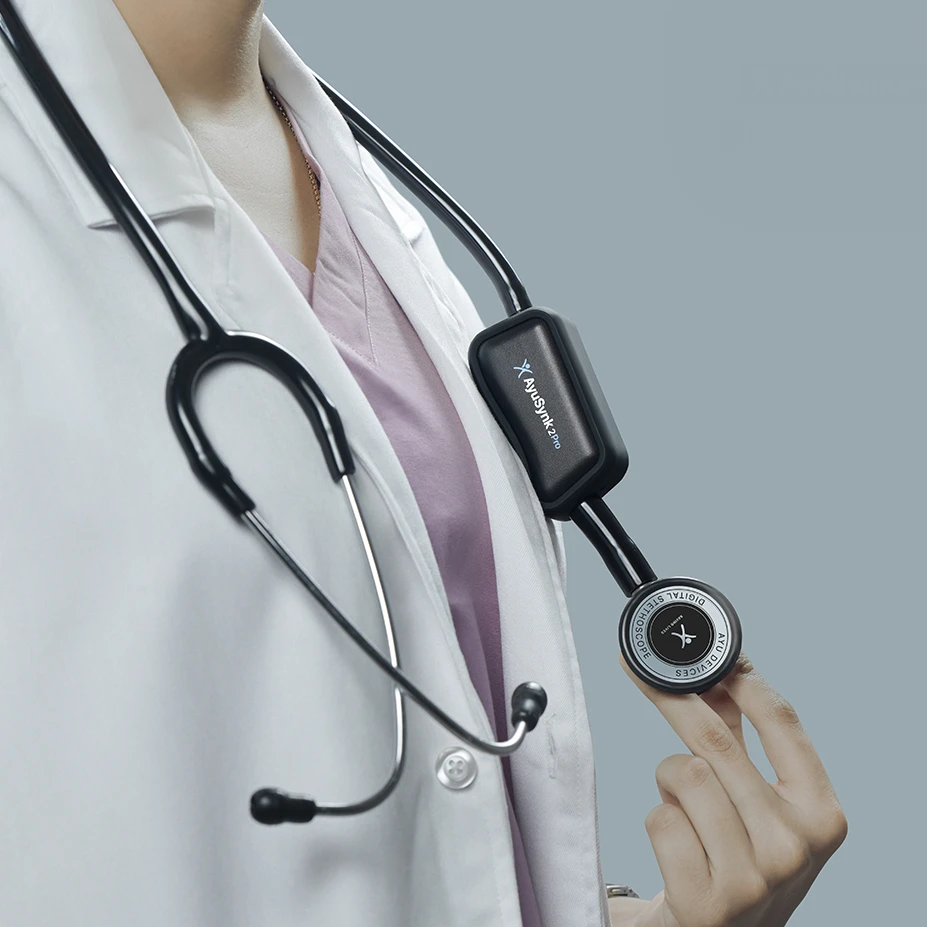
AyuSynk 2 Pro Advance supports tele-auscultation or real-time transmission of physiological sounds. It offers up to 60x amplification, dedicated heart and lung filters, recording, sharing and playback through the AyuShare App.
Tele-auscultation still depends on the stethoscope being with the patient, correct chestpiece placement, trained support and suitable connectivity.
What Current Evidence Supports – and What It Does Not
A small randomized pilot study of real-time remote auscultation using cardiopulmonary simulators found no significant difference in overall lung or cardiac test scores between remote and classical auscultation, although some individual sounds differed. Because the study was small and simulator-based, the findings support feasibility under those specific conditions rather than performance across every clinical setting.
Recording quality, connectivity, placement and clinician experience still matter. Remote auscultation adds clinical data; it does not provide every part of an in-person physical evaluation.
When Remote Auscultation Should Lead to Further Evaluation
Auscultation findings are interpreted with the wider clinical picture. If a murmur, abnormal respiratory sound or symptoms require closer assessment, the specialist can recommend an in-person review or investigations such as echocardiography, ECG, spirometry or imaging when indicated.
For rural teams, this can provide specialist auscultation review before every patient is asked to travel and help prioritise patients who need referral, investigation or an in-person assessment.
Bringing Auscultation Into Rural Specialist Care
Remote auscultation adds heart and lung sounds to the clinical information available during a rural telemedicine consultation. Live transmission supports assessment during the consultation, while recorded auscultation can support referrals, second opinions and later review.
With AyuSynk 2 Pro Advance, we support both live transmission and recorded review, helping rural care teams include auscultation sounds when connecting patients with specialists.
Frequently Asked Questions
What is needed for remote auscultation in a rural clinic?
A compatible digital stethoscope must be with the patient, with correct placement by a trained care provider. Live tele-auscultation also requires suitable connectivity.
Can remote auscultation work during a home video consultation?
Only when a compatible digital stethoscope is available with the patient and can be positioned correctly. Structured settings such as primary health centres or telemedicine kiosks are usually easier places to establish the workflow.
What is the difference between live and recorded remote auscultation?
Live tele-auscultation allows the specialist to listen during the remote consultation. Recorded auscultation allows the same heart or lung sounds to be reviewed later for referral, second opinion or follow-up discussion.
When should an in-person assessment be arranged after remote auscultation?
An in-person assessment may be needed when symptoms, auscultation findings or other clinical information require further physical evaluation or investigation.
Bring Specialist Auscultation Closer to Rural Care

Dr. Ankit Kadarge
Dr. Ankit Kadarge is a writer, and Clinical Product Manager in MedTech who believes healthcare should be simple and understandable for everyone. He started his journey at Oxford Medical College, Bangalore, and soon discovered a love for writing, publishing over 20 articles with MedBound to make medical knowledge accessible.
Previously he has worked at ACKO, leading the life insurance vertical as a pilot doctor, where he gained a deeper understanding of how people experience and sometimes misunderstand healthcare. Today, he builds solutions that solve real problems for doctors and patients, blending his medical knowledge with product thinking.
On his blog, Ankit shares his experiences, learnings, and reflections on healthcare always in a way that’s easy to read and relate to.