How Digital Stethoscopes Reduce Noise and Eliminate Clinical Interference?

Introduction
Silence is rarely experienced in a crowded ICU or OPD. Movement is continuous, conversations overlap, and monitors beep. Clinicians frequently find it difficult to properly hear minor p during auscultation in such settings. Because auscultation is a skill that requires repeated practice over time rather than being a built-in skill, it can be even more difficult for a new practitioner.
This is where a noise reduction stethoscope comes into play, enabling medical professionals in focusing on the most important aspects of clinical examination.
Why External Noise Affects Clinical Assessment Accuracy?
Making a clear distinction between p and external noise is essential to recognize the issue. Unwanted sounds from the surroundings are referred to as external noise, and physiological signals like heartbeats and breath sounds are considered p.
These frequently overlap in actual hospital settings.
For example, in an emergency ward, a clinician may attempt to identify faint crackles in a patient’s lungs. However, background sounds, from equipment or nearby activity, can mask these subtle signals. This makes it harder to detect early signs of conditions like pulmonary edema or fibrosis.
Studies in clinical practice indicate that there is considerable variation in auscultation interpretation, particularly among less skilled doctors. This may cause a delay in making prompt judgments and increase dependency on senior doctors.
On the other hand, devices that enhance sound clarity assist in making diagnoses with digital stethoscopes more accurate, especially in high-stress situations.
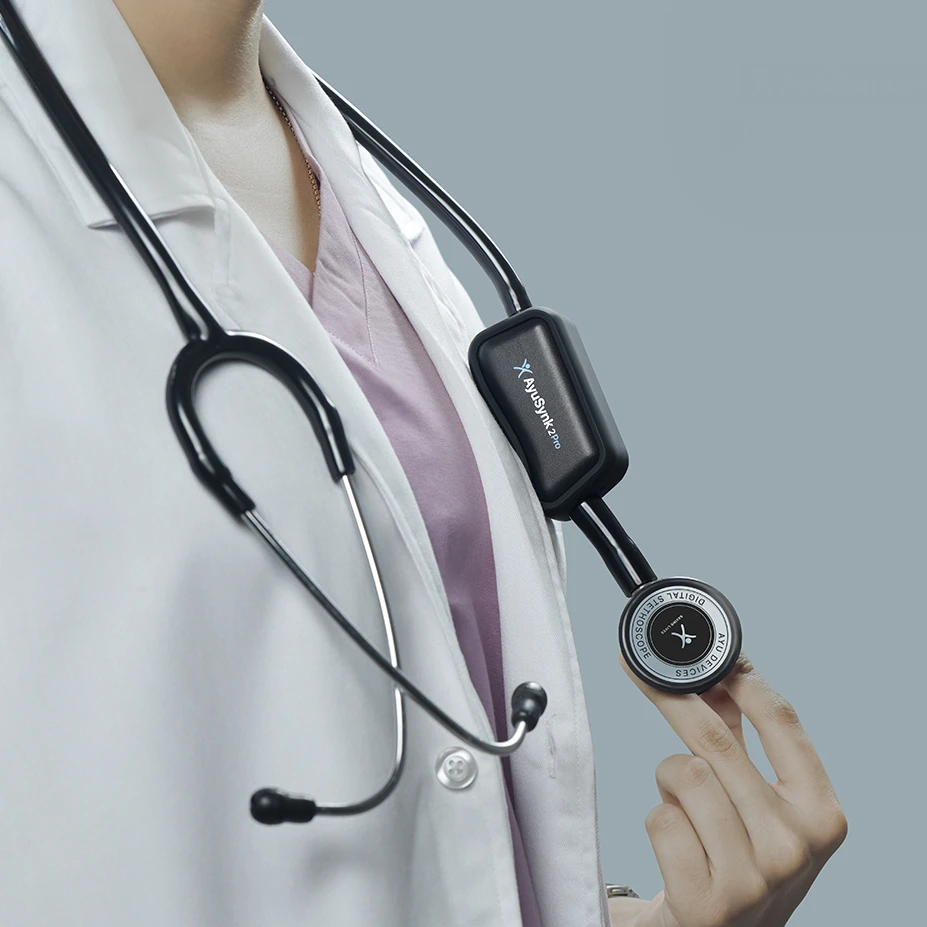
What Is a Noise Reduction Stethoscope?
Even in crowded healthcare settings, a noise reduction stethoscope helps clinicians conduct a more accurate diagnostic process by amplifying p and filtering external noise.
This is accomplished by combining:
- By reducing unwanted environmental interference, sound filtering
- Amplification, which intensifies significant physiological sounds
- Signal clarity enables improved distinction between sound patterns.
During auscultation, these features make it simpler to focus on clinically relevant information.
AyuSynk 2+ is designed specifically to enhance this experience by improving sound clarity through strong amplification and effective noise reduction, allowing clinicians to focus on relevant physiological signals even in high-interference environments.
How Digital Stethoscopes Reduce Noise in Clinical Settings?
Advanced Noise Filtering Technology
Modern digital stethoscopes use advanced filtering systems to reduce external noise and prioritize important sound frequencies. This is similar to how audio processing tools isolate specific signals from background interference.
A stethoscope with noise cancellation can significantly improve clarity in busy environments, allowing clinicians to focus on heart and lung sounds without distraction.
Low-Frequency Heart Sound Amplification
Certain cardiac sounds, especially early-stage murmurs, exist in lower frequency ranges. These can be difficult to detect with traditional tools.
With low-frequency heart sound amplification, digital stethoscopes enhance these subtle signals, making it easier to identify abnormalities at an earlier stage. Research indicates that amplified auscultation can improve detection rates of low-intensity murmurs, particularly in primary care settings.
Digital stethoscopes reduce noise and enhance heart sound clarity
High Sensitivity for Better Sound Capture
A high sensitivity stethoscope for diagnosis is capable of detecting faint physiological sounds that may otherwise go unnoticed. This is especially important in:
- Pediatric care, where p are softer
- Critical care, where precision is essential
Improved sensitivity reduces the chances of missing important clinical signs during assessment.
A high-sensitivity acoustic system, as implemented in AyuSynk 2+, helps ensure that faint physiological signals are not lost even in noisy clinical environments.
Real-Time and Recorded Sound Analysis
Digital stethoscopes provide both real-time and recorded sound data.
- Real-time waveforms are available during auscultation, but can be difficult to interpret because they do not always follow a structured format.
- Recorded sounds, however, can be visualized as phonocardiograms and spectrograms, which present data more clearly.
With AI support, these recordings can be classified into:
- S1 and S2 heart sounds
- Systole and diastole phases
This structured representation helps clinicians better understand patterns and improve interpretation accuracy.
From Noise Reduction to Clinical Diagnostic Accuracy Improvement
Reducing external noise does more than improve listening comfort – it directly impacts outcomes.
Clearer sound differentiation allows clinicians to:
- Distinguish between normal and abnormal heart sounds.
- Identify respiratory patterns more accurately.
- Reduce the likelihood of missed findings.
Research in digital auscultation has shown that enhanced sound clarity can improve diagnostic agreement between clinicians, especially in cardiology and pulmonology.
This leads to measurable clinical diagnostic accuracy improvement, supporting more confident decision-making. As a result, there is a stronger link between better sound quality and accurate diagnosis with digital stethoscopes in real-world practice.
Why Traditional Stethoscopes Struggle in Noisy Environments?
Traditional stethoscopes rely entirely on acoustic transmission. While effective in quiet settings, they have limitations in modern hospitals.
- They do not filter external noise.
- Amplification is limited,
- Interpretation depends fully on the clinician’s experience.
Since auscultation is a skill developed through repeated practice, variability is expected. In high-noise environments, even experienced clinicians may face challenges in isolating subtle p.
This highlights the need for tools that can support consistency in clinical assessment.
Use Cases Across Specialties
Cardiologists
Digital stethoscopes help in identifying murmurs and rhythm variations with greater clarity, especially in early-stage conditions.
Pulmonologists
Clear detection of crackles and wheezing improves respiratory evaluation, particularly in patients with chronic lung conditions.
Pediatricians
In children, p are often faint. Amplification and filtering make it easier to perform accurate patient evaluations.
General Physicians
In OPDs, where patient volume is high, faster and clearer auscultation improves efficiency without compromising accuracy.
Additional Benefits Beyond Noise Reduction
Beyond filtering external noise, digital stethoscopes offer several practical advantages:
- Sound recording for review, allowing clinicians to revisit findings
- Knowledge sharing, enabling collaboration between teams
- Training support, helping junior doctors learn through repeated exposure
An important advantage is that recorded sounds are easier to interpret compared to live auscultation. With structured visualization and AI classification, clinicians can better understand patterns and improve their skills over time.
Practical Considerations for Choosing the Right Digital Stethoscope
When selecting a device, clinicians and hospitals should focus on:
- Sound clarity and filtering capability
- Ease of use, including a comfortable earpiece and Bluetooth connectivity
- Recording and playback features
- Suitability for different clinical settings
The best digital stethoscope for doctors is one that balances performance with usability, ensuring it can be integrated seamlessly into daily workflows.
A Step Towards Better Clinical Assessment
Improving the diagnostic process does not always require complex systems. Sometimes, it begins with enhancing a familiar tool.
Digital stethoscopes that offer clear capture, ease of use, and reliable Bluetooth connectivity can support clinicians in making better decisions. At the same time, their cost-effective nature compared to other advanced diagnostic technologies makes them more accessible across different healthcare settings.
In India, this accessibility has broader implications. Expanding the use of such tools can improve the quality of care not only in urban hospitals but also in resource-limited settings, helping reduce gaps in healthcare delivery.
In certain setups, safe distant auscultation where clinicians can maintain a controlled distance while performing assessment adds another layer of practical value.
Conclusion:
Reducing external noise during auscultation plays a key role in improving clinical assessment. Digital stethoscopes help clinicians focus on body sounds with greater clarity, leading to more accurate diagnoses and better patient care, especially in busy healthcare environments.
Better sound clarity leads to more accurate patient assessment

Dr. Ankit Kadarge
Dr. Ankit Kadarge is a writer, and Clinical Product Manager in MedTech who believes healthcare should be simple and understandable for everyone. He started his journey at Oxford Medical College, Bangalore, and soon discovered a love for writing, publishing over 20 articles with MedBound to make medical knowledge accessible.
Previously he has worked at ACKO, leading the life insurance vertical as a pilot doctor, where he gained a deeper understanding of how people experience and sometimes misunderstand healthcare. Today, he builds solutions that solve real problems for doctors and patients, blending his medical knowledge with product thinking.
On his blog, Ankit shares his experiences, learnings, and reflections on healthcare always in a way that’s easy to read and relate to.