How AyuSynk Digisteth Improves Accuracy in Remote Diagnosis for Rural Healthcare?

The Rural Diagnostic Gap That Still Exists
A primary healthcare facility is frequently the first, and perhaps the only, point of care in many rural areas of India. When a patient arrives with breathlessness or chest pain, the clinician uses the resources at their disposal and their expertise to do a clinical evaluation. Time is often short, diagnostic infrastructure may be insufficient, and access to specialists is limited.
Auscultation becomes an important step in these situations. It might be challenging to recognize subtle physiological sounds, such as mild murmurs or irregular rhythms, especially when experience levels vary.
AyuSynk 2 Pro Lite and similar tele-auscultation systems are designed to address this gap by enabling structured capture and remote review of p, supporting clinicians even in resource-constrained environments.
This makes it difficult to consistently and accurately interpret p in remote diagnosis in rural healthcare.
The same problem is being brought to light by an increasing number of remote diagnostic case study observations. Inconsistent interpretation frequently results in delayed decisions or precautionary referrals to urban hospitals. The variation affects accuracy as well as access.
The Challenge of Remote Diagnosis in Rural Healthcare Systems
It is often known that rural healthcare systems have limitations. The World Health Organization and India’s National Health Profile both claim that there is a severe lack of specialists in rural areas, with doctor-to-patient ratios much below recommended standards.
Among the main obstacles are:
- Nearly 80% of specialist positions at rural CHCs remain unfilled.
- Only 541 out of 5,480 CHCs have all four mandated specialists available.
- More than 31% of rural sub-centres lack dedicated buildings.
Improvements in remote patient diagnosis are directly impacted by these problems. Early indicators of diseases like valvular irregularities or respiratory issues may go unnoticed when p are not consistently interpreted.
Misinterpretation of auscultatory data has been linked to an increase in referrals, many of which are precautionary rather than necessary, according to studies on the adoption of telemedicine. This puts more pressure on urban hospitals that are already overburdened.
Why Accurate Remote Clinical Assessment Matters?
Accuracy in clinical assessment is not just about precision – it directly affects patient outcomes.
In rural settings, accurate remote clinical assessment enables:
- Earlier detection of potential conditions
- Faster clinical decision-making
- Reduced dependency on secondary and tertiary care centers
When clinicians can clearly hear and interpret p, they are better equipped to make informed decisions during initial screening or physical evaluation.
In remote environments, the reliability of diagnosis often depends on two factors:
clarity of p and consistency in interpretation.
Without these, even experienced clinicians may face uncertainty.
How AyuSynk Digisteth Enhances Remote Diagnosis Accuracy?
AyuSynk Digisteth addresses this challenge by focusing on improving how p are captured, reviewed, and interpreted in remote environments.
At its core, the system supports:
- Clear capture of physiological sounds, even in less controlled environments
- Consistent clinical assessment across different locations
- Standardization in interpretation workflows
The process becomes more structured:
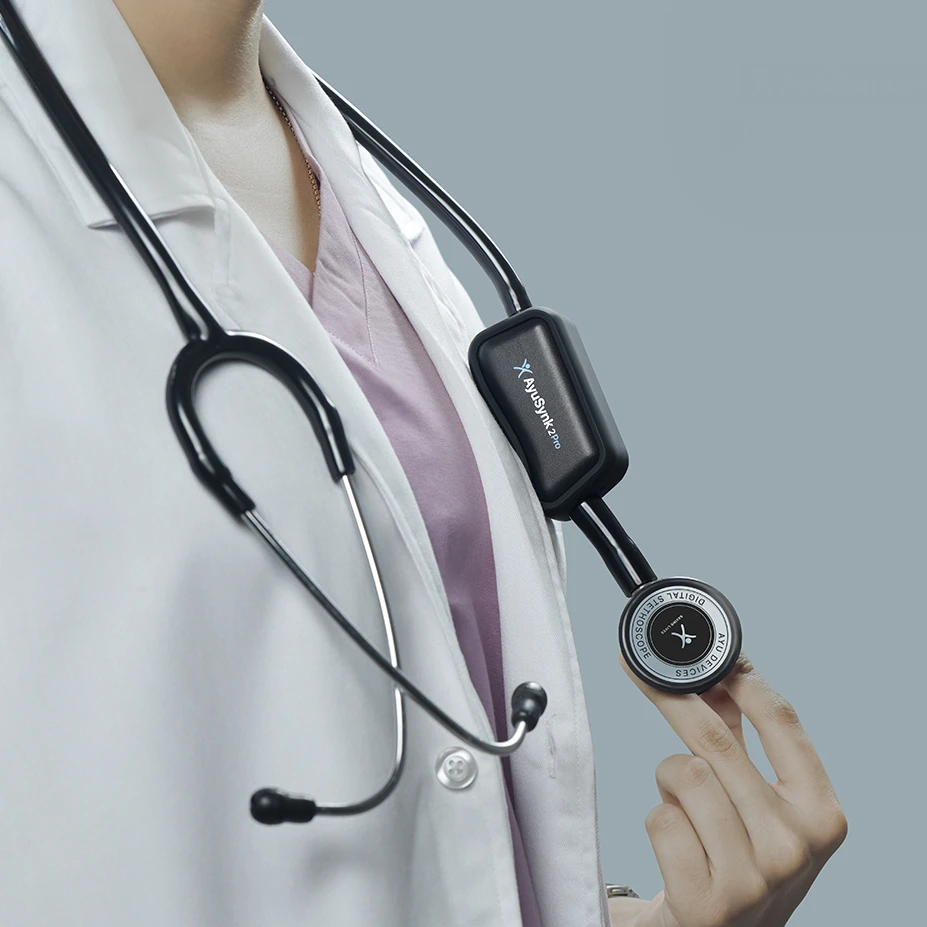
AyuSynk 2 Pro Lite and similar other digital stethoscope support this workflow by enabling real-time recording, remote sharing, and waveform visualization, helping clinicians maintain consistency in interpretation across locations.
This approach supports clinicians in revisiting recordings, reducing reliance on a single real-time observation. It also helps align interpretation across practitioners, which is critical in remote diagnosis scenarios.
Role of Remote Auscultation Systems in Rural Healthcare
Remote auscultation systems are becoming an important part of modern healthcare delivery, especially in underserved regions.
They enable clinicians to perform clinical assessments without being physically present, bridging the gap between rural patients and urban expertise.
Key benefits include:
- Improved access to experienced clinicians
- Faster preliminary diagnosis
- Reduced the need for immediate physical specialist presence
AyuSynk 2 Pro Lite is an example of such a system, enabling clinicians in rural settings to connect with specialists and support remote clinical evaluation without requiring physical presence.
This contributes significantly to primary healthcare diagnostics improvement, allowing frontline healthcare workers to make more informed decisions during screening.
Remote auscultation improves access to expert clinical diagnosis in rural areas
From Waveforms to Clinical Understanding: How Data Improves Accuracy
One of the most important advancements in digital auscultation is the ability to visualize and analyze sound data.
During live clinical assessment, waveforms are generated in real time. However, these live waveforms can be difficult to interpret because they do not always reflect textbook patterns.
Once recorded, the data can be converted into:
- Phonocardiogram
- Spectrogram
These formats provide a more structured representation of p.
With AI-supported classification, key cardiac phases such as:
- S1
- Systole
- S2
- Diastole
can be identified more clearly.
This transformation supports data-driven clinical decision support, making interpretation more consistent and less dependent on individual experience alone.
Case Study Insight: Improving Diagnosis in Rural Clinical Settings
Consider a rural clinic handling a high patient load with limited access to specialists. Medical Officers are responsible for initial screening and clinical assessment.
In this setting, subtle physiological sounds, especially early-stage abnormalities, can be difficult to interpret consistently.
A structured digital auscultation workflow was introduced to support remote diagnosis in rural healthcare.
Instead of relying only on real-time listening, clinicians began recording p and reviewing them with waveform visualization and classification support.
Over time, the outcomes showed:
- Improved clarity in identifying key physiological patterns
- Greater consistency in clinical decisions across practitioners
- Reduced uncertainty during early screening
This remote diagnosis case study highlights how structured workflows can enhance diagnostic confidence without changing the core clinical process.
Impact on Primary Healthcare Systems
Improving diagnostic accuracy at the primary level has a cascading effect on the entire healthcare system.
With better tools and structured workflows:
- Primary healthcare diagnostics become more reliable.
- Unnecessary referrals to speciality are reduced.
- Frontline healthcare workers are better supported.
This contributes directly to primary healthcare diagnostics improvement, strengthening the foundation of rural healthcare delivery.
Supporting Data-Driven Clinical Decision Support in Rural Care
Structured data plays a key role in improving clinical outcomes.
When p are recorded and stored:
- They can be reviewed multiple times
- Interpretation can be validated
- Variability across clinicians can be reduced
This approach enhances data-driven clinical decision support, leading to:
- Better diagnostic confidence
- Improved coordination between rural practitioners and specialists
- More consistent patient management decisions
Role of Telemedicine Ecosystem in Expanding Access
Telemedicine has become an essential tool in extending healthcare access to rural areas.
It enables:
- Remote consultation support
- Faster clinical assessment workflows
- Better collaboration between healthcare providers
However, practical considerations remain.
In telemedicine kiosks, integrating a digital stethoscope is both feasible and effective, as trained personnel can assist patients in capturing high-quality auscultation data.
This highlights the importance of deploying solutions in environments where they can be consistently used and maintained.
A Step Toward Stronger Rural Healthcare Infrastructure
Improving rural healthcare requires solutions that are practical, scalable, and effective in real-world conditions.
AyuSynk Digisteth contributes by focusing on:
- Clear capture of p.
- Ease of use in clinical environments.
- Consistency in remote clinical assessment workflows.
It offers valuable features that support accuracy and comfort while remaining cost-effective compared to many advanced medical technologies that are not widely accessible across India.
By enabling better clinical assessment, it plays a role in reducing healthcare gaps and supporting more equitable access to quality care.
Conclusion
Improving accuracy in remote diagnosis requires better clarity, consistency, and structured interpretation of p.
AyuSynk Digisteth supports this by enhancing clinical assessment in rural healthcare environments, enabling more reliable decision-making through improved sound capture and data-driven interpretation.
This contributes to stronger primary healthcare systems and better patient outcomes in underserved regions.
Better clarity and consistency improve accuracy in remote clinical diagnosis

Dr. Ankit Kadarge
Dr. Ankit Kadarge is a writer, and Clinical Product Manager in MedTech who believes healthcare should be simple and understandable for everyone. He started his journey at Oxford Medical College, Bangalore, and soon discovered a love for writing, publishing over 20 articles with MedBound to make medical knowledge accessible.
Previously he has worked at ACKO, leading the life insurance vertical as a pilot doctor, where he gained a deeper understanding of how people experience and sometimes misunderstand healthcare. Today, he builds solutions that solve real problems for doctors and patients, blending his medical knowledge with product thinking.
On his blog, Ankit shares his experiences, learnings, and reflections on healthcare always in a way that’s easy to read and relate to.