Top 7 Features to Look for in a Smart Stethoscope in 2026

Introduction
For more than 200 years, auscultation has been a fundamental part of clinical evaluation. One objective has driven the progress from the first acoustic stethoscopes to the digitally enabled devices of today, which is to enhance the ability of doctors to understand p.
Auscultation isn’t a natural talent. It is a skill that is acquired through exposure, experience, and regular practice. Studies indicate that it is still difficult to understand pathological acoustic variations, such as heart murmurs, especially for junior residents. According to research that has been published in medical education publications, auscultation diagnosis accuracy can vary greatly based on exposure and training.
This is when modern innovations start to have a significant impact. The way doctors conduct screening and physical examinations is changing due to the introduction of digital devices with improved capabilities. Selecting the appropriate device now has a direct impact on decision-making accuracy, consistency, and confidence.
In 2026, doctors who want to improve their clinical evaluation method will need to understand the properties of smart stethoscopes.
Why Choosing the Right Smart Stethoscope Matters?
The ability to accurately record and analyze p is essential for the quality of assessment in any clinical environment. Physiological sounds, in contrast to outside noise, require accuracy in order to identify minute differences that might point to underlying issues.
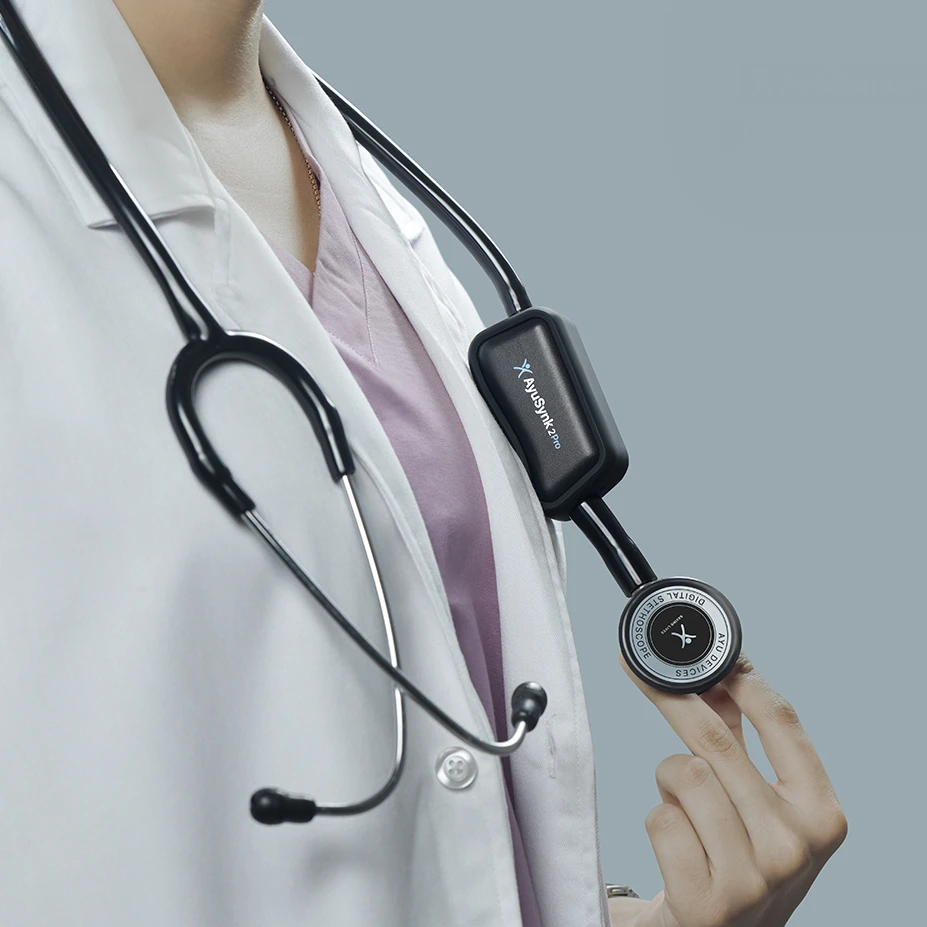
AyuSynk 2+ is designed around these core clinical requirements, combining sound clarity, recording, and digital connectivity to support consistent and reliable clinical assessment.
The appropriate smart stethoscope facilitates:
- Accurate screening and clinical evaluation
- Improved ability to identify physiological patterns
- Reduced variability in interpretation
Globally, telemedicine adoption has accelerated significantly. According to a report by the World Health Organization, telemedicine usage increased sharply post-2020, especially in regions with limited access to specialists. In such environments, tools that support clarity and consistency become essential.
A well-designed device focuses on quality, ease of use, and accessibility – ensuring that clinicians can perform reliable assessments without unnecessary complexity.
1. Clear Amplification of s
One of the most important features is the ability to clearly amplify p without distortion.
In real-world settings, clinicians often need to distinguish between:
- S1 and S2 heart sounds
- Systole and diastole phases
- Subtle variations such as murmurs or added sounds.
Research shows that enhanced amplification can significantly improve detection rates of abnormal heart sounds, particularly in noisy environments like busy clinics.
Clear sound capture enables better interpretation during real-time auscultation, reducing the likelihood of missed clinical indicators.
2. Visual Waveform Representation (Phonocardiogram & Spectrogram)
Modern devices provide visual representations that support interpretation.
A phonocardiogram represents heart sounds as waveforms over time, while a spectrogram shows frequency distribution. Together, they offer a more structured way to analyze physiological sounds.
Devices such as AyuSynk 2+ integrate waveform visualization with recording capabilities, helping clinicians better interpret structured sound patterns during and after clinical assessment.
One of the key advanced digital stethoscope features is the ability to combine these visuals with AI-supported classification. This helps identify:
- S1
- Systole
- S2
- Diastole
An important distinction exists between live and recorded waveforms. Live waveforms are often harder to interpret because they do not follow textbook patterns. Recorded waveforms, on the other hand, can be processed and structured, making them easier to understand.
Studies in digital health have shown that visual aids combined with sound analysis can improve diagnostic accuracy, particularly in training environments.
3. Bluetooth Connectivity for Seamless Use
Modern medical devices are now expected to have Bluetooth connectivity.
It allows:
- Simple connectivity to PCs, tablets, and smartphones
- Physiological sounds recording and storage
- Data sharing for remote consultation or a second opinion
This feature is particularly valuable in teleconsultation settings, where clinicians may need to collaborate across locations.
By simplifying how data is captured and shared, Bluetooth functionality enhances workflow efficiency without adding complexity.
Seamless Bluetooth connection improves workflow and communication
4. Range and Flexibility in Usage
Range plays a crucial role in determining how and where a smart stethoscope can be used.
Some devices support safe distant auscultation within a defined range (for example, up to 10 meters), while others allow greater flexibility without strict distance limitations.
This becomes important in:
- Clinical environments where movement is required
- Telemedicine kiosks
- Remote healthcare setups
Flexibility in usage ensures that clinicians can adapt to different environments without compromising the quality of clinical assessment.
5. Comfort and Ease of Use
A device used frequently throughout the day must prioritize comfort.
Ergonomic earpiece design reduces strain during prolonged use, while intuitive controls allow clinicians to focus on the patient rather than the device.
Ease of use is particularly important in high-pressure environments where quick decisions are required. A simple interface reduces the learning curve and supports faster adoption across healthcare teams.
6. Recording and Playback for Better Learning
One of the most impactful features is the ability to record and replay p.
This supports:
- Skill development over time
- Review and validation of findings
- Collaboration with other clinicians
Recorded sounds are generally easier to interpret than live auscultation because they can be replayed and analyzed in detail.
For a smart digital stethoscope for cardiologists, this feature is especially valuable. It enables detailed analysis of complex cases and supports second opinions without requiring the patient to be physically present.
This capability is a core part of systems like AyuSynk 2+, enabling clinicians to revisit and analyze recordings for improved diagnostic confidence and skill development.
Medical training studies have shown that repeated exposure to recorded sounds significantly improves auscultation skills, reinforcing the importance of this feature.
7. Cost-Effective Access to Quality Care
Accessibility remains a key factor in healthcare technology adoption.
Devices that offer valuable features such as accurate sound capture, visual analysis, and ease of use while remaining cost-effective can have a broader impact.
In countries like India, where rural healthcare gaps persist, cost-effective solutions can support:
- Wider adoption in primary health centers
- Reduced dependency on expensive diagnostic tools
- Improved access to quality clinical assessment
The focus here is not just on affordability, but on delivering meaningful value through accuracy, comfort, and functionality.
How to Choose a Smart Stethoscope in 2026?
Understanding how to choose a smart stethoscope involves evaluating key features that directly impact clinical performance.
A practical checklist includes:
- Sound clarity for accurate interpretation
- Availability of phonocardiogram and spectrogram
- Bluetooth connectivity for data management
- Comfortable design for long-term use
- Recording and playback capabilities
- Suitable range for intended environments
Selecting the right combination of these features ensures that the device supports both immediate clinical needs and long-term skill development.
Smart Stethoscopes in Telemedicine and Remote Care
Telemedicine continues to expand access to healthcare, particularly in underserved regions.
Smart stethoscopes play an important role in:
- Enabling remote clinical assessment
- Supporting collaboration between healthcare providers
- Improving access to specialist input
In telemedicine kiosks, integrating a digital stethoscope is practical and effective.
Despite this, the role of smart stethoscopes in improving access to clinical assessment continues to grow, especially in structured care environments.
Conclusion
Choosing the right smart stethoscope is no longer just a technical decision – it is a clinical one.
Features such as clear body sound amplification, waveform visualization, Bluetooth connectivity, and recording capabilities directly influence the accuracy and consistency of clinical assessment.
As healthcare continues to evolve, devices that combine quality, ease of use, and accessibility will play a key role in improving outcomes and expanding access to care.
FAQs
What are the best smart stethoscope features in 2026?
The best smart stethoscope features 2026 include clear sound amplification, phonocardiogram and spectrogram support, Bluetooth connectivity, recording capabilities, and ergonomic design for ease of use.
How does a phonocardiogram help in clinical assessment?
A phonocardiogram provides a visual representation of heart sounds over time, making it easier to identify patterns such as S1, S2, systole, and diastole during clinical assessment.
Are smart stethoscopes useful for telemedicine?
Yes, they enable remote clinical assessment by allowing clinicians to capture, record, and share body sounds, supporting better collaboration and decision-making.
How long does it take to develop auscultation skills?
Auscultation skills develop over time through repeated practice and exposure. Tools like recording and playback can significantly accelerate the learning process.
Choose smarter tools for more accurate clinical decisions

Dr. Ankit Kadarge
Dr. Ankit Kadarge is a writer, and Clinical Product Manager in MedTech who believes healthcare should be simple and understandable for everyone. He started his journey at Oxford Medical College, Bangalore, and soon discovered a love for writing, publishing over 20 articles with MedBound to make medical knowledge accessible.
Previously he has worked at ACKO, leading the life insurance vertical as a pilot doctor, where he gained a deeper understanding of how people experience and sometimes misunderstand healthcare. Today, he builds solutions that solve real problems for doctors and patients, blending his medical knowledge with product thinking.
On his blog, Ankit shares his experiences, learnings, and reflections on healthcare always in a way that’s easy to read and relate to.