What Is an AI Stethoscope and How It’s Transforming Modern Auscultation

Introduction
Listening to the heart, lungs, and other internal body sounds is known as auscultation and it continues to be one of the most important clinical skills in medicine. Accurate interpretation of these sounds frequently directs important diagnostic and therapeutic decisions in a variety of fields, including general medicine, cardiology, pulmonology, paediatrics, and emergency care. Clinicians can obtain important clinical insights without invasive testing by paying close attention to heart murmurs, lung crackles, wheezes, and irregular rhythms.
However, there are inherent drawbacks to traditional acoustic stethoscopes. Due to background noise, clinician hearing subjectivity, or challenging examination environments like crowded outpatient clinics, remote healthcare facilities, or medical camps, subtle sounds may go unnoticed. These factors can sometimes make a confident diagnosis challenging, particularly in early-stage or borderline cases.
AI-powered diagnostic tools are changing how doctors perform routine exams as a result of the increasing use of modern and advanced technology in healthcare. With its ability to improve sound clarity, facilitate visual analysis, and assist contemporary clinical workflows without taking the place of a clinician’s judgment, the AI stethoscope stands out among these breakthroughs as a powerful advancement of auscultation.
What Is an AI Stethoscope?
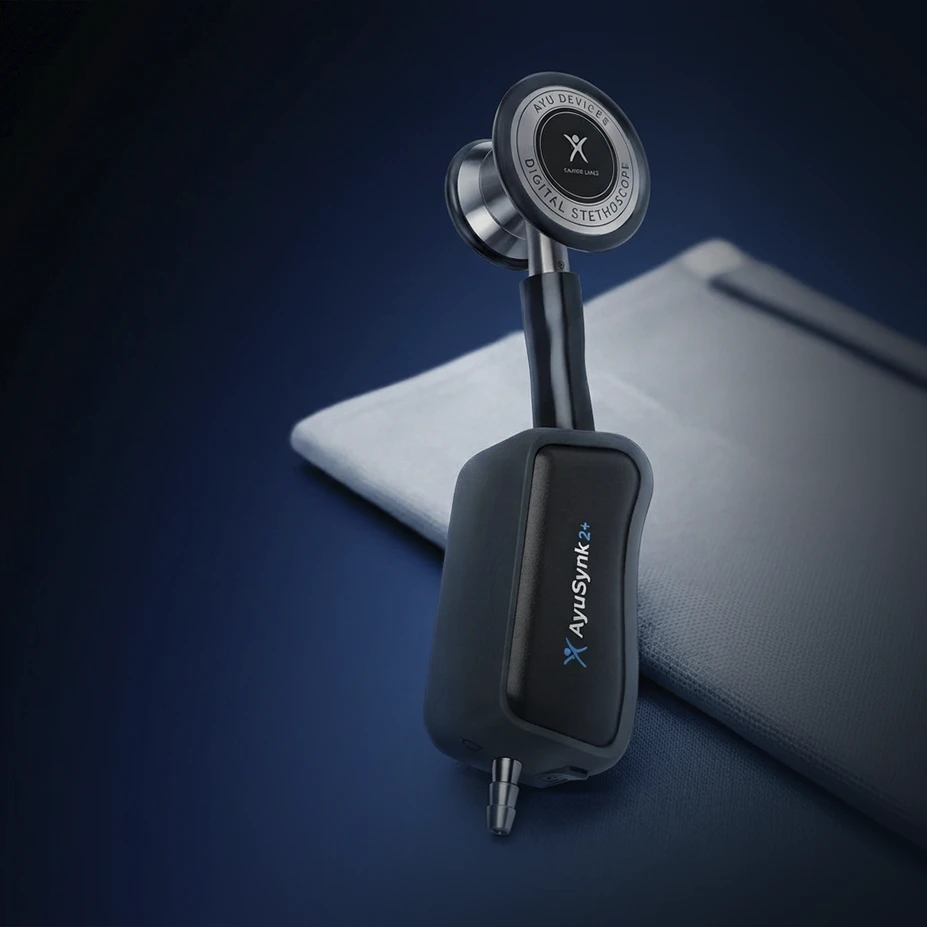
An AI stethoscope is an advanced version of a traditional stethoscope that uses artificial intelligence and digital technology to improve how doctors listen to heart and lung sounds.Its primary function is to amplify body sounds, such as breathing and heartbeats, but with far greater clarity and accuracy.
An AI stethoscope transforms mechanical sounds into digital signals that may be enhanced, displayed, and analyzed by using high-quality microphones, speakers, processors, and controlled amplification. Artificial intelligence and machine learning assist in identifying sound patterns associated with both normal and abnormal body functions.
The addition of a digital display capability, which enables medical professionals to see sound waveforms or frequency patterns along with what they hear, is one of the major improvements. AI helps tell normal and abnormal body sounds apart.
How an AI Stethoscope Works
Sound Capture and Signal Enhancement
An AI stethoscope begins by capturing mechanical heart and lung sounds through high-quality microphones designed for medical auscultation. These sounds are then amplified using high-fidelity amplification, ensuring that even subtle murmurs, fine crackles, or low-intensity breath sounds are clearly audible.
This strong amplification is particularly valuable in real-world clinical settings such as rural health centers, crowded OPDs, emergency rooms, and outreach health camps, where background noise can otherwise interfere with auscultation.
Conversion of Body Sounds into Visual Waveforms
Once the mechanical sounds are converted into digital signals, the system processes them to generate visual representations such as phonocardiogram and spectrogram. These visuals are displayed through the stethoscope interface or connected application, allowing clinicians to see what they are hearing.
This visual feedback supports better interpretation, helps confirm findings, and is especially useful for documentation, second opinions, and teaching purposes.
AI stethoscopes convert sounds into clinical insights.
Pattern Recognition for Heart Sounds
AI algorithms analyze the processed heart sound data to recognize patterns associated with normal and abnormal findings. These algorithms do not replace clinical judgment but act as an intelligent support system by helping clinicians identify potential heart abnormalities more confidently and consistently.
Key Features of an AI Stethoscope
Advanced Sound Amplification
AI stethoscopes are designed with strong amplification capabilities that preserve sound fidelity while enhancing clarity. This ensures that clinicians can detect subtle variations in heart and lung sounds that may otherwise go unnoticed with conventional stethoscopes.
Digital Display for Visual Sound Analysis
The digital display feature allows clinicians to record heart sounds and visualize them as a phonocardiogram. AI classification highlights S1, Systole, S2, and Diastole, making it easier to interpret subtle or complex patterns and support accurate diagnosis, particularly for borderline or complex cases.
Noise Reduction and Filtering Capabilities
Built-in filtering mechanisms help reduce background noise while preserving clinically relevant frequencies. This makes AI stethoscopes highly effective in non-clinical or high-noise environments such as rural health centers, crowded OPDs, emergency rooms, and outreach health camps without compromising diagnostic accuracy.
Clinical Benefits for Healthcare Professionals
Improved Clarity in Heart and Lung Sound Detection
By enhancing sound quality and reducing noise, AI stethoscopes allow healthcare professionals to listen more clearly and confidently. This directly supports better identification of murmurs, abnormal breath sounds, and rhythm irregularities.
Support for Accurate Clinical Decision-Making
Clearer auscultation leads to better-informed clinical decisions. When clinicians can hear and visualize sounds without any disturbance, diagnosis becomes more precise and treatment decisions become more timely across specialties.
Useful in Distance-Based Clinical Support
AI stethoscopes are helpful when a doctor and patient are in different locations and need clinical support through digital connectivity.
With AyuSynk Digisteth and the AyuShare App, auscultation sound data is transferred via Bluetooth from the device to the clinician’s mobile phone. From there, the sound data can be sent through a secure internet link so another doctor can review it when needed.
It is important to note that AyuSynk 2+ supports only recording and sharing of auscultation sounds and does not support live tele-auscultation.
This approach supports virtual consultations and coordinated care without requiring the patient to travel.
Useful for Teaching and Training Medical Students
The ability to visualize and record auscultation sounds makes AI stethoscopes excellent teaching tools. Medical students can use phonocardiograms to understand sounds better and build confidence in diagnosing patients.
Useful for Infectious Disease and Public Health Situations
AI stethoscopes are especially useful during situations such as a andemic or epidemic, where infectious diseases like uberculosis require careful examination while reducing unnecessary physical contact. In cases involving low-immunity individuals or situations where direct contact is risky for patients, an AI-enabled stethoscope with wireless connectivity helps maintain safer clinical practice. These devices are also highly beneficial in resource-constrained environments, rural health centers, outreach programs, and crowded hospitals where quick and safe assessment is important.
Who Should Consider Using an AI Stethoscope?
Practicing Doctors and Specialists
From general physicians to specialists, AI stethoscopes support more confident and accurate auscultation, particularly in busy or resource-limited settings.
Medical Colleges and Training Institutions
Educational institutions can use AI stethoscopes to enhance teaching, standardize learning experiences, and expose students to modern diagnostic tools.
Healthcare Innovators and Research Professionals
AI stethoscopes offer valuable opportunities for research, data analysis, and innovation in clinical diagnostics and digital healthcare systems.
Conclusion
AI stethoscopes are redefining modern auscultation by strengthening one of medicine’s most essential clinical skills – listening. By combining strong amplification, visual sound analysis, and intelligent pattern recognition, these devices help healthcare professionals diagnose patients more clearly and confidently, without obstacles.
The integration of digital connectivity further expands access to quality care, enabling specialists to support clinicians in different locations through secure internet-based transmission. As healthcare continues to evolve, adopting advanced yet clinically grounded diagnostic tools like AI stethoscopes will play a vital role in improving patient outcomes.
The future of auscultation lies not in replacing clinical judgment, but in empowering it, and AI stethoscopes represent a meaningful step forward in that direction.
Listen smarter and diagnose confidently with AI stethoscopes

Dr. Ankit Kadarge
Dr. Ankit Kadarge is a writer, and Clinical Product Manager in MedTech who believes healthcare should be simple and understandable for everyone. He started his journey at Oxford Medical College, Bangalore, and soon discovered a love for writing, publishing over 20 articles with MedBound to make medical knowledge accessible.
Previously he has worked at ACKO, leading the life insurance vertical as a pilot doctor, where he gained a deeper understanding of how people experience and sometimes misunderstand healthcare. Today, he builds solutions that solve real problems for doctors and patients, blending his medical knowledge with product thinking.
On his blog, Ankit shares his experiences, learnings, and reflections on healthcare always in a way that’s easy to read and relate to.